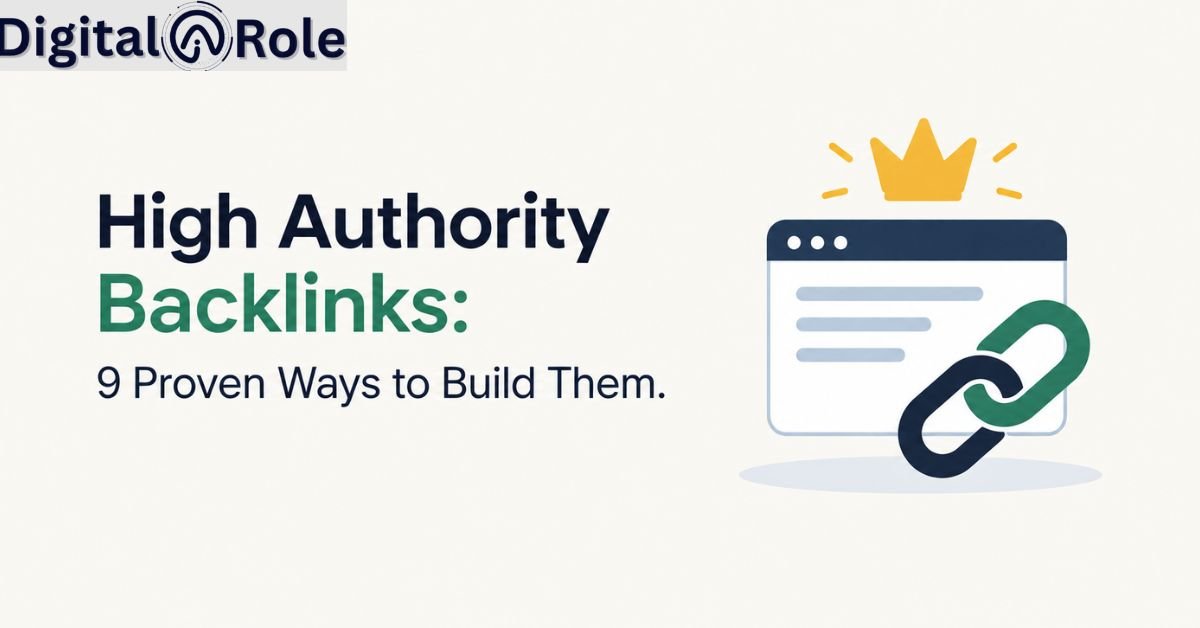
High Authority Backlinks: 9 Proven Ways to Build Them
One high-authority backlink gives your website far more credibility than a simple backlink; it can put your site in front of a relevant audience, strengthen its credibility, and support long-term search visibility. Every backlink is a vote of confidence in your website, but Google can’t consider every backlink worthy.
A high authority backlink comes from a credible, trusted, relevant website that adds editorial value and boosts authority, organic traffic, and discoverability. A link from a credible, authoritative website is better than one from a spammy, irrelevant site.
Mostly beginners ignore the high authority link because they only reach out to websites that have high DA, not relevance. So, you earn them instead of manipulating placements.
In this article, I provide 9 proven ways to get high authority backlinks and explain what a high-authority backlink is. Confusion between high DR backlinks and DA backlinks is solved.
What are High Authority Backlinks?
High Authority backlinks come from sites Google already trusts, which have a reputation that is relevant to your topic and provide genuine value to readers. A high authority website passes that credibility to your site; that’s why you shouldn’t judge a website by a higher DA or DR score.
A strong backlink comes from a legitimate site with relevant content, real traffic, and editorial standards that match the niche for both audiences.
A survey of Google ranking factors: “131 SEO specialists indicated that topical relevance and links from trusted domains ranked near the top 103 Google ranking factors.”
Spam linking is the most negative link-building strategy; focus on a white-hat backlink service that Google loves and that ranks you well in search engines.
Here are the core elements of high-authority backlinks
- Topical relevance (domain + page + context)
The linking domain, the particular web page, and the context should all be semantically associated with your topic. Relevance is now more of a signal than raw authority metrics.
- Editorial placement (earned, not paid/traded)
The link needs to appear naturally in an editor’s or author’s article, not in footers, sidebars, or hidden sponsored posts. One of the main trust signals for high-authority links is editorial integrity.
- Real organic visitors from the linking domain/page.
Measurable organic search volume and rankings for relevant queries, not a high DR/DA with no traffic. Traffic confirms users’ and search engines’ trust. Traffic proves trust from users and search engines.
- Domain Trust and Clean Link Profile
Check for low spam rates, a decent amount of outbound links, and a good-looking backlink profile (no obvious PBN or link farms). Ensure that DR/DA is not over-inflated by cross-checking with Trust Flow or another metric.
- Dofollow link that passes equity
Links that are followed are usually of high authority and are not sponsored/UGC (unless they are sponsored/UGC). If necessary, check using view-source or a browser extension.
- Use natural anchor text and context.
Anchor text should be descriptive and varied and should fit in naturally in the sentence and paragraph. Many links with optimized, exact-match anchors increase risk.
- Stable, permanent placement
Links should persist over time (not be removed after a month) and be permanently hosted on a ranking page with traffic (not just on a page that is not ranking). Compound authority signals to ensure stability.
linkmetrics
- Cross-industry reinforcement and brand.
Recurring brand mentions, news syndication, and cross-industry reinforcement support perceived authority for AI Overviews and E-E-A-T.
What is Link Authority?
Link authority is the overall reputation, relevance, content quality, and backlink profile that a linking website can offer. Third-party metrics can assess potential link sources, such as Domain Rating (DR), Domain Authority (DA), or SEMrush Authority Score (AS).
But these aren’t Google’s direct ranking scores. I suggest verifying content quality, referrers, topic relevance and organic traffic before pursuing a link. For more, explore natural link-building tips to build powerful backlinks.
For example,
You own a website on healthy recipes.
You write an article on 10 top healthy recipes.
Now a healthy-eating expert website writes an article on healthy eating and links to your healthy recipes article, which is relevant.
Health website → Your recipe article.
This link is valuable because it positions you as a trusted source, and Google passes some link equity to your page.
However, that doesn’t mean a website with a DA of 90 passes a 90 authority score.
Google doesn’t look for DA or DR for ranking a website or any disclosed public system where a website passes any “authority score” to others. It simply values backlinks on the following factors.
- Relevance of the linking page.
- Quality and trust of the linking site.
- Whether the link is editorial or natural.
- The context surrounding the text.
- Whether the link is crawlable.
- Other interlinks associated with the page.
What Are High DA Backlinks?
People often mean high DA backlinks as links from sites with a high Moz Domain Authority rating. But a high DA doesn’t always indicate high quality.
An expert survey says that “Google’s top 3 ranking factors are relevance, backlinks, and content quality. Of these, 54.8% of backlinks are more essential for Google ranking factors. This highlights how important backlinks are for a website.
In some instances, a website with moderate DA, real traffic, and a solid editorial team that can provide relevant content is more valuable than an irrelevant site with a higher DA rank and artificial traffic. Avoid building links on low-authority sites.
How to Identify a High-Authority Link Before You Build It
Review the website publishing the backlink before you pursue it, not just its DR or DA. When you build a high-authority link, check and analyze the links so you can easily audit toxic backlinks.
Follow these 5 steps:
- Check Relevance: Is your niche or a similar topic covered on the site
- Traffic is consistent, genuine organic visitors.
- Content is useful, original, and regularly maintained
- Clear publishing standards and credible contributors
- Assistive profile links natural referring domains and anchor text.
Also look for excessive paid-link patterns, irrelevant guest-post sites, domains with little or no organic traffic, inflated DRs, and link farms. If the underlying site lacks authority or an audience, it can create a false sense of security. When you’re considering outreach, manual analysis can help you determine if a potential link is really worth it—a manual qualification process is important for beginners.
How to Get High Authority Backlinks: 9 Proven Strategies
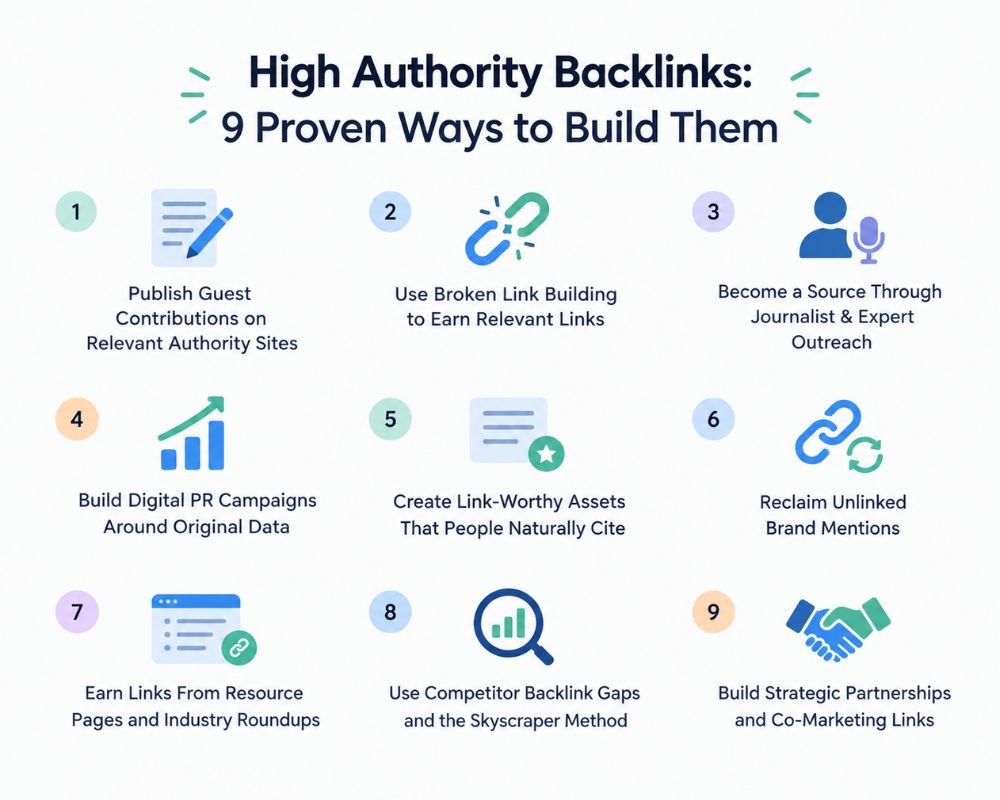
You can get high authority backlinks by publishing guest posts on relevant sites, doing digital PR, building broken links, doing resource page outreach, creating link-worthy assets, building relationships with industry experts, reclaiming unlinked brands, and using skyscrapers and competitor backlink gaps.
You earn high-quality backlinks by following these 9 strategies.
1. Publish Guest Contributions on Relevant Authority Sites
When content helps the reader, it’s a great way to get valuable editorial links from guests. First, find websites related to your niche, then review their organic traffic, content quality, and publishing standards.
Read a few established articles to see what topics they cover, the article format, and how much knowledge and expertise they require.
Rather than pitch hundreds of sites to “write for us,” consider pitching a specific article idea that addresses an actual content need. In writing, prioritize helpful information, and stick to links that are natural and in context to your website.
Beginner task: Research 20 relevant websites and then analyze their content and develop 3 customized topic pitches.
2. Use Broken Link Building to Earn Relevant Links
Broken link building helps publishers replace an old or no-longer-existing resource with something useful from your site.
Follow this easy procedure:
Find: Qualify: Create/Match: Pitch: Replace
Actually find broken links on relevant sites. Then determine if your current material, or something you can make, is really similar to the dead page. Inform the site owner about the broken link, and suggest that your page be used in its place.
The best answer is relevance: rather than asking for a link with no value, you’re providing a solution to a problem.
3. Become a Source Through Journalist & Expert Outreach
Journalist and editor outreach can help you earn editorial mentions by sharing usable information. Share original ideas, expert opinion, practical information, industry examples, or brief, quotable quotes that pertain to your field of knowledge.
You can do this by using journalist source websites or by reaching out directly to your target reporters and publications. The purpose is to avoid promoting your site in all answers. Instead, give journalists a clear, accurate perspective they can use in their reporting.
If your contribution wins, the coverage can contain a mention of your contribution and a backlink to your website. Be a useful source; don’t waste time with generic pitches.
4. Build Digital PR Campaigns Around Original Data
Digital PR can transform original information into content journalists and publishers want to cite. It is the #1 link-building strategy many marketers and SEO experts prioritize: digital PR over guest posting. Don’t simply market a page; make something newsworthy that publishers will want to talk about.
This could be in the form of industry surveys, original research, trend reports, statistics, data visualizations, proprietary datasets, or newsworthy studies.
Use this framework:
Research → Identify the news angle → Make the asset → Develop media list → Pitch them → Get coverage.
A well-crafted data push can attract attention from multiple relevant publications, which may lead to multiple editorial hits from a single data asset. Authoritative mentions can also reinforce the connection between your brand and its topic, aiding discoverability via search and AI.
5. Build Link-Worthy Assets that People Link In Naturally
Design materials that are useful and are a source for other websites and publishers. These can range from original research, statistics pages, infographics, free tools and calculators, templates, interactive resources, and industry reports.
A useful cycle is
Make → Market → get cited → improve → get more links
The benefit is that a really useful resource can keep generating referrals after its initial promotion. Instead of a single infographic, try creating iterative data hubs that people can rely on for data and industry information.
For instance, you can update an annual report with new figures, enrich it with new findings, and advertise the latest version. With each update, the site gets more chances for relevant citations and higher-quality backlinks.
6. Reclaim Unlinked Brand Mentions
One of the easiest link-building opportunities for novices is unlinked brand mentions, where the publisher has already mentioned your brand name. All you need to do is search for relevant mentions, which exclude a hyperlink.
Use this process:
- Find websites mentioning your brand.
- Confirm there is no link.
- Check whether a link would help readers.
- Contact the publisher.
- Request a natural link.
Opportunities can be uncovered with the help of brand-monitoring tools and backlink platforms. Be brief and inform the reader of the benefit of clicking through to your relevant page. The publisher will already know your brand so that the conversation can flow more naturally than with cold outreach.
7. Earn Links From Resource Pages and Industry Roundups
Resource pages usually include lists of resources and may feature a variety of pages and links. Industry roundups usually list recommended articles, tools, or insights on a particular topic. It offers a resource page link-building tactics and relevant backlink opportunities if your content is truly relevant to the page.
Search for the following:
- “keyword” + resources
- “keyword” + useful resources
- “keyword” + weekly roundup
Please read the page before contacting the publisher. If your resource is filling a true need and is relevant to the audience, send a short, tailored pitch in which you describe the resource. Don’t publish all of your articles. You should only contact them if they are relevant or helpful.
8. Use Competitor Backlink Gaps and the Skyscraper Method
Competitor backlink analysis can show sites linking to similar sites but not to yours. Use this workflow:
Research competition → Find domains that link to it, find gaps in content, make something better, and outreach.
Don’t plagiarize or plagiarize an article longer. Make the resource more accurate, include more original data, provide more useful examples, create more vibrant visuals, provide fresher information, and make the resource more user-friendly.
For instance, if multiple competitors link to outdated facts or references you have already verified, produce a new data asset with the latest facts and information, better explanations, and original research.
The aim is to answer the question more effectively, not just churn out words. This will make the asset more useful for readers and more interesting to readers linking sites.
9. Build Strategic Partnerships and Co-Marketing Links
Relevant editorial links can be generated as a natural extension of strategic partnerships when two organizations are offering relevant information or experiences. These include co-authored research, expert roundups, industry studies, podcasts and webinars, testimonials, events, co-marketing campaigns, and partner content.
For instance, two complementary businesses can publish a joint business study and share the results with each other’s audiences. There may also be a relevant website link in a podcast appearance or webinar that becomes a speaker or guest profile.
The link shouldn’t be the only reason for the collaboration; it should be a natural result. First, make a valuable product for both audiences; then build the backlink.
High Authority Links vs. High DR Backlinks: What Should You Prioritize?
A high DR score is one sign of a potential prospect, but it’s not the only criterion.
| Signal | Strong Backlink | Weak/Risky Backlink |
| Relevant | Closely related | Unrelated |
| Traffic | Real audience | Little/no traffic |
| Placemen | Editorial/contextual | Manipulative |
| Content | High quality | Thin, duplicate, or low-value |
| Authority | Genuine reputation | Inflated metrics |
| Purpose | Helps readers | Exists mainly for SEO |
The real-world lesson is that you don’t want DR; you want backlink quality. Look at the real site, audience, content, and link context to determine if a prospect is worthwhile.
How to Build High Authority Backlinks Without Google Penalties
Create links based on content, not just to change search engine rankings.
Don’t buy links designed to game rankings: massive link exchanges, private blog networks, automated backlink blasts, guest posts with irrelevant content, keyword-stuffed anchor text, poor-quality directories, or mass-generated content made only to earn links.
Rather, adhere to a simple guideline:
Build something you want to be linked to, go where you are relevant and valued, and earn links there through relevance and value.
This keeps link building from becoming a game of quick hacks and tricks and instead focuses on relevant content, trustworthy relationships, and editorial relevance. Additionally, it makes your backlink strategy more sustainable because every link has a purpose beyond improving your search ranking.
Conclusion
It’s not about getting the highest DR or DA but about earning links that are authentic, valuable to the audience, and relevant to your website. You can do this through guest posts, broken link building, digital PR, mentions (without links), or anything link-worthy; the goal is the same: create something worth linking to and forge real links with publishers.
When considering how to acquire high-authority backlinks, consider a website’s relevance, organic traffic, content quality, editorial standards, and overall link profile. Keep in mind that high DR backlinks or high DA backlinks are not necessarily authoritative backlinks.
Link authority depends on a combination of these three factors: reputation, relevance, and trust.
By implementing effective and sustainable authoritative link-building strategies, you can improve your search visibility, drive more referral traffic, and establish a strong brand presence in the digital landscape.