9 Natural Link Building Tips: A Proven Guide to Building Powerful Backlinks
Building backlinks can be tempting. But many shortcuts are PBN links, paid links, manipulative link exchanges, and irrelevant placements that make your site look risky. That is where natural link building tips save you.
Natural link building focuses on earning editorial backlinks because when other websites genuinely find your content useful, credible, and high-quality, they link to your website in their own content. Instead of begging for links, you build an asset that attracts editorial links while strengthening your brand and authority.
In this guide, I provide you with 9 natural link building tips that help you create content that people cite and earn relevant backlinks without paid and manipulative backlink tactics.
It promotes content ethically, evaluates backlink quality, avoids Google spam issues, and turns quality backlinks into referral traffic and lasting brand authority.
Google takes manual action against spam backlinks that manipulate its algorithms, so ethical link acquisition is essential for sustainable SEO.
What is natural link building?
Natural link building is the process of earning backlinks by making linkable assets such as industry-related reports, statistics, useful resources, and in-depth guides and having other websites consider your content trustworthy, relevant, and worthy of being cited. Unlike manipulative links, natural links are earned, not bought, traded, or forced.
In short, you create content that earns links through quality and value.
“During Google’s August 2026 Spam Update, 16.71% of previously top-10 URLs in SE Ranking’s dataset fell beyond position 100—an 82% increase compared with a comparable period without a confirmed update.
There are three key differences:
Natural links: Links that are obtained naturally due to the worth of your content.
Outreach/relationship/promotion Related links: Links that are achieved by legitimate outreach, promotion, relationship, or resource recommendations.
Manipulative links: Links that are designed to manipulate search results, including links that serve to give ranking credit to the page for which they are linked, and link schemes that are designed to manipulate search results.
Natural doesn’t mean ‘accidental.’ You can actively share great content, reach publishers, share expertise, and network with the industry. Editorial and user value matter most. A link used primarily to affect rankings can pose an SEO threat.
Google’s spam policy considers links designed to game the system a violation, so any strategy you use should focus on earning links through valuable content and legitimate promotion.
Where Does a Natural+Backlink+Service Fit?
A good natural backlinks service will help your website earn links, not just sell a set quantity. It can carry out the following activities:
- Content creation
- Digital PR
- Relevant outreach
- Expert commentary
- Relationship building
- Resource promotion
Watch for promises of “50 high-quality backlinks in 30 days” and guaranteed ranking increases. A reputable company should be able to explain why they want links, where they will be placed, and how they will benefit readers.
9 Natural Link Building Tips that Earn Valuable Backlinks
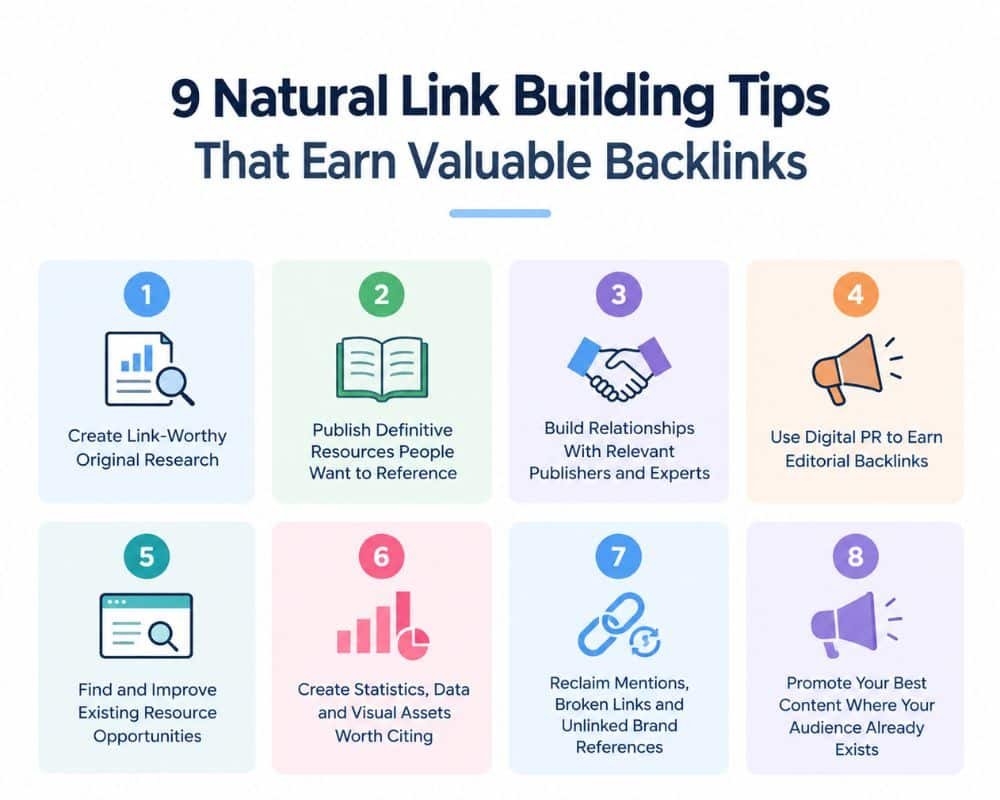
Earning backlinks is less about finding high-quality websites for backlinks and more about giving those websites a reason to link with you. The best natural link building strategies combine useful content with linkable industry reports with statistics, genuine relationships, and ethical promotions and build assets that earn links.
Here are nine practical ways to build backlinks that support SEO, referral traffic, and a website’s authority.
1. Create Link-Worthy Original Research
Original research is one of the best ways publishers can earn natural backlinks because it gives them something they can’t just copy and paste from another article. Original data gives journalists, bloggers, researchers, and marketers something to quote from your page.
Consider creating:
- Industry surveys
- Original statistics
- Customer data studies
- Experiments
- Case studies
- Proprietary datasets
- Trend reports
For instance, if you wrote a previous article for your blog entitled “10 SEO tips,” do a comprehensive study of 1000 websites and share the top 10 technical issues that you found with them. Other websites on technical SEO can cite you as a resource.
Tip: Make research easy to cite by including the sample size, methodology, key findings, charts, and limitations. Provide a downloadable report or original data set, as appropriate.
2. Publish Definitive Resources People Want to Reference
One of the best natural link-building tips is to develop resources that become valuable referrals in your niche. An all-encompassing page can be linked to again and again if it answers questions or offers tools not readily available elsewhere.
The following are examples of resources that may be available and could be linked:
- Ultimate guides
- Checklists
- Templates
- Calculators
- Glossaries
- Statistics pages
- Industry directories
- Research libraries
To get a more precise reference test, before publishing, use the following test:
Could anyone interested in this justify quoting this page?
If the answer is no, reinforce the resource. Include original examples, data, expert advice, imagery, templates, or information that fills a true need.
Don’t make a resource long just to be comprehensive. Useful enough to provide another publisher with a reference to improve that publisher’s content.
3. Build Relationships With Relevant Publishers and Experts
Relationships are where natural backlinks start. If the publishers and experts that you work with have an awareness of your work, it will be more likely that they will notice and reference relevant resources that are actually helpful.
Build relationships by:
- Interviewing industry experts
- Incorporating quotes from experts into your material.
- Using quotes from experts in your text.
- Featuring on relevant podcasts
- Contributing expert insights
- Attending industry events
- Engaging in specific groups
- Participating in original research in collaboration with others
Don’t worry about quantity; focus on relevance. You don’t need hundreds of industry contacts. A smaller network of knowledgeable publishers, experts, and creators can create more meaningful opportunities.
For instance, a backlink from a trusted niche website that has similar readers to your target audience can offer you more referral traffic than an unrelated website with high third-party SEO scores.
The goal isn’t to build links for links’ sake. It’s to be a valuable contributor to your field that people will turn to for information.
4. Use Digital PR to Earn Editorial Backlinks
Digital PR can turn interesting information into editorial opportunities. Don’t just message journalists because you want them to link to you; make it something they should mention or report on.
Potential digital PR assets are:
- Original statistics
- Expert commentary
- Industry trends
- Data-driven stories
- Surveys
- Relevant newsjacking
Present the opinions of the founders or subject-matter experts.
For instance, a search marketing firm might survey 500 small businesses about their top search marketing problems and share the results. The study can be cited in an article on the same topic in a business publication.
The goal is not to obtain “newspaper links.” Its goal is to create information that is actually useful, timely, credible or newsworthy for journalists and readers to use as a reference.
A good rule of thumb in pitching a PR piece is to ask yourself:
Who would want this information without a backlink?
If you don’t know that audience, strengthen the story first.
5. Find and Improve Existing Resource Opportunities
Resource page link building can be effective if you have a resource that enhances an already good page. The error is treating every page with a list of links as a backlink opportunity.
First, locate pages of resources using searches like
- [niche] intitle: resources
- [niche] inurl:resources
- [niche] inurl:links
- [niche] “useful resources”
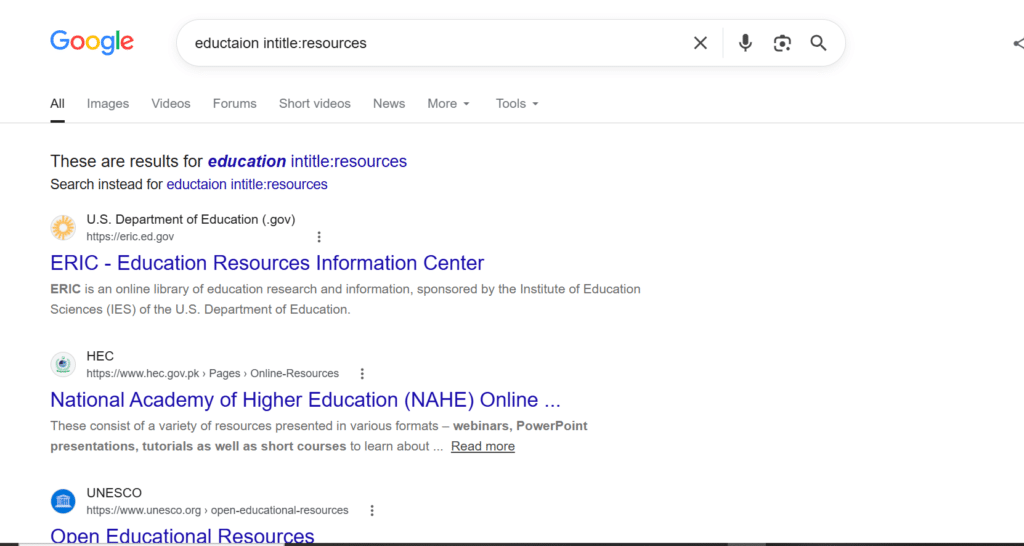
Afterwards, repeat the process:
- Locate appropriate resource pages.
- Consider whether the page is valuable.
- Identify a current need or an outdated resource.
- Design something to fill that space.
- Write to the owner or editor of the site.
- Specifically describe how your resource would benefit their audience.
- The publisher will decide whether to include it.
The qualification step is extremely important. Check for topical relevance, editorial quality, active site, genuine audience value, and logical tie to the page.
Don’t try to get links from pages that are meant to sell links or that have hundreds of outbound links that are not relevant to the page.
6. Create Statistics, Data, and Visual Assets Worth Citing
People tend to connect with content when it helps them better understand or support their own content. This is why original statistics and visual materials are helpful for natural link building.
Consider creating:
- Original statistics
- Infographics
- Charts
- Maps
- Diagrams
- Industry benchmarks
- Data visualizations
- Free templates
An article about content marketing might feature a new content benchmark indicating average conversion rates between content formats. Other marketers discussing those benchmarks may cite the original study.
Keep assets easy to understand and reference. Use sources, methods, dates, definitions, and context.
Avoid making an infographic just for backlinks.
Best practice
Ensure the underlying data is valuable enough that the asset will be useful without anyone needing to reference it.
7. Reclaim Mentions, Broken Links, and Unlinked Brand References
You don’t always need to build something new to get backlinks. You can often earn links by looking for opportunities where your current content and/or brand already apply.
Unlinked mentions
Look for sites that reference your brand, research, product, or expertise but don’t include a link to the right page. If a link will really benefit readers, kindly recommend the proper URL.
Broken links
On relevant pages, find broken links and decide whether you have a usable alternative. State the problem and offer your resource as an alternative.
Lost backlinks
Keep track of crucial backlinks you’ve acquired in the past. Check whether a valuable link has been removed; if not, find out whether the page has been updated, deleted, redirected, or replaced.
In all three cases, outreach isn’t forcing; it’s assisting. You’re identifying something that could be improved, not asking another website to give you a backlink.
8. Promote Your Best Content Where Your Audience Already Exists
If nobody finds the good stuff, it won’t get linked to. Ethical promotion ensures you put the best in front of people who might be interested.
If you’re speaking to the general public, you should take these points into account:
- Industry communities
- Email newsletters
- Podcasts
- Professional associations
- Relevant forums
- Social platforms
- Personalized email outreach
Find channels that your target audience is already involved in; don’t just broadcast your message everywhere.
Remember this principle:
Promotion is discovery, and value is the reason to link.
For instance, an original industry study discussed with professionals engaged in that conversation can create valuable visibility. On the other hand, if you share the same link repeatedly in irrelevant forums, it can look like spam and offer little benefit.
Don’t submit auto-generated comments, irrelevant community posts, or aggressively seek out people.
9. Make Your Content Easy to Cite and Share
One of the easiest (and surprisingly obvious) natural link building strategies is to create content that is easy to understand, easy to verify, and easy to reference.
Add linkability to your pages with:
- Clear headings
- Concise definitions
- Original statistics
- Descriptive charts
- Author information
- Use correct publication or update dates.
- Sources and methodology
- Embeddable assets
- Descriptive anchor text
- Easy-to-find contact information
Imagine a journalist needs a definition, fact, or source. If that information is contained within a 3,000-word article, they may move on. Your expertise becomes easier to find and reference when it’s well organized.
Don’t use exact-match keywords in every link you create to the page. Google link-building practices recommend using anchor text that is descriptive, concise, and relevant.
Most importantly, optimize for the person deciding whether to link, not the search engine you hope will reward the link.
As your content becomes credible, useful, relevant, and easy to reference, good marketing will earn valuable backlinks.
How to build backlinks without causing Google link spam problems.
The trouble with building backlinks isn’t that they’re risky, but that links are built solely to play the Google ranking game.
A sustainable approach should therefore be based on the content’s value, relevance, and user benefits.
Google’s spam policies list link spam and manipulative linking practices as examples of spam it will take action against.
Link Building Practices to Avoid
- Take extra precautions with:
- Purchasing links to boost rankings.
- Too many or unnecessary link exchanges
- Automated link-building programs
- Private blog networks (PBNs)
- Irrelevant guest post campaigns, primarily for links.
- Keyword-stuffed anchor text
- Low-quality directories made only for SEO purposes.
- Comment spam
- Press the Enter button.
- Clickable content that is created mainly for search engines.
It’s all about purpose and benefit. This isn’t a blanket rule that makes legitimate outreach, guest contributions, digital PR, and partnerships bad. The strategy becomes dangerous when the main goal isn’t to add value for the user but to create ranking signals.
Frequently Asked Questions
1. What is natural link building?
Natural link building is the process of getting links to your site by making other sites find your content useful, relevant, credible, or worth linking to. It is about creating useful resources and promoting them fairly, rather than gaming search engine rankings.
2. How do I find the best keywords for my website?
Develop original research, helpful guides, numbers, tools, templates, and other resources that can be linked to. Share them on the appropriate communities, publications, experts, digital PR, and tailored outreach. Your point is to have a realistic reason for people to mention your content.
3. Do natural backlinks have a positive impact on SEO?
Yes. Relevant editorial backlinks can attract visitors to your website, drive referrals, and enhance your site’s reputation. But it is not just about the quantity of backlinks; it’s also about their quality and relevance.
4. What are the types of link building to steer clear of?
Do not purchase links that can be used to manipulate rankings, link schemes, too many link exchanges, PBNs, automated links, guest posts with keywords in the title, or links that are not relevant to the content.
5. Is a natural backlink service safe?
It’s possible, provided it supports more authentic content promotion, digital PR, outreach, and relationship building. Don’t use providers that promise a set number of backlinks or rankings without clarifying how they will benefit you.
Conclusion
The essence of natural link building is to gain attention rather than create backlinks. Original research, useful resources, valuable data, and content people actually want to cite can bring in relevant links and build your brand’s authority over the long term.
Ethical promotion, real relationships, resource outreach, and easy-to-cite content are the best natural link building tips as well.
Do not use shortcuts like paid links, manipulative exchanges, automated placements, and other link schemes that may lead to link penalties. Instead, evaluate each backlink by its relevance, editorial value, user value, and trustworthiness. If you consistently provide content people want to link to and promote it to the right audiences, backlinks aren’t just an SEO metric; they are a source of referral traffic, credibility, visibility, and sustainable business growth.