Get Powerful High DA Backlinks That Actually Rank
A DA 90 looks impressive on paper but is still a weak link for SEO. If a website has little traffic, no relevant niche, publishes links everywhere, has a high spam score, and publishes links without editorial context or relevant anchor text, its impressive authority score never brings meaningful SEO value.
Most beginners focus only on high-DA backlinks, not the question, “Is this backlink powerful for my site?”
DA and DR are third-party metrics, but when you choose a high authority domain backlink, DR, DA, relevancy, organic traffic, and editorial context are the main factors to consider.
In this guide, I explain what a high-DA backlink and a high-DR backlink are, how to get them with the right strategy, and the practical steps: authority, relevancy, trust, editorial placement, real traffic, and link context.
We’ll also explore risky link opportunities, choose between DA and DR, decide which metrics matter most, and assess whether they deliver the best SEO value.
What Are High DA Backlinks: Do They Actually Help Rankings?
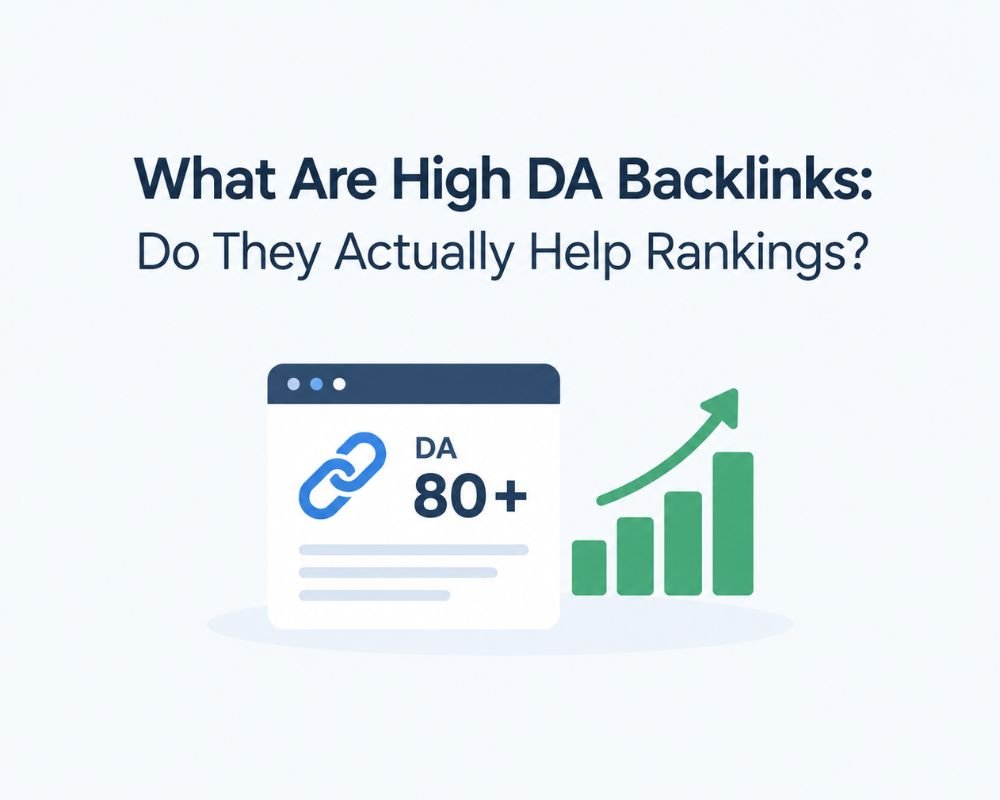
A DA score of 90 is better than a DA 40 website if it is relevant, high-quality, and the context matches; then it is a high authority backlink, not a low-quality or spammy one.
High DA backlinks usually come from sites with a high Domain Authority (DA) score, a Moz metric used to determine a domain’s relative ranking power. It is not a Google ranking factor. Ahrefs Domain Rating (DR) is another backlink metric that isn’t a Google ranking factor, and it’s similar.
You can use them to compare informal link sources, but you shouldn’t treat them as Google’s authority score. A high DA site that has no topical relevance and poor organic ranking could be a worse bet than a low-ranking site with a high topical relevance and authentic audience.
High DA vs High DR Backlinks: What’s the Difference?
Use DA and DR as screening metrics, not quality verdicts. Before pursuing any website for link booking, focus only on topical relevance, traffic, editorial credibility, and the ability to place your link. These strategies help you earn backlinks without spam.
| Metric | Provider | Measures | Best Use |
| DA | Moz | Relative link authority | Prospect comparison |
| DR | Ahrefs | Backlink-profile strength | Prospect comparison |
| Organic traffic | SEO tools | Search visibility | Quality validation |
| Relevance | Manual assessment | Topical connection | Context validation |
| Trust | Manual assessment | Site/editorial credibility | Risk assessment |
The 6-Factor Framework for Powerful High DA Backlinks
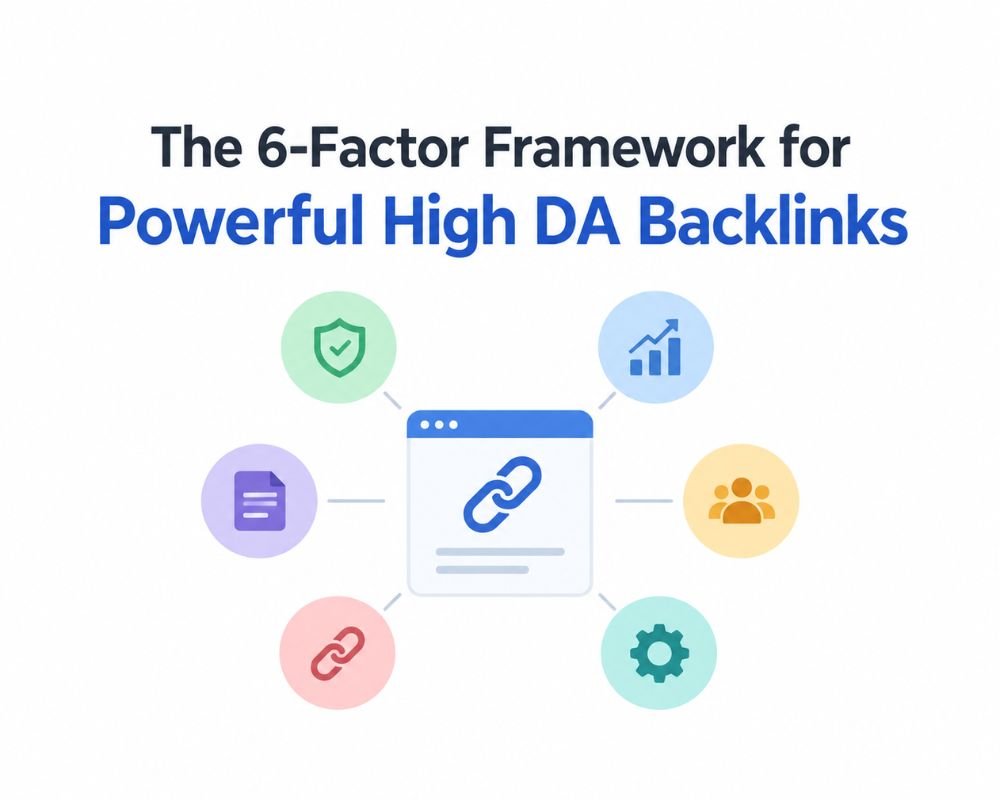
Rather than focusing on any particular DA or DR score, consider each possible backlink based on 6 criteria:
A strong backlink is equal to Authority + relevance + Trust + Editorial Placement + Real Traffic + link context.
Although these two metrics help with comparison, neither gives a full picture of DA or DR. In fact, Ahrefs also recommends that the most important metrics to consider when evaluating a website include not just DR, but also backlink quality, outbound link quality, organic traffic, content quality, and topical relevance.
1. Authority: Does the Site have the right strength?
For the basics, begin with DA/DR, but dive deeper! Look for referring domains, the quality of their backlinks, their page-level authority, and the number of links they provide to other sites. A site with a high domain rating but thousands of outbound links may be less useful than its headline number suggests.
2. Relevance: Is the Website Relevant to Your Topic?
More people find this chart useful than impressive.
Link-building statistics show that “58% of SEO professionals suggest topical relevancy matters more for the backlink quality factor.”
A general website with a DR 80 rating may not match the niche an article focuses on. In contrast, a reputable cybersecurity website with a DR 45 rating might be a more appropriate source for a cybersecurity article. The more your audience and content are related to the audience and content of the page you’re linking with, the more “natural” it looks.
3. Trust: Would a Real Person Trust This Website?
Don’t just stick with the home page. Look for About, authors, editorial standards, existing articles, reputation, transparency, and business/contact. Read 3-5 recent articles. Find high-quality content, not filler pages stuffed with links.
4. Editorial Placement: Where’s Your Link?
A relevant article that naturally mentions your resource is very different from a footer, author bio, sidebar, random directory, or unrelated article.
Google considers buying links, low-quality directory links, footer/template links, and automated link building as link spam.
5. A Review of the Site’s Traffic and Visitors.
Review steps such as estimated organic traffic, ranking keywords, traffic trends, top-performing pages, and geographic visibility (if applicable). Most importantly, check whether the linking page is searchable. Keep in mind that third-party traffic statistics are not exact analytics information.
6. Link Context: Does the Link Make Sense?
Context = Relationship between your page, the linking page, its context, anchor, and reader intent.
For instance, a cybersecurity stats record obviously connected to your initial cybersecurity research has a clear contextual relationship. An unrelated lifestyle article that suddenly connects to your SEO service does not.
How to Evaluate a High DR Link Before You Reach Out
When you evaluate high DR links, you can reach out to websites manually, or you can use top-rated link-building agencies that combine manual outreach, quality content, and transparent reporting.
Check the backlink before investing your time in outreach efforts with this 5-minute vetting process:
Step 1: Check DA/DR
Limit your use of DA or DR; don’t use them as the final decision. A high score only indicates a strong backlink profile; it doesn’t mean the site is relevant or trustworthy.
Step 2: View Organic Visibility
Ask:
Is there any significant search volume on this site?
Look at the estimated organic traffic, ranking keywords, and trends. A high-DR domain with no search visibility deserves more attention.
Step 3: Evaluate topical relevance
Check its latest articles, primary categories, ranking keywords, and audience. You want a real connection between the website and your article.
Step 4: Check existing outbound links
Be wary of too many too-good-to-be-true commercial links, unrelated niches, too many anchor text variations, and too many obvious patterns of paid links. Google has specific examples of manipulative link practices that it marks as spam.
Step 5: Evaluate the Exact Page
Don’t look at just the domain. Analyze the page to which your link will go.
A key difference between Ahrefs and other tools is that Ahrefs divides DR (Domain Rating) from URL Rating (URL). URL Rating measures the strength of an individual page, while Domain Rating measures a domain’s backlink profile. So, within a strong domain, individual pages can have very different backlink profiles.
The conclusion is this: a link with a high DA is more attractive when it all fits together, such as a domain, page, audience, content, traffic, placement, and context.
How to Get High DA Backlinks Without Chasing Metrics
Guest Contributions: Earn the Context, Not Just the Link
Cover briefly:
- Identify publications that will appeal to your audience.
- Present original knowledge or a relevant subject.
- Write material that will meet the needs of the audience of a publication.
- Deserve a warranted mention in the editorial as an example.
- Verify the publication with your six factors before spending time.
Link: Your detailed guest post/link-building article.
The key message:
A guest post isn’t good just for a link. Useful when the publication, content, placement, and audience make that link actually helpful.
Digital PR and Original Research: Give Publishers a Reason to Cite You
Briefly introduce:
- Original statistics
- Surveys
- Industry studies
- Experiments
- Proprietary datasets
- Original research
- Useful tools/calculators
Original research, tools, infographics, and other linkable assets can attract authoritative links. It also mentions a Wistia case study where they generated approximately 4,000 links from the initial data.
The differentiating factor is linkability:
Don’t create content merely because you want a backlink. Make something that other websites have a reason to link to.
Broken Links, Resource Pages & Unlinked Mentions
Do not describe how it works, as your supporting articles already do this.
Rather, train the quality control process:
Opportunity = 6-factor test – prioritise – outreach – monitor
For instance, if a page is not relevant, not trusted, not editorially maintained, and cannot generate meaningful referral traffic, then a finding-resource-page backlinks opportunity should not proceed.
Evaluate topical relevance, traffic, editorial standards, and anchor/context instead of just link count.
Link Outreach Tips 2026: Pitch the Value, Not the DA
This is where you can incorporate your secondary keyword.
- Provide the novice with four rules:
- Customize for the publisher’s information.
- Provide the reader with value, not the DA requirements.
- Describe specifically how your resource fits.
- Ensure the editorial reason for linking is apparent.
Include a brief warning:
Don’t send emails that are basically “Your web page has a high DA; link to me.
This makes this section more convincing and memorable.
How to Avoid Bad High-DA Backlinks and Google Penalties
Shift to transitioning from acquisition to risk:
An SEO tool may show a powerful backlink in its list, but it could be a bad or risky link to add to the profile. So, focus on an ethical backlinks service that avoids bad link building and prevents Google penalties.
Red Flags to Watch
Use a concise list:
- Pay links designed to boost ranks
- Automated link-building
- Excessive reciprocal linking
- Irrelevant guest posts
- Low-quality directories
- Manipulative exact-match anchors
- PBN-style footprints
- Websites that display large amounts of ads from unrelated sites.
- Obvious link-selling patterns
You have found that buying links, spam strategies, irrelevant links, over-manipulation, and unusual patterns are significant dangers.
Don’t Confuse “High DA” With “Safe”
Should be a concise, snappy subsection.
Explain:
DA is a metric. Trust is a judgement.
A website can have a great third-party authority score and still be irrelevant, have poor editorial standards, have poor organic visibility, or use a manipulative link pattern.
Therefore:
- High DA ≠ automatically high quality
- High DR is NOT a guarantee of safety!
- High metric + quality of the 6 factors = stronger prospect
This is one of the straightest methods to distinguish your article from others that just list a list of “high DA backlink sites.” You found that this metric-centric approach is prevalent in today’s SERP.
These three sections are best when played at a particular rate.
Know the metrics → know the quality framework → use it when acquiring things → don’t pursue shady opportunities.
That makes the article much more pro than
Guest posts → PR → Broken links → Directories → Repeat.
Best of all, “link outreach tips 2026” isn’t a keyword-stuffed-for-words phrase; it’s a home for it.
Conclusion
It’s not about the number of websites linking to yours, but the number of high-DA websites linking to yours. A DA 90 or DR 80 link may be a bad deal if it lacks meaningful relevance, real traffic, editorial standards, or context.
A better approach is to evaluate opportunities using these six factors: authority, relevance, trust, editorial placement, real traffic, and link context. This framework will help you determine which backlinks are “high DR” and actually valuable, not just pretty.
The objective is the same regardless of the link source: secure a relevant, editorial link that aligns with your target audience’s needs and supports long-term growth.
When it comes to high-DA backlinks, you want to do more than just pay attention to the domain’s score; the endorsement’s quality matters. And if you’re ready to scale, apply the same rules to any link opportunity you are considering investing in.