Toxic Backlink Audit and Removal: 7 Urgent Fixes
Your backlink profile is just flagged as a penalty when you open your dashboard. Your traffic dropped 15-20% in the Google Search Console. You spend months building quality backlinks, crafting quality content, and earning legitimate links, but some spammy, irrelevant anchor text, PBN networks, and low-quality domains ruin your struggle. This is where toxic backlink audit and removal save your backlink profile and protect you from Google penalties.
Google link spam algorithms become more efficient at identifying the spam backlink, whether you acquire them intentionally or they land on your domain uninvited. Google now penalizes backlinks from irrelevant niche sites, bought links, expired domains, and low-quality guest post farms written by AI. One link from a spammy site spoils your overall backlink profile.
A truly toxic backlink exploits relevance mismatches and abuses the Google algorithm. As a result, it distrusts your domain, and you lose thousands of visitors with authority.
But you don’t worry, in this article, I’ll explain to you exactly how to clean your backlink profile so you can easily conduct a backlink audit and remove them with specific steps.
Why a Toxic Backlink Audit and Removal Strategy Is Non-Negotiable in 2025-26
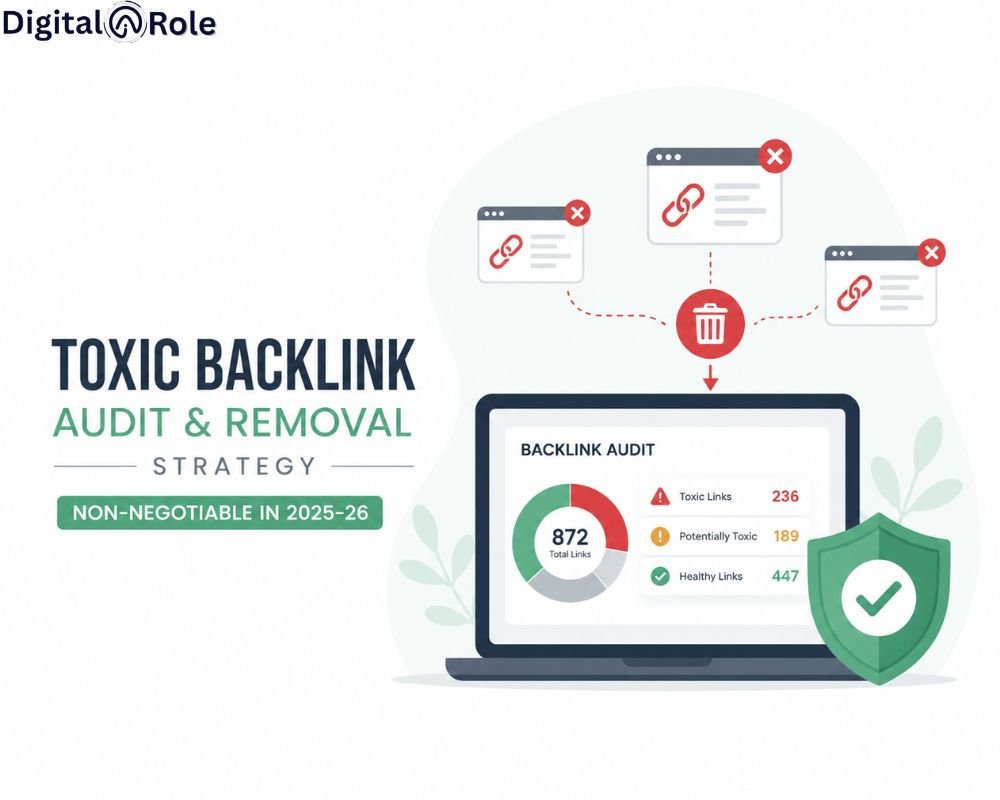
Google’s algorithm isn’t penalizing for low-quality links; it’s rewarding for cleaning up profiles, too. The latest updates to the core algorithms have focused more on link-quality signals, leading to a primary trust indicator being your backlink profile. So, you need to backlink audit, which cleans your profile and tells you which link sites
The true cost: Poisonous sites without a response during an upgrade experience a 20-35% traffic fluctuation. Manual actions are preferred. A minimum time of 3–6 months is required for recovery.
For individuals in the backlink industry, this has all turned upside down.links are not created to protect authoritative websites. Even if a competitor has a clean profile, their site’s ranking can be higher than that of a high-authority site with a dirty profile.
2025-26: Sites audited every quarter have 40% more stable rankings. Without toxic links, 15-30% of organic traffic is lost within 6 months. The average recovery period is 90 – 120 days following penalties.
Obviously, the Google spam core policies have already demonstrated that “link quality assessment” will be the algorithmic first priority. It was evident that very few changes were made to the sites that had previously undergone an audit and that did not have a 40%+ loss of visibility.
Audits are not in response, not reactive, but in anticipation of danger. You’re being proactive in preparation for the next transition.
What counts as a toxic backlink now?
The definition of a toxic backlink evolves with the algorithms, but in 2026, it is more sophisticated because people make fools of themselves, while Google’s algorithms are more efficient and smarter.
Red flags that are detected:
- Irrelevant link from a niche that never matches the site, even though it has high DR. This type of site harms your authority.
- You take multiple backlinks from the same site with the cluster, which causes temporal anomalies.
- Many backlink experts over-optimized anchor text. Only use partial match or exact match, 5-8% for your anchor text profile.
- Make a link chain with an expired domain that redirects to a dead domain; it transfers minimum authority, but it is risky.
- You write a guest post on a low-engagement platform with thin, AI-generated content, which is considered worse spam in the eyes of Google.
- You build a PBN network, take links from your network, and share hosting.
Google’s Spainbrain algorithm is correlated with user behaviour signals. If the link is useful for audiences, then you rank and win.
How to Conduct a Toxic Backlink Audit: Tools & Metrics That Matter
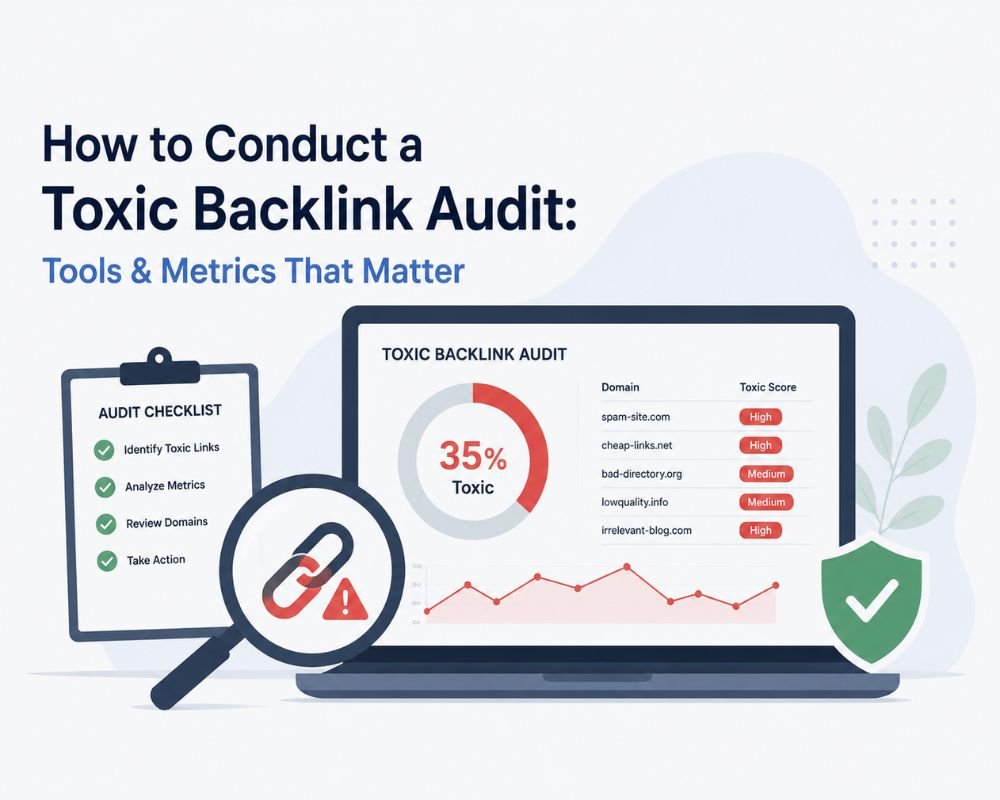
Conducting a toxic backlink audit is essential because Google rolls out 2-3 updates every year that analyze both spammy links and helpful content. You need a link profile audit checklist that helps you conduct a proper audit using the tools, so you have a clear idea of what you do now.
Selecting the correct tools to use for toxic backlink audits
Ahrefs is very good at determining when anchor text doesn’t conform to expectations and analyzing the competition. In terms of spammy domain clusters, SEMrush identifies them more quickly using its organic traffic estimates. Moz was very effective at flagging expired domains. Citation Flow/Trust Flow discrepancies are a way Majestic shows footprints of PBNs.Majestic shows up PBN footprints via citation flow/trust flow discrepancies.
Pro move: Layer them on top of each other. With Ahrefs, you’ll find out which links are causing the problem. SEMrush will reveal it, since it most accurately captures this (contextual mismatch, low engagement). Moz confirms risk level. Avoid one tool audits.
Essential Metrics to Track During a Backlink Audit
Don’t just focus on domain authority.
- An unusually high number of emails with a spam score>40% will be deleted instantly.
- The concentration of anchor text indicates keyword manipulation.
- The repetition of anchor text may be a signal of keyword manipulation (>8% means more than 8% anchor text matches).
- For the sake of argument, people use the term “domain velocity” to refer to sudden clusters that correspond to people buying a domain with a PBN.
- Traffic to backlink ratio (higher link ratio with no traffic = low intent site)
Reading the Data: Contextual Red Flags Beyond Scores
The best link to use is a 50 DA link from a niche other than your vertical, as a 30 DA link from your vertical is safer. This isn’t something that the dashboard score will tell you: context. Verify: relevance, audience overlap and content quality. If the link point is wrong, one may trigger algorithmic suspicion.
The 7 Urgent Fixes for Your Backlink Profile
These are the real steps cleaners take when they come across toxic links during their audit — this is how you’re going to prioritize them. Any patches are targeted at a particular penalty risk category, in priority order and by patch ease.
Fix #1 – Disavow High-Risk Spam Links Immediately
High-risk spam = manipulation signals that are easy to spot. Content for sites that have been scraped and/or have a de-indexed domain should go into this category. Sites with content that has been scraped and/or de-indexed domains belong in this category, with the exact-match anchors that link to them.
The Disavow Tool will take a .txt file containing the domain name (or URL) on each line. Google’s disavow file is processed within 24-48 hours.
Certain: Reject and dismantle domain-wide (not individual URLs) when there are 1-2 bad links present in the domain.
Typical pitfalls of experts – disavow too soon before removal actions begin (raises red flags with site owners), disavow too aggressively, risking loss of good contextual links or upload URLs rather than domains (very inefficient).
Best practice: only disavow domains with a 40%+ spam score and no topical relevance. If the case is borderline, try for removal first.
Craft a website designed to be easy to access and built for speed. Accessibility & Page Speed
Fix 2 – Target Manual Links From Unrelated Niches
Handling context mismatch is now one of the main penalties. Links on your HVAC site to a finance blog could be a red flag to the algorithm.
Identification: Cross-reference each domain you refer to/parse niche keywords. Theoretically, you can use SEMrush topic analysis or Ahrefs content audit, and if the site you’re referring to has no audience overlap, it’s a candidate.
Removal method: These sites typically offer links for sale on a purposeful basis. E-mail owners of sites that link to you: “I saw your [Topic] post includes a link to my [Niche] site. Is it able to delete this link and include appropriate information instead? The success rate for direct outreach is 30-40%.
ROI insight: Use the first number before referring to Domain Authority. Remove all DA mismatches; if the contextual noise is low-DA, it will not affect the results.
Fix 3 – Remove Links From Low-Quality PBN Networks
Detecting PBN: Watch out for:
- Multiple links from domains that point to the same/similar Hosting Footprint.
- 0 backlinks from external websites
- Prominent mention of your keywords on top-ranking websites with the same term as your anchor text.
- New domains, with immediate content.New domains, with instant content.
Outreach template:
Subject: Link removal request
I see that you are linking to your site from [referring domain]. I’m struggling with this link placement and would appreciate it if this site is removed from the placement within a week (7 days). Please confirm receipt.
This makes sense because PBOs can be aware that Google is watching. Building a case through direct and firm requests has a 25-35% removal rate. Follow up 1x after 5 days.
Fix #4 – Audit Anchor Text Distribution & Unnatural Patterns
Red flag thresholds:
- Penalty risk if anchor = Exact match anchors >8%.
- The manipulation signal is indicated by brand name anchors whose percentage is less than 40%.
- Low quality profile (less than 30%) has generic anchors (click here, read more)
Rebalancing (no deleting): Avoid removal of valid links. Rather, earn new links that feature natural, anchored text (how-to content, educational resources). It is good, helping to lower the toxic ratio, but at the same time, it is raising the authority.
Time to rebalance: 90+ days. It’s a process, so begin now, but some improvement should show in time.
Fix 5 – Clean Up Expired Domain & Redirect Chains
Domain Redirection History Tools, such as Ahrefs, can help you identify redirect history. Tackle for the browses: “flag” domains, currently 3+ years old, but recent links (bought/expired indicators).
Why Chains Matter: A→B→C redirect chains compound link risk. Degradation of the signal indicates to Google’s crawler. Removal is simple because they’re usually deleted or simply redirected to links that don’t work.
Action: If the website is still up, ask for it to be taken down. When expired, please check for disavowal after 30 days.
Fix #6 – Remove Irrelevant Guest Posts & Article Syndication Links
A guest post is written specifically for a platform, is subject to editorial review, is more than 300 words, and is written for the audience.
Syndication spam: Distributed in large quantities across 50+ networks and with little customization, lacking engagement metrics.
Syndication is when the site has little organic traffic (fewer than 1,000 visitors per month), and you place your link in the “recent posts” sidebar. Wait, it takes about 60 days anyway to auto-remove, but if you’re in doubt, ask for their removal.
Fix #7 – Request Removal From Toxic Link Directories & Scraped Sites
Automated removal approach: Send automated removal requests (e.g., via RecipeRemovalTool or to known scrapers) – 99% removed within 48 hours when they know they are going to be removed under a DMCA.
Template for directories:
The following is a request to remove the (URL). The link is added without permission. Please remove it within 10 days, or I will file a DMCA Complaint.
Low-hanging fruit for removal: These links are unlikely to improve website authority even if they are removed, but they do offer psychological completion to your audit, as well as algorithmic completion.
Frequently Asked Questions
Q: How to fix Backlink Profile Issues?
Addressing Backlink Profile issues involves several steps, such as using backlink checkers like Ahrefs, Semrush, or Moz to spot toxic spammy links or links with dead pages. Communicate with the web admins of the offending spam sites and politely ask them to remove the link. If they don’t do anything, gather all these bad URLs in a text file and use Google’s Disavow Tool to have Google ignore them. Third and finally, repair any broken links, both internal and external, so that you’ll have transferable link value throughout your website.
Q: How to clean the Backlink Profile?
There are 3 main steps to cleaning your backlink profile: Audit, Request and Disavow.
Get a copy of your full backlink profile from Google Search Console.
Request: Mark the spammy links as spam (adult sites, aggressive PBNs, irrelevant foreign directories, etc.), and email the owners of these sites to request that they be removed.
Disavow: For the remaining links, upload a clean .txt file directly to Google’s Disavow Tool to completely remove those links from your site’s connection to the toxic domains.
Conclusion
Cleaning up toxic backlinks isn’t something you can do once and forget about; it’s a constant challenge that requires a systematic approach. You’ve discovered methods for ruthless auditing, strategic removal, and future prevention. The 7 urgent fixes should be prioritized. Time is saved with the removal process. The prevention system is progressive and puts you ahead.
The difference between professionals and amateurs: action! But skill without action is useless without knowledge.
Start this week.
Conduct your audit today! Make critical removals by tomorrow.
Conduct outreach for the next 2 WEEKS.
As of week 4, the chat signal parameters on your profile will be clean to Google.
You are losing traffic at the moment because you are competing with those who wimp out in the link department. Your cleaned backlink profile positions you to get that share! Please do not push this discussion to the schedule due to an algorithm change. Reservations may be made starting now, the terms are checked quarterly, and you’re safe!
It’s a part of your profile, and it’s a part of your rankings.