Resource Page Link Building: How to Find, Pitch & Secure High-Authority Backlinks
Resource page link building is an old tactic. Still, it’s one of the most powerful backlink tactics for a relevance-first approach, targeting pages that already create useful resources for their target audience. Instead of manufacturing links, you pitch a useful guide, tool, template, or research that the editor may choose to include.
Many backlink builders chase backlinks based on DA/DR, send generic emails, and end up with irrelevant placements with low-authority pass. When you build backlinks, focus on quality over volume.
Understand Google’s backlink spam policies before you start a backlink strategy. Resource page backlinks are the process of finding relevant resource pages to pitch your own useful guide, tool, template, and visual assets for inclusion.
In this guide, you’ll learn how to find resource pages in your niche that allow you to build natural backlinks. I share tips on how you pitch editors, use a resource page outreach template, and measure results with a practical workflow and tools you can apply to your campaign.
What is resource-page link building?
Resource page link building is an outreach SEO strategy where you find a resource page in your niche that creates useful resources and suggest linking to your published content.
The resource might be a comprehensive guide, tools, industry research, a template, a checklist, or other assets that are genuinely helpful for the page’s audience.
Instead of writing a new article for a high-quality backlink, you identify an existing resource page where you can genuinely fill an informational gap. The site owner and editor then decide whether your page is acceptable or not.
You can simplify the process in six steps.
- Find
Search for a relevant resource page that fits your website’s niche and audience.
- Qualify
Evaluate the resource page’s relevance, authority, organic traffic, page quality, and whether the page is actively maintained.
- Match
Identify which content on your website matches the target resource page.
- Pitch
Contact the appropriate editor or site owner with a short email template and a personalised suggestion.
- Follow-up
Send 2-3 polite follow-ups within a week if you don’t get a response, without turning the campaign into spam.
- Track
Monitor the placement, referral traffic, rankings, and other meaningful outcomes.
The key principle
Don’t ask them, “Where can I get a backlink?”
Ask, “Where would my genuine backlink be helpful for the audience?”
This shift creates quality backlinks that are relevant, sustainable, and useful for publishers and readers.
Does Resource Page Link Building Still Work in 2026?
Yes, it is worth it when you find them through relevant first editorial outreach, not by chasing a high volume of backlinks. A guide reveals that “72% of resource page links come from DA 50+ sites, whose average lifespan is 5 years.”
It is a white-hat backlinking technique because it focuses on the following elements.
- Create a high-quality resource page for backlinking
- Find a relevant page that is helpful for the audience
- Suggest the resource honestly.
- Let the editor decide to include it.
- Avoid manipulative anchor text and link placement demands.
Here are examples of resource pages from different niches
| Resource Page Type | Example | Typical DA |
| University department lists | “Marketing Resources for Students” on an .edu site | 60-90 |
| University library research guides (LibGuides) | “Business Research Guide” on a university library site | 50-80 |
| Government agency guides | “Small Business Resources” on a .gov site | 70-90 |
| State/local government pages | “Resources for New Residents” on a city .gov site | 40-70 |
| Nonprofit reference lists | “Mental Health Resources” on an .org site | 40-70 |
| Industry association resource pages | “Member Resources” on a trade association site | 40-70 |
| Industry blog roundups | “Best SEO Blogs and Tools” on a marketing site | 30-60 |
| Chamber of Commerce pages | “Local Business Resources” on a Chamber of Commerce site | 30-60 |
| School / K-12 teacher resource pages | “STEM Resources for Teachers” on a school site | 30-60 |
| Scholarship / financial aid lists | “Scholarship Resources for College Students” | 40-70 |
| Personal finance blog resource lists | “Best Budgeting Tools and Resources” | 30-60 |
| Health/medical org directories | “Resources for Patients” on a hospital site | 50-80 |
| Parenting/family blog resource lists | “Resources for New Parents” | 20-50 |
| Startup / small business resource hubs | “Tools and Resources for Startups” | 30-60 |
| Niche community pages | “Photography Resources for Beginners” | 20-50 |
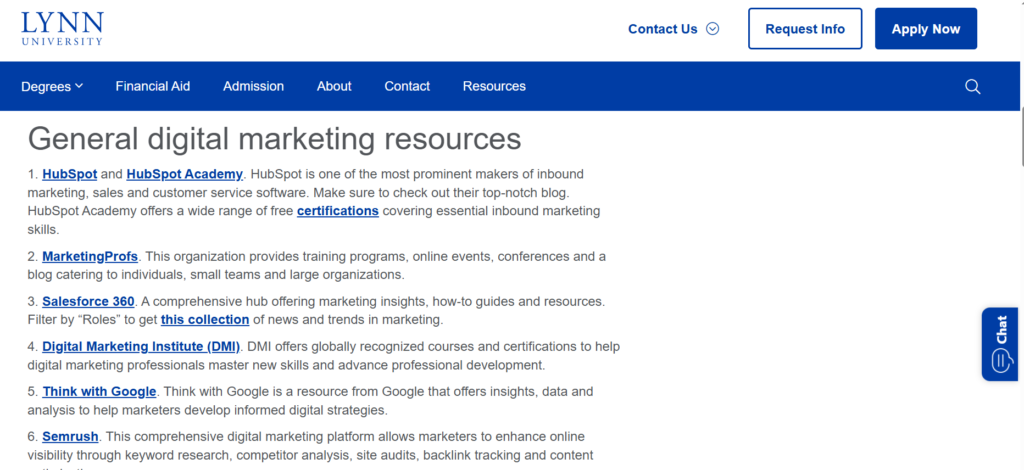
For example, this is a resource page from Lynn University about digital marketing. It gathers helpful links to other websites, such as HubSpot, MarketingProfs, Salesforce, the Digital Marketing Institute, Think with Google, and Semrush.
Each link includes a short description explaining how the resource can benefit marketers. This shows readers the value resource pages offer, and it gives relevant websites backlink opportunities.
How Resource Page Link Building Differs from Guest Posts, Directories & Other Types of Link Building
Resource page link building isn’t a one-size-fits-all approach to building backlinks. The biggest difference is what you add and how much editorial control the publisher has over the final link.
| Method | What you pitch | Editorial control | Main advantage |
| Resource pages | Existing resource | High | Topical relevance |
| Guest posts | New article | Medium | Contextual placement |
| Directories | Business/site listing | Low–Medium | Discovery and citations |
| Broken link building | Replacement resource | High | Solves an existing problem |
| Digital PR | Story, data, or newsworthy asset | High | Authority + visibility |
Resource page backlinks are a great option if your content will directly enhance an existing resource list. This differs from a guest post, where you typically create a new article for the publisher; here, you may propose using an existing article that fits a real need on the publisher’s site.
Why Resource Page Backlinks Can Be Valuable for SEO
A resource page backlink may be beneficial if it comes from a helpful, informative, and well-maintained page, especially if it is relevant. The value isn’t determined by the site’s DR, DA, or the number of links pointing to the page.
Consider these factors:
- Topical relevance: The linking page and your resource should be about similar topics.
- A link chosen by an editor for its relevance to the reader is more useful to readers than a random link.
- Referral traffic can send qualified visitors straight to your website.
- Discoverability: Links can lead to relevant content, which may help users and, if search engines find it useful, improve discoverability.
- Authority signals: High-quality, relevant links may help build the overall link profile search engines consider.
- Relationship building: Help build relationships with editors, publishers, and site owners for future opportunities.
However, having a link on a resource page does not necessarily boost rankings. Its value is based on its relevance, the quality of the page it links to, the context of the editorial, and the way the link is used.
What makes content “resource-page worthy”?
Before requesting an editor to include your URL, ask yourself a much more important question:
Why should this editor, in particular, want my link?
A resource page exists to help its audience. You need to improve this page with your content, not just add another backlink.
The most commonly accepted formats are listed below.
Not every piece of content is an automatic fit for a resource page, but anything clear, practical, or original is a better fit.
Examples include:
- Original research
- Collect and analyse statistics and data to identify patterns.
- A selection of free tools and calculators.
- Templates
- Checklists
- Comprehensive guides
- Step-by-step tutorials
- Glossaries
- Frameworks
- Downloadable resources
For more detail, you can read our guide on create content that earns backlinks.
When your content is backed by original research, first-hand insights, useful tools, and substantial guides, it gives an editor a good reason to recommend your content over a generic article that doesn’t have anything original to offer.
How to Find Resource Pages in Your Niche
The first big move towards a successful resource page link building campaign is learning how to find resource pages. The goal isn’t to gather hundreds of URLs; it’s to find pages where your resource is truly relevant to the topic, audience, and editorial agenda.
Look for Google search footprints, your competitors’ backlink profiles, and not so ‘usual’ pages like “Further Reading” or “Helpful Links.” Qualify all prospects before calling the site owner. This will keep you from sending out outdated, irrelevant, or poor-quality pages.
Google Search Operators for Link Building That Actually Work
Google search operators can help you find content pages that you may not find by using normal keywords. To find variations of website labels for resource collections, mix your niche with different footprints.
| Search operator | What it can uncover |
| [niche] intitle: resources | Pages with “resources” in the title |
| [niche] inurl: resources | URLs containing /resources/ or similar structures |
| [niche] inurl:links | Industry link and useful links pages |
| [niche] “useful links” | Curated useful-link collections |
| [niche] “helpful resources” | Educational or informational resource lists |
| [niche] “recommended resources” | Curated recommendations |
| [niche] “further reading” | Articles and pages containing additional reading |
| [niche] “resource list” | Explicit resource-list pages |
For example, an SEO website could search:
SEO intitle: resources
or:
SEO “further reading”.
Avoid using a single operator. Resource pages come in many forms, and testing multiple footprints can yield a much larger pool of prospects.
Find competitor and industry backlinks.
Your rivals can expose resource-page openings that you can’t come across when searching Google.
Use this workflow:
- Identify 3-5 relevant competitors’ websites that target a similar audience and offer similar resources.
- Utilise a backlink analysis platform to find out which pages are linking to your site.
- Search for keywords including resources, links, further-reading, recommended, useful, etc. pages.
- Delete irretrievably irrelevant domains, bad sites, and pages that don’t really align with your audience.
- Look for patterns in resource pages, organisations, topics and publishers that link to several competitors.
- Add qualified prospects to your campaign spreadsheet and include page URL, relevance, authority metrics, contact, potential asset and outreach status.
This makes competitor research a “prospecting shortcut” instead of guessing where resource links might be; you can investigate pages that have linked to similar resources.
Identifying Listicles, “Further Reading” Sections & Hidden Resource Lists
A common error is looking only for URLs with the `/resources/` path. A valuable resource page may have no obvious “resource” label.
Search for pages that are titled or include sections of the text like
- Helpful Links
- Further Reading
- Recommended Tools
- Learning Resources
- Useful Websites
- Industry Resources
- Suggested Reading
Also look at relevant listicles and curated guides. While the URL doesn’t have to include `/resources/`, a page titled “Best SEO Tools” or “Top Resources for Small Businesses” can act as a resource page as well.
The wider your search footprint, the greater the chance you’ll discover competitors that miss the important thing: page-link-building chances.
Resource Page Link Building Tools That Speed Up Prospecting
The right resource page link building tools can save you a lot of time in manual prospecting. The problem is that not all link-building opportunities are created equal. They can help you identify relevant pages, analyse your backlinks, evaluate prospects, find broken links, and organise your outreach.
Useful options include:
- Ahrefs is useful for competitor backlink analysis, identifying referring pages, and analysing potential prospects.
- Semrush analyses backlink profiles, referring domains, organic visibility, and competing websites.
- Screaming Frog is useful for crawling resource pages and broken or problematic outbound links at scale.
- Google search remains one of the most powerful discovery tools, with a few clever “search operators.”
- Google Sheets is perfect for prospect data, qualification scores, personalisation notes, and campaign status.
- Email hunters help you find email contact details when they aren’t in plain sight.
- An outreach platform helps you organise personalised campaigns, follow-ups, and response tracking.
- If you prefer professional assistance, consider partnering with reputable best link building agencies that specialise in manual, outreach-based link acquisition.
There’s no tool to determine if a link is “deserving. Discovery and analysis using software; relevance and editorial fit using human judgment.
How to Vet and Prioritise Your Resource Page Link Building Opportunities
Securing a prospect is just part of the challenge. When sending an email, find out whether each opportunity is worth pursuing.
Check authority signals: DR/DA, traffic, and spam signals.
DR and DA can be valuable screening tools but shouldn’t be the sole basis for your prospecting efforts.
Check:
- Organic traffic
- Topical relevance
- Referring domains
- Page-level relevance
- Indexation
- Outbound-link quality
- Site reputation
- Spam signals
Formal evidence of an actual audience.
A great site with strong authority could be a bad investment if the resource page doesn’t fit the rest of the site, has been neglected, is too link-heavy, or was created for search engine optimisation.
Topical Relevance vs Vanity Metrics
Follow this hierarchy:
Relevance, Real audience, Editorial quality, Authority metric
A DR 80 site in a different industry, for instance, may be a poor outreach target compared to a DR 40 specialist site with an audience similar to your target audience.
It’s not just about how powerful the domain is.
Ask:
Do you think that the readers on this page would benefit from your resource?
If yes, proceed to explore further.
How to identify resource pages that are abandoned or link-rotted.
Not all resource pages are maintained. If pitching, do a quick page health check first.
Look for:
- Last meaningful date:
- Broken outbound links
- Domains that have been removed or redirected to different sites.
- Outdated references
- Excessive external links
- Comments from recent engagements or other engagement signals
- Current organic traffic
- Does it still meet the needs of the intended user?
A site with many broken links may offer a strong broken-link replacement opportunity. Rather than just asking for placement, identify the issue and propose a suitable alternative.
Create a Resource Page Prioritisation Worksheet.
Alternatively, each prospect can be scored from 1 to 5 based on:
The Priority Score is the sum of the five factors listed above: Relevance + Page Quality + Traffic + Link Opportunity + Contactability.
The higher the score, the closer the prospect is to your campaign.
A page that is relevant to the topic, has traffic, has a well-written post, has a broken-link opportunity, and has a clear audience fit and editor should outrank a high-DR page with no audience fit and no editor.
How To Pitch A Resource Page And Get Them To Respond
Outreach is the conversion moment of a campaign after you’ve identified and qualified the right prospects. You don’t have to try to convince every website to link to you. It’s about making a specific, believable suggestion that enhances the publisher’s page.
“In the resource page backlinks highly personalised pitch, the response rate is 5-15%.”
Identifying the “Real” Decision Maker on the page.
If possible, name the person responsible for maintaining or publishing the resource page.
Potential contacts include:
- Page author
- Content editor
- Webmaster
- Marketing manager
- Resource-page owner
- Organization contact
If you don’t have an info page on the website, check the author bio, contact page, editorial information, LinkedIn profile, or company team page before assuming it’s a general info page.
The closer your message is to the person who is in charge of the page, the easier it will be to explain why your resource is relevant.
What’s in a High-Converting Outreach E-mail?
A good resource-page pitch will take the form of the following four points:
Personal observation: Talk about something in particular about the target page.
Relevance to resource page: Share how your resource is relevant to the current collection.
Specific value: Indicate the benefits that readers will receive from the resource.
Low-friction CTA: Ask whether they’d consider adding or updating a CTA.
Don’t make common outreach errors like
- I enjoyed your terrific website.
- Long introductions
- Generic praise
- Sending more than one unrelated URL.
- Using anchor text with the exact match.
- Requiring an exact match anchor text.
- Artificial urgency
- Making it seem the resource is relevant when it is not
Keep it short enough that the recipient can read what you are asking in seconds.
Resource Page Outreach Email Template
Use this resource page outreach email template to publish a resource page on your site.
The editor should find this resource page outreach email template easy to use. Specify the page number, explain the resource’s usefulness, and let them decide whether it belongs.
Subject: Resources for your [topic] page
Email:
Hi [First Name],
I was researching [topic] and found your [resource-page name]. I saw that you already have resources on [specific topic].
Recently, I wrote [resource title], which helps readers [one-sentence description of what they can do with it].
I thought it might be helpful for readers interested in [specific benefit].
Would you consider it for the page?
Thanks,
[Name]
[Company/Website]
The wording isn’t the main point. The pitch should be relevant and personal. Don’t make your editor do the work of figuring out whether your resource fits their page.
The broken-link replacement angle
People who own resource pages and know you’re solving a problem they have are more likely to respond to broken-link outreach.
Use this workflow:
Identify the broken link: Identify the original topic, create or identify an equivalent resource, contact the curator, and suggest a replacement.
For instance, if a resource page references an old guide that no longer returns a 404, you can provide the editor with information about what resource they think should have been included instead.
Broken-link variation:
In your [topic] resources page, a link is broken.
Hi [First Name],
While reviewing your [resource-page name], I noticed that the link to [old resource] seems to be broken.
Here’s a current resource for [topic]: [URL].
If you are replacing the page, it might be useful to have an alternative reference for the broken page.
Either way, I wanted to make you aware of the broken link.
Best Regards,
[Name]
This works best if your replacement resource addresses the same need as the original. If you have a broken link, don’t use that as an opportunity to sell an unrelated page.
When and How to Follow Up
No response doesn’t necessarily mean rejection. A few gentle reminders might be appropriate if editors are busy.
A good sequence to go with is
- Follow-up #1 should be sent within 3- 5 business days of your original e-mail.
- Follow-up #2: 5–7 days later
- Short follow-up message to close the loop at the end of the message.
Follow-up should not regurgitate the pitch; it should clarify it.
Stop when someone clearly refuses to participate, asks you not to contact them again, or says they aren’t taking submissions. Outreach is more about building helpful relationships than sending the same message over and over while looking for a backlink.
Conclusion
When you build relevant, useful, and authentic backlinks, resource page link building is a worthwhile component of any contemporary SEO campaign. The steps are simple: find relevant resource pages, filter each opportunity, match the right asset to the opportunity, pitch the editor, follow up, and monitor the outcome.
Do NOT use DR and DA as final decision criteria. A page on a relevant site with a live, meaningful editorial context may be a better opportunity than a high-authority site hosting a page unrelated to the page’s content. Most of all, provide editors with what they really want to recommend.
Using the correct resource page link-building tools, a customised resource page outreach email template, and an effective qualification process, you can cultivate quality resource page links, rather than engaging in manipulative link-building schemes. The aim isn’t just to get another backlink, but to earn a helpful mention that benefits your site, the publisher, and their target audience.