How to Find Broken Link Building Opportunities Before Your Competitors

Every day, thousands of webpages disappear, pages die, and 404 errors occur, leaving behind broken links. Web admins never notice these links, but savvy SEOs do.
You don’t need to chase expensive guest posts and link exchanges; you need broken link building opportunities, and this is exactly what I guide you how to find broken link building opportunities before your competitors fill that space.
Broken link building is one of the white-hat tactics that remain essential in 2026. In this strategy, you never need to buy expensive links, exchange links, or use automated placement. Broken link work because you give them helpful, authoritative content, which recovers a page’s ranking.
You find a dead link on the website; offer them a working replacement, and web admins agree on it because you give them value. You only need a broken link checker Chrome extension and tools to find broken links.
In this article, I explain to you how to find broken link-building opportunities before your competitors find them and discover the best tools for broken link building. Write a reply-worthy email that impresses the webmaster.
You need to create link-worthy replacement content and execute a broken link-building strategy that consistently earns high-authority backlinks.
What Is Broken Link Building? (And Why It Still Works in 2026)
Broken link building is an effective strategy in which you identify a 404 link on a relevant page on someone else’s website and recommend your relevant high-authority link as a fix. You solve the admin problem; in return, you get high-quality backlinks.
“74% of SEO specialists recommend that broken links affect the rankings. When you identify websites with broken links, always pitch them if they are relevant to your site; this gives you a high impact on rankings.
Create high-quality content and avoid many link-building mistakes to avoid while you earn editorial links. Instead of trying to find websites that will link to you, broken link building begins with providing a genuine solution.
A broken link is a source of annoyance for your visitors, loss of trust, and a poor experience for your visitors. You offer value to the website owner by informing them of broken resources and recommending a resource that might be suitable.
Why it works
- Enhances user experience (UX) by fixing 404 links.
- Supports web admins to keep accurate and trustworthy content.
- Gets high-quality editorial links, rather than purchased or link-exchanged.
- Complies with Google’s preference for editorially acquired and valuable (relevant) backlinks.
Expert Insight
Broken link building is value-first: You don’t ask, you fix first—response and conversion rates are far more impressive than cold outreach.
Pro Tip: In an AI-powered world of Google search, editorial links from reputable sites are more beneficial over time than link-building strategies that can be manipulated because they show true relevance and credibility.
Why Broken Link Building Opportunities Are Growing Every Year
The Web is constantly evolving. Websites are remodeled, companies are closed, domain names expire, and old content is purged. Each page removed creates broken links on other sites, presenting proactive SEO experts with new link-building opportunities.
The top reasons that broken link opportunities are continuing to increase:
- When a web page is redesigned, it might be difficult to find. It may be hard to find a web page after a redesign.
- Expired or abandoned domains
- Older blog posts that have been removed and outdated guides.
- All the rest of the resource pages that are not often updated.
- Pruning content to enhance website quality.
Ahrefs found that 6% to 66% of all links on the web are eventually broken, and 66.5% of links from sites launched after 2013 are broken.
Broken Link Building vs Guest Posting vs HARO
Guest posting and HARO (Connectly) are still effective link-building strategies but can be more time-consuming and competitive and involve building relationships. One of the most effective types of broken link building is because it’s filling an existing gap, so website owners are more likely to be receptive to your outreach.
| Tactic | How It Works | Google’s Treatment | Link Trust Signal |
| Broken Link Building | You replace a dead link with better, relevant content; the webmaster adds it voluntarily | Not flagged — no scheme involved, purely editorial | High — genuinely earned |
| Paid Links | Money, product, or services exchanged for a placed link | Explicitly named as a link scheme; can trigger devaluation or manual action | Low, detectable pattern |
| Link Exchanges | Two sites agree to reciprocally link to each other | Flagged when “excessive”—occasional exchanges are fine, patterns aren’t | Variable — depends on scale |
| PBNs (Private Blog Networks) | A network of sites built solely to funnel links to a target site | Treated as a large-scale manipulative scheme; high penalty risk | Very low — artificial by design |
- Guest posting is not the best route to take when:
- You don’t want to write guest posts to get editorial links.
- You don’t want to write a guest post to get editorial links.
- But competitors have removed pages that you have valuable backlinks on, which you can get.
- Unused resource pages with broken references.
- You have high-quality content on your website that you can use to replace a dead page.
- You need a scalable outreach program that has search engine optimization tools and automation.
When there are no broken links or when you’re looking for brand awareness and new readers, however, guest posting is a more suitable choice.
Broken link-building opportunities
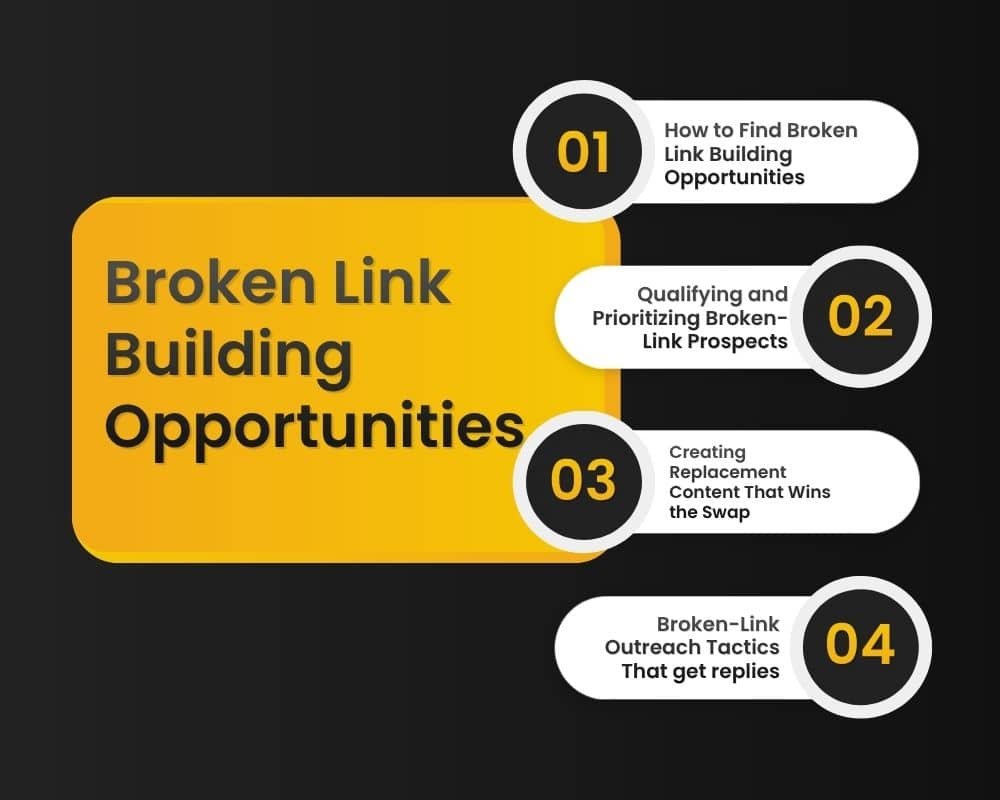
The best link builders aren’t only finding broken links—they create processes and systems that are continually searching for broken links if you are monitoring other websites and competition on a regular basis.
You can get in touch with website owners before the other SEOs have found the same opportunity, giving you a greater chance of earning the backlink, as they have information on what the 3 main features of a quality backlink are. One of the largest competitive gaps in current SERP content is the lack of monitoring—most information is only about one-off prospecting.
Step 1: How to Find Broken Link-Building Opportunities.
You can’t fix a dead link without first locating a link to fix. There are three sure ways in: your competitors’ backlink profiles, resource pages that are old, and tools that show up at scale.
Extracting dead pages’ backlinks from competitors.
You already have links in your niche; your competitors didn’t. The only thing you need to do is locate the ones that ceased functioning.
Using Ahrefs’ Site Explorer or Semrush’s Backlink Analytics, run a competitor’s domain, then filter for pages that return a 404, and sort by referring domains. You will return the list of dead pages that other sites in your area are still linking to.
This can be a shock to people’s systems.
Original angle:
Most guides will stop at “find the dead page and pitch the linkers.” A sharper move is constructing a map of link intersections—a cross-referencing of sites that have a number of competitor 404s. The group of overlapping linkers is your most leveraged outreach list; one high-quality replacement piece of content can convert multiple people in one go rather than individually, page by page.
Mining Resource Pages & Search Operators
Broken-link goldmines are resource pages that are compiled lists of the “best of” and “useful links” that universities, blogs, and industry sites make available but which few people go back to maintain once they are up and running. The search operators can find them in a matter of seconds:
- Google Search Operator
- “keyword” + resources
- “keyword” + useful links
- intitle: resources “keyword”
- inurl: links keyword
- site:.edu keyword resources
- site:.gov keyword resources
- intitle: “recommended resources”
- inurl: resources intitle: SEO
- filetype: pdf keyword resources
After compiling a list, use Check My Links or Screaming Frog to mark those pages that are returning a 404.
Original angle
Create a standing source list instead of depending on search-operator luck. Pull resource and citation pages from Wikipedia category lists and .edu pages in your niche.
It’s a prospect list that’s used and reused, and it’s a list that other competitor guides don’t bother creating—and one that will serve them well on every campaign, not just this one.
Best tools to find broken links for link building
This strategy doesn’t require an enterprise budget to be carried out well. The straight answer:
| Tier | Tools | Best For |
| Free | Check My Links (Chrome extension), Google search operators, Screaming Frog (free tier, 500 URLs), Wayback Machine | Solo bloggers, one-off campaigns, manual page-by-page checks |
| Paid | Ahrefs (Broken Backlinks + Content Explorer), Semrush (Backlink Analytics) | Agencies and teams running ongoing, multi-competitor campaigns at scale |
One other tool we have to highlight is Ahrefs’ Content Explorer: You can browse a topic on the entire web and view pages that are now broken, not just one competitor at a time.
Original angle
There are very few people in this niche who publish automation guidance. It can be achieved by a simple Screaming Frog CLI command or a straightforward Ahrefs API call and is rare in the majority of existing competitor content—and a huge value-add for users who want to go beyond manual checking and have their scans run weekly instead.
Step 2: Qualifying Broken Link Building Opportunities
10/10 is easy when you get a 404. Not all dead pages are worth an email — pursuing quantity at the expense of quality is what declines conversion rates in this tactic. This step involves filtering quickly in order to put outreach time into prospects that will say “yes.”
Relevance, Domain Authority & Link Placement
There are three criteria to determine if a broken link opportunity is worth following up:
Topical relevance first.
A moderately authoritative website in your exact niche will be more effective than a very authoritative website in a different niche. If the dead page does not resemble your website as a replacement, then pass it over—no domain authority is going to make up for an obvious mismatch between the domain owner reading your pitch.
Check Domain authority
Most practitioners find these rough tiers useful as a sanity check, namely to check DA/DR 30+ (roughly), 50+ (strong), and 70+ (priority check). These are only guidelines; the numbers will vary depending on your niche, the level of competition in your niche, and the tool you are using.
Link placement Anchor text
A broken link in the footer or sidebar template that a human does not maintain is not likely to convert. A broken link within the text of the article (as opposed to one that someone intentionally broke) is a much better indicator that someone will see and respond to your fix.
As a volume check, a broken page that received 10+ links is likely to be worth the outreach. That’s not enough, or the numbers get dicey when it comes to ROI and the time invested in a link.
The Editorial Freshness Score — An Original Vetting Framework
A site may have a lot of authority and yet be effectively abandoned, and that is when your perfectly made email is in the inbox where no one looks. Let’s have a straightforward scoring system to take into consideratio,nass given in the table
| What You’re Checking | Why It Matters | Quick Way to Check | Points |
| How trusted the site is | A link from a well-established site helps you more than one from a brand-new or low-quality site | Look up the site’s “Domain Rating” using a free tool like Ahrefs’ free DR checker | Up to 40 |
| Is anyone still running the site | If the owner’s gone quiet, your email won’t get read — let alone acted on | Check their blog or social accounts for posts in the last 3–6 months | Up to 30 |
| Has the site been updated lately | An abandoned site is a dead end no matter how good it looks on paper | Check the date on their last blog post or page update | Up to 30 |
Total: out of 100. Add up all three, then use it to sort your list—go after the high scores first, and skip anything that scores low across the board even if the site looks impressive.
So a prospect with DR 65 only receives 30 of the 40 points from this factor and then adds the points it receives on social signal activity (out of 30) and update recency (out of 30) to get their total out of 100 points.
The reason: If a few other factors for a site are not great, but the link from a DR 80 is, then it’s worth the chase. If a DR 20 site does not score well on the other two factors, it would not be worth prioritizing.
Step 3 — Creating Replacement Content That Wins the Swap
Responding to an email from a webmaster is only half the task. You’ve got another negative experience, and they’ll know!
Using the Wayback Machine to Match Original Intent
If you’re about to pitch anything, go to the Wayback Machine and check out what it was like in the past. This lets you know what this page offered to the readers: step-by-step, data-rich reporting and simple definitions.
Your replacement has to satisfy the same need; it’s not just a similar overall subject. If it’s a 12 Tools for X dead page, and you write a blog post that’s a generic blog post about X, you did not solve the webmaster’s problem; you gave them a reason to say no.
Equating the Dead Page’s Value or Exceeding It.
Once you understand the original’s content, all you have to do is win on the points you can see and compare immediately: fresher information, new examples, improved graphics, and a more streamlined organization that you can skim through in no time. Web admins are not judging your content as a judge would score an essay. They are determining whether or not the switch of the link will make their page better, and it only takes about 30 seconds. Let them have a very easy yes.
The capability of replacing static dead pages with video and infographics.
If the original dead page was a simple, uninteractive article, try to provide something more than that article—something that will perform better than the simple page for that page, as a format. A concise video explanation or tidy infographic about the same topic could actually be a worthwhile improvement over a like-for-like replacement—and when you’re done, the webmaster has something of interest for their website page to share.
The Content Co-Creation Outreach is Trust-Building
Here’s the move that most broken-link guides don’t suggest: Don’t only provide your page as a replacement—you can offer to help theirs. If an influential blogger’s resource dies, and you have real knowledge on the subject, suggest doing a new version together with that blogger.
The byline will remain as it is, and the audience-to-blogger relationship will stay as is, and you will have a link (sometimes a more contextual/impactful one) because you contributed, not replaced. This makes a transactional exchange into a relationship, and that makes a huge difference, especially where websites wouldn’t take a “use my page instead” pitch.
Step 4 — Broken-Link Outreach Tactics That Get Replies
All up to this point is for one email. This is the one thing you cannot get right, and the most precious content in the world isn’t read. The average response rate of broken link building is 12-15%. It means people only reply to you when you have a strong pitch idea and a relevant link replacement.
The Personalized Pitch Template
The tone that will help is helpful and not transactional. Specify the precise broken URL, state which page it’s found on, and in your words, provide your content as the solution, rather than the request.
Hi [Name],
I was reading your article on Topic and saw that [Broken URL] returns a 404.
Just in case you’d like to know anyway, here is a new guide covering the same topic.
Best,
[Your Name]
Do not exceed 100 words. Avoid stating the link directly; rather, state the problem, then state the solution, and have the value speak for itself.
Follow-Up Cadence & Multi-Channel Touches
The vast majority of placements won’t come from the first email; they’ll come from the second or third. If no response is received after 5 or so days, send 1 follow-up; again, keep it short. A brief mention on LinkedIn or X can be helpful if the site owner is not active on these platforms.
This will help to reiterate the email without being too pushy or cold. Do not use this as a second touch for every prospect; use it when you have a true and meaningful reason to contact them on this channel.
Broken Link Building Meets HARO — An Intersection Competitors Miss
Journalist-sourcing sites such as HARO, which Featured.com has owned for a couple of years, provide a wonderful way to connect with expert sources for journalists, a pairing that few seem to have. If you can get a quick, original data point, something you’ve got in your own analytics, a quick survey, or anything that’s actually newsworthy, you’re not just providing a link fix; you’re providing something valuable.
But it’s an email that’s a lot harder to ignore, and it’s particularly effective if your replacement content already required a data hook to get noticed on its own.
Conclusion
In case you only get one thing from this guide, it’s that finding broken link building opportunities doesn’t simply occur once; it’s a repeatable process.
As long as you keep the process going, competitor backlink audits, resource page mining, and the free-to-paid tool stack we walked through in Step 1 will continue to help you discover new broken link building opportunities.
The difference between the campaigns that do work out and the ones that burn out is not in the software; it’s in the discipline, who you’re talking to, what you’re offering, and what you’re saying. That’s the distinction between a broken link-building strategy that gains regular, good-quality links and that is not considered and dismissed as spam.
And this is not like the technique used to put sites at risk from Google’s wrath. Each link you can get this way is a webmaster’s choice and not based on a scheme or on an algorithm update to fear.
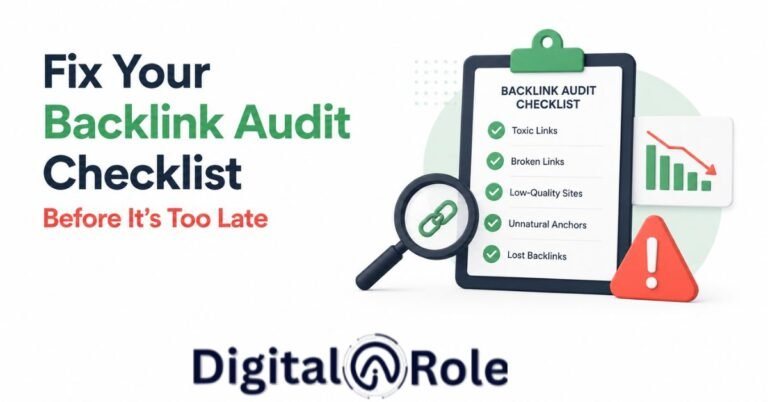
Do it gradually: send 5 personalized pitches this week on just one competitor and run them through the best tools to find broken links in that competitor for link building that are mentioned in this guide. When you’ve got that first batch, grab the [Broken Link Audit Checklist] and [Outreach Tracker Template] to make that first batch a repeatable pipeline rather than a one-off win.