What Are the 3 Main Features of a Quality Backlink? Guide
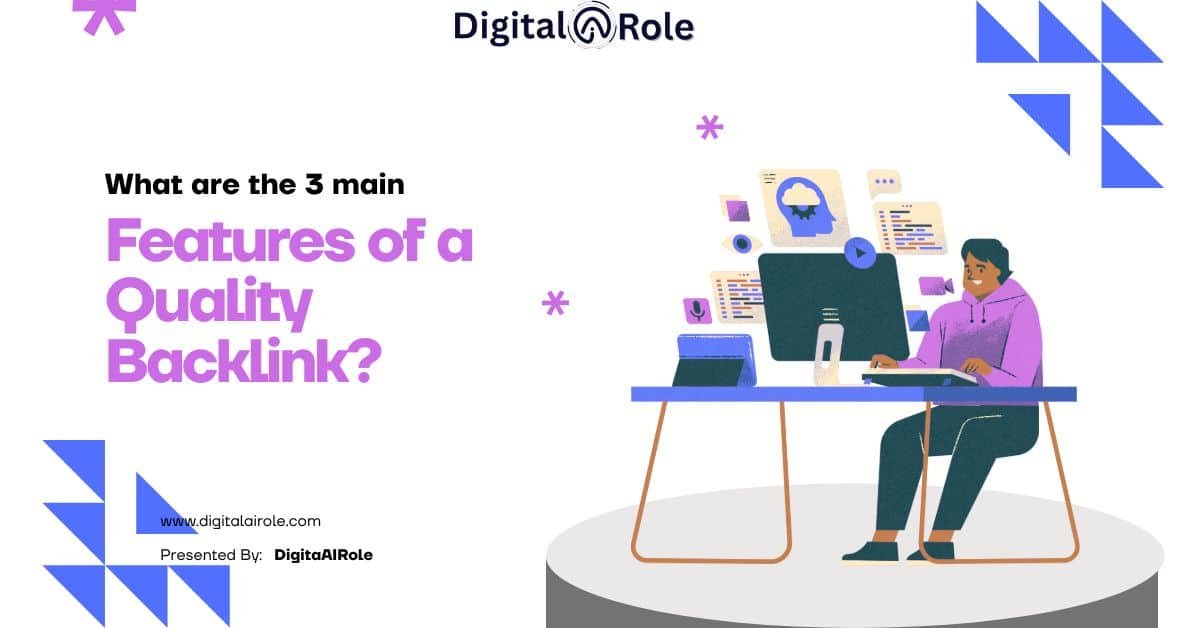
You’re building thousands of backlinks for your website, but it doesn’t show any rankings, or it gets worse. Abandon this strategy. Because when you build backlinks, focus on these 3 main features: relevance, authority, and natural editorial placements.
Google’s own guidelines reward link quality instead of quantity. Naturally earned backlinks are most favored by search engines and web admins. But sometimes you may not distinguish between quality and low-quality backlinks.
So, what are the 3 main features of a quality backlink? And why is this such an important part of SEO?. In this guide, I explain to you how to check backlink quality without any tools and link-building mistakes to avoid, which improves your overall backlink profile and website authority.
Key takeaways
- A Quality backlink is a natural editorial link that is earned from a trustworthy website and is topically relevant to the website that passes authority to the user website.
- The 3 main features of a quality backlink are contextual relevance, source authority, and natural editorial placement.
- Google prioritizes backlinks that fulfill the E-E-A-T criteria: Expertise, Experience, Authoritativeness, and Trustworthiness, rather than building links to manipulate rankings.
- Backlink quality always has more weight than quantity. Don’t chase more low-quality websites.
- Whenever you build backlinks, consider relevance, organic traffic, authority, anchor text, and their placement within the content.
- EDU and .GOV sites do not automatically increase authority. If it relates to your website niche, has organic traffic, and builds authority for you, then you take the link.
What are quality backlinks?
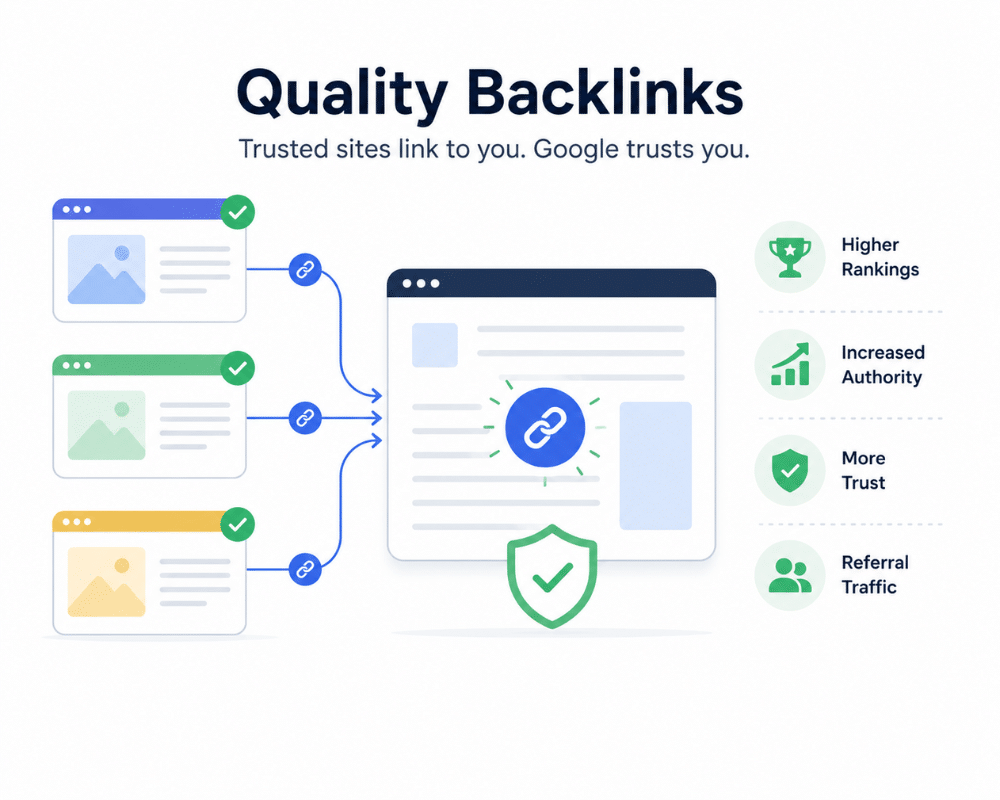
A quality backlink is an editorial link from a credible and topic-relevant site that brings value to the readers and naturally recommends your content.
While the days of a long string of backlinks building any kind of ranking are gone, many people believed that every backlink was a boon to ranking. The idea that the more backlinks you have, the better you will rank was not true for Google anymore.
You need to read the Quality Backlinks guide, which informs beginners about essential signals on how Google evaluates a backlink for website authority.
Google is not interested in the number of links that are linked to your site, but it is interested in what quality backlinks are. A backlink is similar to a recommendation. If your content is trusted and helpful to the reader of the site, the link is considered a good signal of trust and value.
How Google Actually Evaluates Backlinks Today
In today’s Google backlink policy, there are several ways they look at backlinks. Currently, Google assesses backlinks in a few different ways.
Google’s algorithms don’t rely on just one metric for backlinks, such as Domain Authority (DA) or Domain Rating (DR). Instead, they take several signals into account at the same time: topical relevance, the trustworthiness of the linking site, the context in which the link is included, and its naturalness. Links that are only set up for ranking purposes or those that are part of a link scheme may be disregarded or even be in violation of Google’s spam policies.
Backlinks as Trust Signals (Not Just Ranking Signals)
Imagine backlinks as endorsements of a professional reference, not just a vote. Backlinks that come from an existing SEO blog with a link to your study on link building have more weight than a hundred random links in the directories.
SEO statistics show that “a top-ranking website gains new follow backlinks from a new website at about 5%-14.5% growth per month.
Quality backlinks can also help bring referral traffic to your website, expose your content to new viewers, and strengthen the authority of your site in your niche. So they gain the confidence of their users and search engines too.
Quality backlinks are crucial for E-E-A-T
Google’s E-E-A-T content guidelines emphasize credibility, which means that sites that reliably convey the Experience, Expertise, Authoritativeness, and trustworthiness aspects are rewarded.
The editorial links, or links placed by editors of relevant and reputable sites, also give a boost to these signals, as it means that informed publishers found your article worthy of linking to. Google knows you’re a trustworthy source of information the more robust your backlink profile is.
The 3 Main Features of a Quality Backlink
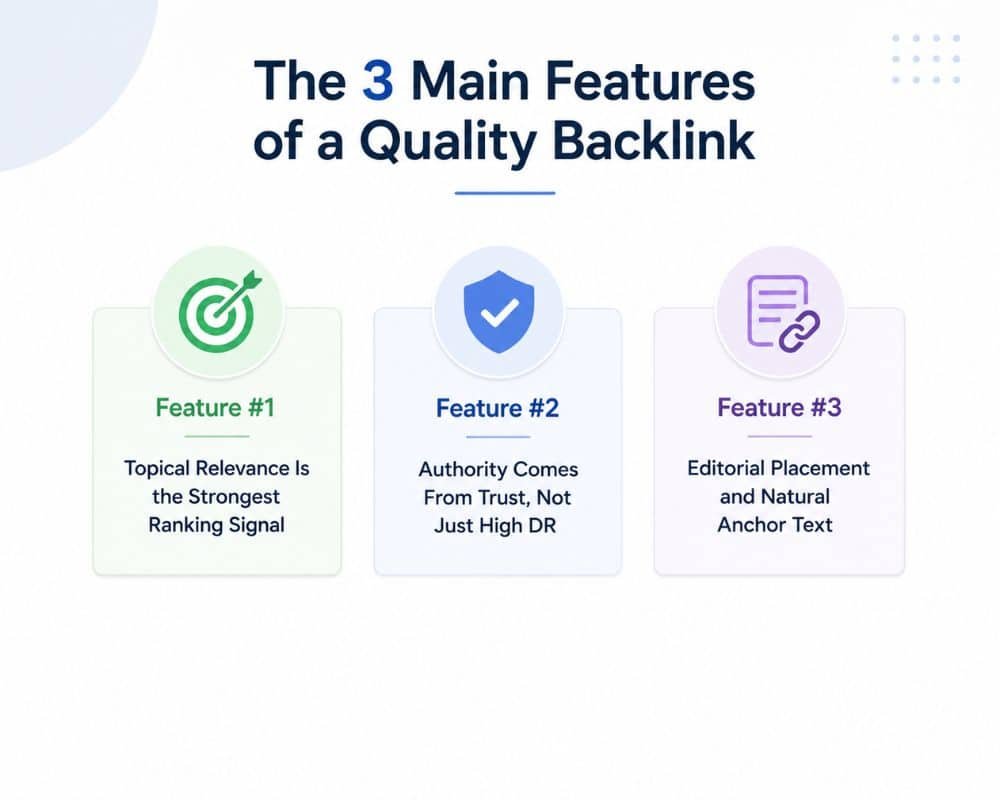
Not every backlink will be the same. An editorial link from a well-known site can be worth more in terms of SEO than hundreds of spam links. So, here is the checklist for quality backlinks. There are plenty of factors that can impact link worth, but there are 3 characteristics that always distinguish great backlinks.
Feature #1 — Topical Relevance Is the Strongest Ranking Signal
Topical relevance is a measure of how relevant the linking page is to the page with the backlink. The link is natural and useful to readers if it is linking to similar content on both pages.
For instance, if one blog that is dedicated to digital marketing links to your backlink audit article, you get a good link to a page that is related to SEO, which is what the links are about.
For example, if one blog that’s devoted to digital marketing links to your guide on backlink audits. You receive a great link to a web page, which is related to SEO, which is what the links are about.
Rather than a casino website that presents a link to the same guide, it is lacking in context and undermines the trustworthiness of the link. Google also takes into account the “contextual relevance,” meaning that the surrounding words of the backlink must align with the topic being referenced.
Likewise, semantic relevance analyzes the general message of the linking content to see if it matches your page, as opposed to page-level relevance, which looks at an individual article on your site instead of your domain. Last but not least, both sites are within the same niche relevance.
| High-Quality Backlinks | Low-Quality Backlinks |
| Health Blog → Health Guide: Both topics are related to each other | Health Blog → Online Casino: The topic doesn’t match. |
| SEO Agency → Link Building Guide: It considers natural connections for backlinks. | Cooking Blog → SEO Guide: It loosely matches the topic. |
| Finance Website → Tax Planning: Both industries are correlated and work together. | Fashion Blog → Cryptocurrency Exchange: In this case, the topics have no relevance. |
The more topically relevant the two web pages are, the stronger the trust signal that is sent to Google. Thus, obtaining backlinks from relevant websites should always be your priority.
Feature #2 — Authority Comes From Trust, Not Just High DR
A single characteristic of human nature makes it unfeasible to achieve high DR alone. There is one aspect of human nature that makes high DR unattainable.
A lot of marketers will think that if a website has a DR of 80, it’s automatically worth more than one that has a DR of 35. Actually, neither Domain Authority (DA) nor Domain Rating (DR) is a metric Google uses to rank pages. These scores are helpful estimates generated by SEO tools, rather than Google’s own scores.
Rather, Google assesses if a site has established a good reputation by providing customers with regular, high-quality content, real expertise, and trustworthiness for its niche.
The smaller of the two industry blogs might be able to pass more meaningful value than a site with lots of thin or unrelated content with a high DR.
Backlink authority is like the sum of a few signals:
Four components determine authority: Relevant Content, Trustworthy Reputation, Real Organic Traffic, and Editorial Standards.
To assess a backlink, you should ask yourself questions such as:
- Are articles posted on the website original and well researched?
- Is it getting its organic traffic? If so, is it consistent?
- What is its reputation in the industry?
- Would readers like to follow this link?
For instance, a DR 35 cybersecurity blog connected to your cybersecurity guide is more valuable than a DR 80 entertainment website, which is not related to the topic. When it comes to relevance and trust, it usually outweighs a high metric.
Feature #3 is Editorial Placement and Natural Anchor Text.
The location where a backlink is placed is as crucial as who is linking to you. Google values editorial links (links that are organically embedded within the main content) more than other types of links because these help users.
Make comparisons between these common link placements:
| Link Placement | SEO Value |
| Editorial link inside article content | Excellent |
| Contextual link within a helpful paragraph | Excellent |
| Sidebar link | Good |
| Footer link | Fair |
| Paid or sponsored link without proper attributes | Lowest |
Another good quality backlink should also be based on natural anchor text instead of forcing keywords within all links.
Examples include:
- Good: Google’s link spam guidelines;
- Branded: “Ahrefs”
- Partial Match: backlink quality checklist
- Over-Optimized: “best quality backlinks cheap” (avoid)
- Bad: “Click here”
A varied anchor profile is natural and mimics the way people reference valuable information on the web. If you over-optimize anchor text with keywords, this can look like keyword stuffing, which can lead to a diminished value of your backlink profile.
Beyond the 3 Features: The Signals Google Uses Before Trusting Any Backlink
While relevance, authority, and editorial placement are the basis for a good backlink, Google looks at a few other signals prior to placing value on any link.
1. Traffic of the Linking Page
Links from pages that attract genuine organic traffic will be more beneficial than links on pages that no one visits. Referral traffic also indicates that the link is valuable for users and not just for search engines.
2. Freshness of Content
Links from fresh, well-maintained pages are more likely to be relevant for a longer time than links on outdated or de-indexed pages. New content might represent up-to-date information and editorial control.
3. Outbound Link Quality
The more the pages are connected to many other sites that have nothing to do with this page, the less reliable the suggestions will be. Quality pages only use resources that are a good fit.
4. Link Position on the Page
A link that occurs naturally in the main content is more likely to be considered a natural link than one that is contained in a long list of resources, an author’s bio, a sidebar, or a footer.
5. The editorial context around the link
Not just the anchor text is looked at by Google, but the surrounding words and paragraphs as well. If there is any context behind the backlink, then it can help the search engines to understand the reason behind the backlink.
6. Dofollow vs. Nofollow vs. Sponsored vs. UGC
The nofollow, sponsored, and UGC (User Generated Content) attributes add context to the relationship between sites; dofollow links generally pass ranking signals. Google has long ignored the nofollow tag, even though it hasn’t been a hard-and-fast rule since 2019.
Nofollow shouldn’t be treated as a hard rule. Google has long ignored it when it deemed it suitable for use as a discovery or ranking signal.
Although dofollow links are important for a healthy backlink profile, it is important to understand that it is a combination of these attributes that makes up a healthy backlink profile.
Backlink Quality vs Quantity: The Future of High-Quality Links in 2026
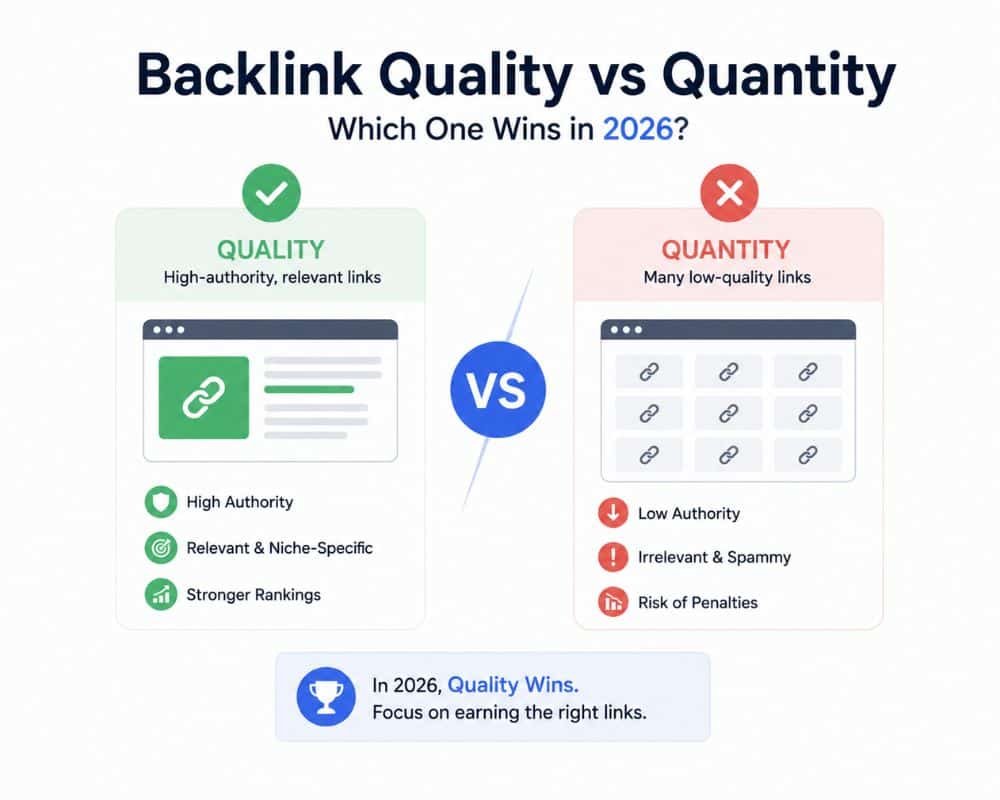
A survey conducted on the state of link-building among 500 SEO professionals, “62% now prefer to focus on quality over quantity links,” and “44.5% of digital PR has surpassed guest posting as the most popular method of gaining links.”
It’s consistent with what, for years, people have been saying: metrics such as Domain Authority and Spam Score may be helpful, but they are not the only ones used by Google to determine the value of a backlink.
But many resellers selling “50 high DA backlinks for just a few hundred dollars” are typically selling the kinds of backlinks Google would not care about.
Here I’m sharing with you a real case study on quality over quantity
1. Online clothing store website A
Meet Rohan, who launched his clothing store online. In 6 months, he built 50 backlinks because a reseller sells him per link for $30, which is cheap. But the quality and authority of the site are also cheap.
After a week, when he refreshed his ranking, he waited for millions of traffic, but his website was penalized by Google. Because of spam link building on directories, forums, and irrelevant high-DR websites.
Rohan chased quantity, not quality, so he faced worse and lost rankings and sales.
2. Skincare Website B
Meet Sara, owner of a skincare brand. She has no time to chase the quantity of backlinks, so she buid relationship with bloggers focused on digital PR, shares genius insights, and earns natural links by finding high-authority linking domains.
After months, she sees the real results because she invests in networking with industry who actually believe her content is worth it. She ranks in months, not overnight, which is the key difference in quality and quantity.
Rule of thumb
Ten relevant, high-authority links with natural anchor text placement that have organic traffic perform excellently in Google rankings instead of a hundred low-quality links. These types of links only create penalties and lower rankings for the website.
How to Check Backlink Quality: A 5-Point Framework
Don’t take one DA or DR score as a final saying; these scores can be made to look good if spammy links are pointing at a domain, and traffic can be faked by ranking on junk keywords. Here are the 5-point check that it really holds up:
- Relevance is the linking page’s overall topic really relevant to you?
- Authority starts with DA/DR, then looks past (see below).
- Is there real organic traffic to the referring page, or is it a ghost page that nobody reads?
- Where is the link (in body content or in a footer/sidebar)?
- Anchor text is it natural, or has it been constructed to target a keyword?
There is no need to create an enterprise budget to operate this. If you want to dig deeper, you can use Ahrefs or Moz to identify more authority and traffic.
But Google Search Console gives you a list of the people already freely advertising you. Do all five checks before you accept a placement or if you are pursuing one, before you invest time in reaching out.
Link-Building Mistakes to Avoid in 2026
The majority of site owners are not going to be penalized for just one bad link. They’re penalized for a pattern. That is typically the nature of the mistakes that form that pattern are avoidable:
- Purchasing links with nofollow and/or sponsored attributes, when the link itself is legit.
- Trying to buy Domain Relevance but getting a profile that looks good but actually accomplishes nothing.
- Having identical anchor text in many of the links leading to a site. Link profile with the same anchor text many, many times.
- Relying solely on guest posting as a link acquisition tactic and not the actual building of an audience.
- No consideration of existing profiles and ignoring old links that have become spammy, chain or PBN.
Conclusion
If you want to create a sound SEO strategy that will not get affected by Google’s algorithm changes, you must know what are 3 main features of a quality backlink are. As you now know, the best backlinks will have three fundamentals: topical relevance, authority, and natural editorial placement. These signals work together to help search engines decide if a backlink will carry over any trust and ranking value.
Don’t only use Domain Authority and Domain Rating when checking for quality backlinks. Rather, think of the general context like relevance, organic traffic, editorial standards, and anchor text. This way, you can effortlessly evaluate backlink quality before pursuing outreach or partnerships.
It’s worth noting that the debate of backlink quality vs. quantity is not as close as it once was. A few quality backlinks that are relevant and editorial will almost always be more effective in the long run. Meanwhile, common link-building pitfalls like purchasing links or link farms and excessive optimization of anchor text will reduce your authority in the long term and could lead to a penalty.
The key to the best backlink strategy is not to get as many links as possible, but to receive the right links. Make valuable content that people are truly seeking to reference, build relationships inside your niche, and focus on quality over shortcuts. This will help you build a backlink profile that will improve rankings, establish trust and help you achieve sustainable organic growth.