11 Link-Building Mistakes to Avoid in 2026
What if your bad link-building strategy is the main reason your website dropped rankings? Because many SEO specialists never understand this, Google’s spam detection doesn’t ignore the manipulative links once they catch any links that never give you any rankings and penalizes you.
30% of paid links are removed within the year; this is a harsh reality: not every backlink is equal for your website. That’s why understanding link-building mistakes to avoid isn’t optional; you bookmark them when you build a link-building strategy.
So in this way, you make a difference in your backlink profile, which compounds your authority, and bad ones trigger your rankings. In this article, I explain to you 11 link-building mistakes you need to avoid. In that way, it costs you high traffic and gives a credible vote, which builds authority and makes you a trustworthy site.
Key takeaways
- Focus on quality links: It’s better to have a handful of high-quality backlinks than a ton of spammy ones.
- Don’t use manipulative link building: Don’t use paid links, don’t use PBNs, don’t over-optimize with anchor text to avoid Google penalties.
- Earn links with valuable content, relevant websites, and a good balance of dofollow and nofollow links.
- Regularly check backlinks: Perform regular backlink audits to keep the site at optimum SEO performance, looking out for lost, broken, or toxic links.
- Do what Google does: user-focused, ethical link building based upon Google’s Search Essentials is the way to sustainable rankings and organic traffic.
Why does link-building still matter in 2026?
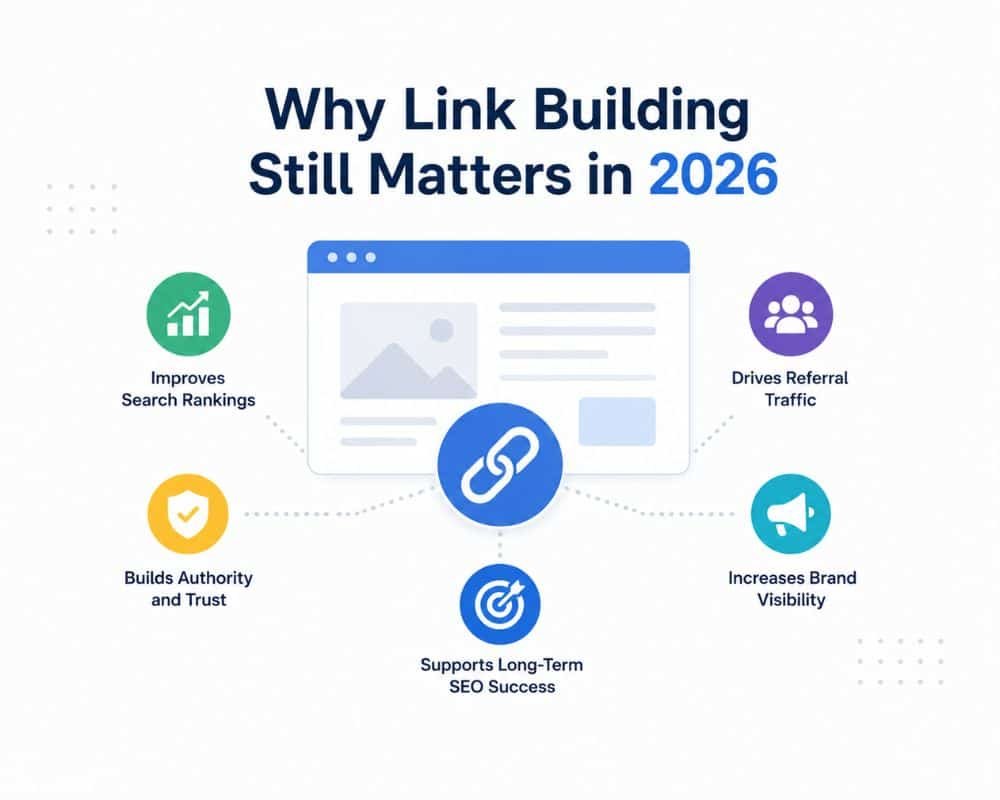
Even though Google keeps changing its algorithms and the search experience is being enhanced by AI, backlinks are still one of the best SEO ranking signals available. But Google’s link rating has changed drastically. Instead of just having a large number of links, relevance and quality are given greater weight today than trust
You need to focus on the main feature of quality backlinks: quality, relevance, and trust are more important in search engines today than volume of links. Your search rankings are going to be sustainable if your website gets editorially placed links that are relevant to the context of your website and are coming from authoritative sites.
If you want to avoid common link-building mistakes to avoid, it’s essential to understand how
Google evaluates backlinks in 2026.
Understanding how Google values link signals
Google uses several quality backlinks metrics to assess backlinks instead of just one. Knowing what these signals are helps you build links that can lead to long-term SEO success.
PageRank
Google’s original PageRank algorithm has evolved, but its essence is still the same. Links from trusted pages carry more weight than links from less trusted pages because they represent trust and credibility.
Link Relevance
Context matters. A backlink from a site in your niche will carry more weight than a backlink from a site that falls outside of your niche. Google looks at the relationship between the linking page, the content near the link, and your website to see if there is topical relevance.
Authority
Authority is an overall indicator of the credibility of the linking website. Links from a trusted or reputable domain will be more valuable for SEO than those from a new or lesser-known domain.
Trust
Google values links from websites that are considered to be expert, transparent, and reliable. Higher quality, clearer authorship, and positive reputation on secure websites mean that the trust signals will pass.
Natural Link Acquisition
Earned backlinks are the safest ones to have. Google will look down on websites that acquire links through bad schemes and automated link-building methods and will consider the real and sustainable methods to be better. Building links through original research, tools, case studies, digital PR, and having valuable content is the way Google expects to find links.
Helpful Content System
Google’s Helpful Content System complements its ranking systems to reward content that is “made for people. When it comes to earning authoritative backlinks, it’s important to publish valuable, original content. The key to building quality do-follow backlinks is to create high-quality and original content. If real problems are being solved within your content, authoritative websites are more apt to reference and link to it without the manipulation of any sort.
The 11 Link-Building Mistakes to Avoid in 2026
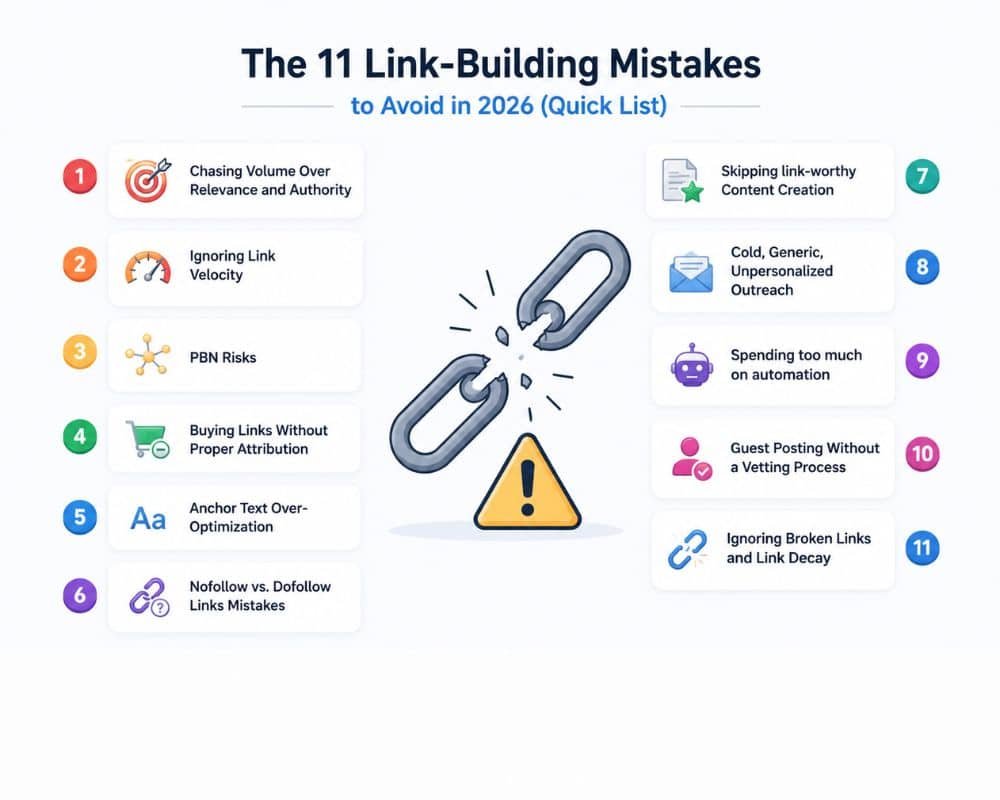
Link-building is a game of strategy that is performed with full focus, not randomly. So, whenever you make a plan for backlinks, analyze the backlink profile and audit it. Many non-experts make this mistake; they only focus on DR, not relevance.
Here I share 11 link-building mistakes which you need to avoid.
1. Chasing Volume Over Relevance and Authority
Link building in 2026 is not a game of quantity but of quality. It’s not about building as many links as possible, but about earning them by creating valuable content and practicing ethical SEO strategies that Google will appreciate.
If your link-building approach still begins with the question ‘how many links can we get this month’, then it’s time to turn the question around. But as Google’s own John Mueller has stated over and over again, it is not the quantity of links that matters, but the quality.
And a few links from sites that your audience already trusts will be more impactful than dozens of links from low-authority directories every time.
A single link from an authoritative industry site may be more valuable than fifty links from a link farm or other blogs. When considering adding a link to your outreach spreadsheet, ask yourself: would this domain be of interest to my real readers? If that’s negative, it’s not worth an outreach hour, much less the risk.
Put this relevancy backlink checklist to use before you ask for or get a backlink:
- Is the website relevant to your niche or industry?
- Does this page include content about things related to your topic?
- Does the website have real organic traffic?
- Will your content be helpful to the site’s users?
- Does the backlink fit into editorial content?
- Would you still want this backlink if Google didn’t count it?
2. Neglecting Link Velocity
While there’s no specific number of backlinks that triggers a Google filter, there is a pattern — a sudden and unnatural influx of links to a new or little-known website. If a site that has no backlinks for a year acquires 200 links in one week, it isn’t organic growth, and Google’s algorithms are programmed to see exactly that. Be aware of your outreach pace, and adjust it to the authority and content production of your site. It is a natural link a month for a new blog with 5-10 quality links, but it is not a natural link a month for a new blog with 100 links, even if all of them are legitimate.
Put this checklist to use before you ask for or get a backlink:
- Is the website relevant to your niche or industry?
- Does this page include content about things related to your topic?
- Does the website have real organic traffic?
- Will your content be helpful to the site’s users?
- Does the backlink fit into editorial content?
- Would you still want this backlink if Google didn’t count it?
If you responded “Yes” to most of the above, the site may be a good candidate for outreach. Focusing on relevant and high-quality backlinks will boost your authority and help you develop a natural backlink profile that fits Google’s ranking algorithms.
3. Using Private Blog Networks (PBNs)
Private Blog Networks (PBNs) are among the worst practices in link building that can be done to exploit the search results. While there may be some ranking boost with PBNs, they are against Google’s spam policies and, when caught, will result in significant ranking penalties.
Private Blog Networks, or PBNs, are a mysterious area of SEO that many people aren’t familiar with.
A Private Blog Network (PBN) is a network of websites that are designed to link back to another website for the purpose of gaining backlinks, but not for user value. These sites tend to feature old domains with established authority and publish inferior or filler content just to transfer the authority.
On the surface, they might seem like good backlinks, but they leave behind tell-tale signs that Google’s algorithms can spot.
Private Blog Network Risks (PBN Risks)
- Google’s non-action or devaluation of PBN backlinks.
- Rankings that have been lost due to algorithm changes.
- Manual actions for engaging in link schemes.
- Lost SEO investment in link-building that goes away.
- Long penalties are considered long recovery periods.
While PBNs might help to boost your SEO in the short term, in the long term, they can actually harm your ranking because of their unnatural backlink profile.
How Google Identifies PBNs
Google’s SpamBrain system is always monitoring backlink patterns for suspicious link building. It searches for the following indications:
- Multiple sites with links to the same domains artificially.
- Shared hosting, shared IP addresses, or shared ownership.
- Thin or duplicated content on sites.
- Repeated anchor text phrases.
- Rapidly increasing in poor-quality backlinks.
If these patterns suggest a link scheme, Google will most likely not rank the links. If these patterns suggest a link scheme, Google will ignore the links or lower their ranking value.
Manual Actions vs. Link Devaluation
Manual penalties are not applied to all sites with PBNs. Google often devalues the backlinks, meaning they don’t pass any authority in many cases.
If Google’s reviewers find that a website is involved with a large-scale link manipulation program on purpose, it could get a Manual Action, which could result in a dramatic drop in ranking until the problem is corrected.
If the link is oriented toward ranking, and it isn’t useful to anyone, it is a liability, not an asset.
Prioritize getting editorial backlinks from:
- Digital PR campaigns
- Guest blogging on popular sites
- Original research and industry reports
- Find any resources and tools that are link-worthy
- Relationship-based outreach
These techniques now meet Google’s Search Essentials and are sustainable.
4. Buying Links Without Proper Attribution
Purchasing hundreds of affordable links can be looked at as a shortcut to ranking higher; nonetheless, it is one of the costliest link-building errors to stay clear of. Buying backlinks costs you $509 per average backlink, which means you need a large budget to buy backlinks. “Only 6.6% of websites rank after the 2024 Google Spam update.”
So the conclusion is this: you buy links, but from credible websites that have relevant past authority, and they’re only acceptable when they’re labeled “sponsored” for ads.
The worst sources for inexpensive backlink packages can be websites with automated content, private blog networks, directories of poor quality, or link farms with minimal SEO benefits.
Google has deemed purchasing links with PageRank a violation of spam policies. Not all paid links lead to a penalty; many are ignored, and so you’ve paid for links that generate no measurable value.
Try to stay away from backlink offers like the following:
- Fiverr backlink gigs
- Link-selling marketplaces
- Automated backlink software
- Low-quality blog networks
- Spammy web directories
- Link farms
This is why these services are more about quality than quantity, and they often give you backlinks from quality and relevant websites.
Quality backlinks are more time-consuming and costly, but they last for years! For example, spam detection systems by Google may result in the extinction of “cheap backlinks,” or they value them less and make them dangerous.
A good rule of thumb is that if a backlink package guarantees hundreds of links in just one day, it’s likely a scam.
5. Anchor Text Over Optimization
Another top anchor building error to prevent is anchor text over-optimization. Anchor text helps Google to gain insight into the content of the linked page, but if it contains the same keyword-rich anchor text too often, it can appear manipulative.
For instance, if all links to your page include the same anchor text, “best SEO agency,” Google might think that you’re trying to manipulate your page’s ranking.
Anchor text can appear in various forms. Anchor text can be in a number of different forms.
Having a diverse mix of anchor text in a healthy backlink profile.
Branded: Company/Website Name.
Use generic text: “Click here,” “Read more,” and “Visit this page”.
Partial Match: Has some portion of the target keyword in the content.
Topical: Relates to the topic but doesn’t necessarily use the exact term.
Exact Match: Contains the exact target keyword.
Natural diversity is one of the best methods to determine whether backlinks have been earned or manipulated.
The following anchor text distribution is recommended, as per the curriculum guidelines:
| Anchor type | Recommended share |
| Brand Anchor | 40% |
| Generic Anchor | 20% |
| Partial Anchor | 20% |
| Topical Anchor | 15% |
| Exact Anchor | 5% |
These percentages are not Google’s guidelines but are commonly believed to be good practice for having a natural backlink profile.
It shows when the anchor text is over-optimized. It indicates if anchor text is over-optimized.
Look out for the following warning signs:
- Most of the backlinks contain the same keyword.
- Your backlink profile is dominated by anchor text that is identical to your keywords.
- Anchor text is unnatural in sentences.
- Multiple websites have the same anchor text.
- Backlinks are generated on pages unrelated to the site’s content with anchor text that is full of keywords.
Use natural anchor text to link pages and boost your rankings. Use natural anchor text for linking pages and improve ranking.
To avoid over-optimization:
- Make sure that you use branded and natural anchor text.
- Use different types of anchors for different campaigns.
- Match anchor to the context.
- Think of readability rather than keywords.
- Allow publishers to select anchor text as appropriate.
6. Nofollow vs. Dofollow Links Mistakes
The biggest nofollow vs dofollow links error is to believe that nofollow backlinks are not SEO friendly. Although dofollow links have the benefit of passing PageRank, it’s important to keep in mind that nofollow links can also play a role in a healthy backlink profile and indirectly benefit SEO efforts.
Google implemented its Hint System in 2019, where the `rel=”nofollow”` directive is being treated as a hint instead of a hard rule. This could mean that Google will take into account nofollow links during its web crawling, indexing, and relationship analysis between sites.
Why Nofollow Links Still Matter
A natural backlink profile will have a range of link attributes. A nofollow link passes referral traffic and brand visibility and gets cited as a result in AI overviews, which means it takes these as a strong trust signal and does not ignore them.
Not following nofollow links could be an avenue for further visibility, apart from standard SEO.
The advantages of nofollow links.
- Generate targeted traffic from authoritative websites.
- To boost brand awareness and online credibility.
- Enhance your backlink profile’s diversity.
- Enable your content to be found and cited in AI-driven search experiences.
- Leave the doors open for future editorial backlinks.
For instance, if you obtain a nofollow link from a web link powerhouse such as Forbes or Wikipedia, you can get thousands of visitors to your site even though it doesn’t convey the typical link juice.
Search engine crawlers follow some links; others areSearch engine crawlers follow some linkswlers, others are not.
| Attribute | What It Signals to Google | Passes Link Equity? | Best Use Case | Real-World SEO Value |
|---|---|---|---|---|
| Dofollow (default) | Full editorial endorsement | Yes | Earned, organic mentions in articles and guides | Highest — passes full ranking signal |
| Nofollow (rel=”nofollow”) | “Don’t automatically trust this “link” is treated as a hint, not a hard rule | Not directly, though it may still be considered | Blog comments, forum posts, unverified or user-submitted content | Indirect referral traffic, brand visibility, AI-answer citations |
| Sponsored (rel=”sponsored”) | Paid or compensated placement | No | Paid partnerships, sponsored content, affiliate links | Compliance and referral traffic protects you from manual actions |
| UGC (rel=”ugc”) | User-generated content | No | Comments, forum posts, reviews | Low direct SEO value, but keeps your profile compliant |
Best Practice: Concentrate on gaining a balanced amount of dofollow and nofollow links rather than solely pursuing dofollow backlinks. Having a diverse backlink profile makes Google’s ranking algorithm look at it more favorably.
7. Skipping Link-Worthy Content Creation
Whether it’s a top-notch outreach campaign or not, you won’t receive backlinks if your content doesn’t provide value. One of the most common link-building errors to avoid is creating content that doesn’t provide any reason for people to link to it.
People connect to content when it benefits their audience, not when you ask them to connect to it.
Backlinks are earned because of content.
Backlinks will come to high-quality content by itself if it is
- Original and insightful.
- Based on facts or studies.
- Practical and actionable.
- More thorough than other pages.
- Easy to cite for other articles.
Rather than produce content for search engines, focus on creating resources that will actually solve real problems.
Certain content formats attract backlinks.
Some of the most link-worthy assets are the following:
- Original industry research
- Statistics pages
- The templates and checklists are absolutely free!
- Free SEO tools or calculators. Free SEO tools or calculators.
- In-depth case studies
- Infographics and visual guides are available.
These formats bring a different value and are more convenient for journalists, bloggers, and publishers to reference.
To help you answer that question, here is a mini checklist to determine if your content is link-worthy.
- Ask yourself the following questions before publishing:
- Is this content unique?
- Does it address the same questions as other articles? Are original data, examples, and visuals included?
- Would I recommend this page to my website visitors?
- Is it an improvement on other resources for a specific problem?
If the answer to several of these questions is “No,” make the content as good as possible before beginning outreach.
8. Cold, Generic, Unpersonalized Outreach
However, outreach is still one of the best ways to get editorial links, and sending out mass emails utilizing mass templates is one of the fastest methods to be ignored—or marked as spam.
Quality of links over quantity.
The first one is that personalized outreach works. Backlink statistics data found that “there is an 18.2% chance to open personalize e-mail.” The first is that personalized outreach works.
There are dozens of outreach emails that editors and website owners get daily. The key thing about personalized emails is that they show that you care and they tell your audience why they’re worthy of your emails.
Effective outreach includes:
- Making a personal reference to the recipient.
- In a recent article published,
- Describing how your resource is of value.
- Being brief and courteous in the message.
Email reputation is a top priority that you don’t want to overlook.
Before starting outreach activities:
- Use SPF, DKIM, and DMARC for domain authentication.
- Slowly activate new email addresses.
- Don’t send hundreds of emails the first day.
- Track bounces and spam complaints.
Example Outreach Email
Thank you for your technical SEO guide; it was a great read.
Hi Sarah,
I just read your article on technical SEO and was particularly impressed with the section on crawl optimization. In our recent post, we’ve updated our guide on common link-building pitfalls, providing new examples and useful checklists to follow. I wonder if it would be useful for your readers if you ever update the article. Whatever the case, it’s good to see you continuing to produce quality content.
Best regards,
[Your Name]
9. Spend too much time on automation.
While AI can revolutionize link building, excessive automation can lead to a robotic approach and harm your brand’s reputation.
Don’t automate relationships; keep them.
Risks of Over-Automation
- Excessive use of AI can lead to:
- Generic outreach emails.
- Incorrect personalization.
- Low response rates.
- Spam complaints.
- Missed relationship-building opportunities.
Google likes real relationships and real “backlinks” as opposed to getting links automatically.
When Automation Is Appropriate
- Finding prospect websites.
- Tracking outreach campaigns.
- Monitoring backlink status.
- Scheduling follow-up reminders.
- Organizing contact lists.
Review AI-generated emails before sending to make sure that they are natural and personal.
10. Guest Posting Without a Vetting Process
“Guest posting SEO” is the term used for optimizing a website by including other people’s links and content.
Guest posting is still effective—just when done correctly.
It’s not the act of guest posting. The issue is publishing on low-quality websites just for backlinks.
BuzzStream indicates that only about 1.37% of guest posting opportunities will be of good quality editorial value. In contrast, the large majority of low-cost mass-produced guest posting sites will have negligible SEO value and may be devalued by Google’s search algorithm. That is why it is more important to build quality, relevant, and editorial links than just guest post links.
Google has threatened to penalize such widespread “link-building” style guest blogging on numerous occasions.
Analyze opportunities for guest posts. Consider guest posting opportunities.
Ask yourself:
- Does the site have original content?
- Is the audience interested?
- Is it genuine, natural traffic?
- Do editors make regular submissions?
- If there were no backlinks, would you still write there?
If the majority of the answers are “yes,” it probably is a good opportunity.
11. Forgetting to deal with Broken Links and Link Decay
Many people think that backlinks are permanently attached.
They don’t.
Around 66.5% of links are lost over the course of nine years, according to research done by Ahrefs, which shows a long-term effect of link decay on SEO performance.
Why Links Disappear
- Pages get deleted
- Businesses rebuild their websites. Organizations restructure websites.
- Redirects break
- Domains expire
- Content gets updated
- Remove references to the site owners.
Hidden cost of link removal
Imagine you spent:
100 hours on outreach
$2,000 on content creation
Earned 120 backlinks
When two-thirds of these backlinks are gone over the years, you may not earn much return in the long run unless you are aware of the process and take proactive measures to recover links.
Monitor Your Backlinks Regularly
- Develop a monthly maintenance schedule:
- Use Ahrefs or Semrush to find any missing links on your site.
- To keep an eye on any 404 errors seen in Google Search Console.
- Restore deleted page(s)
- Redirect lost links.
- Recover lost links.
- Let publishers know if valuable links are lost
Regularly update out-of-date content to maintain relevance of backlinks
Conclusion
These are the ways to avoid link-building mistakes and prevent your website from dropping in ranking, wasting your outreach efforts, and even getting penalized by Google. The best approach to go with is to ensure that the content you create is high-quality, relevant, and trusted and that it earns backlinks.
That includes not over-optimizing for anchor text and knowing what PBN risks are and how to fix some of the most common nofollow vs. dofollow link mistakes before they take a toll on your backlink profile.
Invest time in relationships, content that warrants links, multiple anchors, and link tracking. Google values websites that gain authority organically through valuable content and ethical SEO methods.
To achieve more sustainable rankings, more organic traffic, and a backlink profile that will hold up to future algorithmic changes, it’s time to begin auditing the links today. The sooner you correct these errors, the sooner you’ll set up a more secure and solid SEO basis.