9 Red Flags to Avoid When Buying Backlink Services
Buying backlink services is one of the highest-leverage moves in SEO, but it can be a waste of money because you choose the wrong service provider. One bad backlink can undo 2 years of work by wiping out your organic traffic overnight.
Earning and buying links can make a difference because when you rely on someone else to buy links, they may give you a link from a dead domain, and Google may flag your website as spam and de-rank it.
The market is full of SEO backlink building services with unbelievably low prices for high-demand websites that guarantee you’ll rank on Google and advertise you on high DA/DR websites, but place irrelevant links.
Whenever you hire a backlink service for your website, always check their previous link-building profile. The biggest red flags include guaranteed rankings on Google, private blog networks, irrelevant links, automated link placements, fake website metrics, over-optimized anchor text, hidden publishers, and poor reporting.
In this article, I guide you on how to hire a good backlink service provider that delivers quality, beneficial backlinks, because not all service providers are scammy. You’ll learn to identify unreliable providers and evaluate high-authority, white-hat backlink strategies that prioritize relevance, transparency, and sound SEO practices.
What is an SEO backlink service?
An SEO backlink service is provided by an agency or freelancer to earn a quality link from a high-authority website, improving your search visibility, driving organic traffic, building credibility, and strengthening your SEO performance.
Backlink services are useful for
- New websites that need a backlink profile.
- Blogger needs for their blog backlinks with zero authority.
- Businesses looking to increase their search visibility.
- E-commerce businesses because they need Google search customers.
- Agencies who need link building support for their clients.
Typical services provided by a backlink service
- Audit and strategy: The provider reviews your existing backlinks, niche, and competitors’ links. From there, they decide how many links to push, which pages to target, and what quality of sites to pursue.
- Prospecting: They create a list of sites they want to link to. They create a list of sites they want to link from. A good provider will narrow down options based on relevance to your content, organic traffic, and domain strength (DR/DA).
- Content creation: Guest posts and PR articles/writings are those written by them. Some service providers offer this separately.
- Outreach. They email site owners, editors, and journalists, negotiate placements, and follow up. This is the longest and most time-consuming aspect and is what makes people hire a service
- Link placement. The link activates on the other site, preferably as a contextual (in-body text) and dofollow link.
- Anchor text planning. They use variations of the text you can click on (brand name, bare URL, topic keyword, generic phrases) such that the link profile looks natural.
- Reporting. You will be given a report for every live URL that you submit, including the metrics, anchor, and date placed. Many providers send reports once per month.
- Guarantees and support. Some replace links that are removed from the page or are deindexed within a specific time frame (usually 6-12 months).
Types of backlink services
| Service type | What you get | Typical quality | Typical cost | Best for |
| Guest posting | Article written and published on a third-party blog with a link to you | Medium to high | 100–500+ per post | Steady, topical links |
| Link insertion (niche edits) | Your link added into an existing, indexed article | Medium to high | 50–400 per link | Fast results from aged pages |
| Digital PR | Studies, data, or stories pitched to journalists for news coverage | Very high | 2,000–10,000+ per month | Brand authority, competitive niches |
| Broken link building | Replacing dead links on other sites with your content | High | 100–300 per link | Sites with strong resource content |
| Resource page outreach | Getting listed on curated “best resources” pages | Medium to high | 100–300 per link | Tools, guides, educational content |
| Competitor gap analysis | Finding sites that link to rivals but not you, then targeting them | Varies | Often bundled into packages | Catching up to competitors |
| Local citations and directories | Listings in local directories and business profiles | Low to medium | 50–300 one-time | Local businesses (NAP consistency) |
| HARO and expert quotes | Getting quoted in articles through journalist requests | High | 300–1,500 per month | Experts and founders with real insight |
| Link audit and disavow | Reviewing existing links and disavowing spammy ones | Not applicable (cleanup) | 100–500 one-time | Sites with a penalty or a suspicious profile |
| Bulk or PBN links | Large numbers of links from low-quality or network sites | Very low | Very cheap | Generally avoid, with a high penalty risk |
9 Red Flags to Avoid When Buying Backlink Services
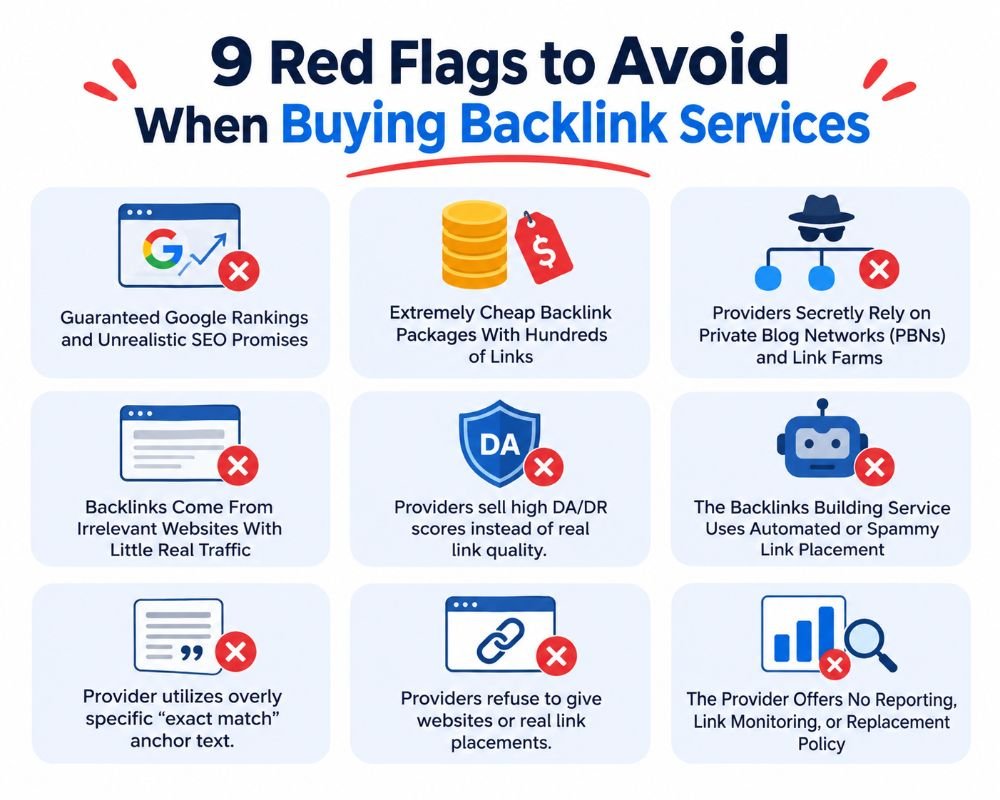
Not all backlink service providers are fake or scammers. Some focus on three main features of quality backlinks: relevance, genuine editorial placements, and source authority. 51% of SEO experts and link builders agree that relevance and content quality are among the three most important future link-building tactics, but spending £600 on link building every month.
Let’s look at the nine warning signs to watch for before buying a backlink package.
1. Guaranteed Google Rankings and Unrealistic SEO Promises
One of the primary red flags is a service that guarantees a specific Google ranking or promises to drive traffic up. An SEO strategy that promises to put you on the first page of Google in seven days or to deliver 10,000 backlinks in 24 hours may seem appealing but is largely unrealistic.
Factors affecting search rankings are content quality, website performance, competition, search intent, technical SEO, and overall website relevance. Search engines decide rankings, and even a good backlink can’t guarantee a specific ranking.
Another key distinction is that guaranteed link delivery is a one-time service. Another important distinction is that guaranteed link delivery is a one-time service. A provider can reasonably agree to place a certain number of links, but it is misleading to guarantee a specific ranking.
How to spot it: If they guarantee a fixed position, make sure their traffic projections are reasonable, and if they promise a backlink package can beat the competition, they are lying.
Instead, ask providers about their link acquisition process, ask for examples of campaign successes, ask for proof, and clarify exactly what they can guarantee. A good SEO backlink-building service should be transparent and not guarantee control over Google’s ranking.
2. Extremely Cheap Backlink Packages With Hundreds of Links
If you see offers like 500 backlinks for $10 or 5,000 links for $50, be wary. They may focus on quantity over quality and could be based on automated directory submissions, comment spam, forum profiles, or bulk-generated placements.
Unfortunately, more links aren’t always better for SEO. Low-quality links may not be seen by search engines, and some links may vanish if the website is taken down or the spam is pulled from the site. Buying hundreds of links with few, if any, editorial or referral properties can waste your money.
According to a 2025 survey of 821 link building professionals, the average price of a backlink was around $382. This is an industry standard; however, not a minimum price or an indication that a high-dollar backlink will count. Price depends on outreach, content development, publisher needs, and placement.
How to tell if it’s true: Ask the provider whether they will tell you where the links are coming from and how they can generate so many links at a low cost.
The alternative: Review the real work that’s being delivered for the correct price. Inquire about prospect research, personalized outreach, content creation, editorial placement, and reporting. A few good links may be better than thousands of dubious links.
3. Providers Secretly Rely on Private Blog Networks (PBNs) and Link Farms
Private Blog Networks(PBNs) are networks of websites that are owned and/or operated by a single entity and are typically designed to produce backlinks to target websites. Link farms are groups of pages or sites developed primarily to make links available for exchange or sale.
These networks are used by some backlink vendors to make their packages seem more worthwhile. They might show placements with high authority, but they will not disclose that the websites are mostly for search engine manipulation.
Beware of similar website formats, duplicate or substandard content, irrelevant topics, odd outbound links, and ownership/hosting patterns. A single sign isn’t enough to constitute a PBN, but multiple signs should be considered.
Google’s spam policies recognize link schemes that aim to manipulate rankings as an offense. It also has a system to detect and neutralize link spam, called SpamBrain. This suggests that links from manipulative networks may offer little lasting value.
An examination of 44,000 link-selling sites revealed that about a third of the links were gone after one year. This shows that domain placement is unstable, but it does not prove that all removed domains were penalized.
How to tell if it is genuine: Check the websites’ publishing history, content quality, outbound links, and apparent editorial independence.
How to do it: Ask whether the websites are owned by independent operators with real audiences and editorial standards. Don’t use providers who won’t tell you about their publisher network.
4. Backlinks Come From Irrelevant Websites With Little Real Traffic
Even if one site has impressive metrics, it can be a bad idea if its audience and content don’t connect with your business.
For instance, a skin care firm getting backlinks from gambling websites is unlikely to get any significant referral traffic. Likewise, a marketing agency might get little return from unrelated coupon directories, and a technology blog might not be able to defend link placement from low-quality lifestyle sites.
Topical relevance matters because a useful backlink should match the topic of the linking page. Genuine traffic also helps you tell whether a site has an audience that may find and visit your content.
According to a 2025 survey, 87.9% of link-building professionals rated relevance as a factor in determining backlink quality, and 70.3% rated website traffic. These findings indicate that professionals don’t rely solely on authority scores when evaluating potential placements.
How to find it: Look at the website’s main topics, traffic patterns, publishing regularity, and the surrounding context of the suggested link. Try to find websites whose visitors would be interested in topics related to your business.
The alternative: Focus on audience overlap, not a niche match. For example, a digital marketing agency is a good candidate for a relevant link from a business growth or entrepreneurship site.
5. Providers sell high DA/DR scores instead of real link quality.
Third-party metrics can help you gauge certain aspects of backlink strength, such as Domain Authority (DA), developed by Moz, and Domain Rating (DR), created by Ahrefs. They can offer some comparisons initially, but they are not an official Google ranking score.
Some providers boast that they place on websites with a DA of 80 or a DR of 90 to make their packages look impressive. But don’t expect to find usable content, organic traffic, relevant visitors, or trustworthy editorial standards on a site with a high score.
A domain could have strong backlink stats and still feature articles that don’t relate to the site, have bot-like traffic, or include too many outbound links. Your backlink matters, too, as certain pages are better than others. Not all content on a website is necessarily valuable.
According to the 2025 link-building survey, 71.7% of professionals consider the link’s authority, using metrics such as DA/DR. They also consider relevance and traffic to their websites.
How to recognize it: Don’t simply take the score at face value. Check out the connection page: its backlinking domains, natural traffic, content quality, and outbound links.
The alternative: Use DA and DR as an indicator, rather than a purchase criterion. Review the actual page that the backlink will be placed on and whether there is a logical reason for them to link it to your site.
6. The Backlinks Building Service Uses Automated or Spammy Link Placement
While automated backlink template sites can speed up a legitimate SEO campaign, they can be perilous when providers create backlinks as if they were spam.
These often include blog comments, forum profiles, directory submissions, poor-quality sites, or automatic links spread across many different websites. Some sellers also develop sitewide links in the footer or on the sidebar, which are seen on hundreds of pages of the site.
Their strategies are oriented to the generation of links, not relevant mentions. If automated link creation is meant to manipulate search engine results, it may violate Google’s link spam policies.
It’s crucial to differentiate between the legal use of SEO tools and spam automation. Software tools can help you identify prospects, organize outreach, monitor backlinks, and track campaigns. The concern is that automation can lead to unnatural placements at scale without human review.
Ask how it is done: whether placements are human-reviewed and whether publishers approve the content before publishing. If a provider doesn’t explain its process or only submits forms automatically, be careful.
The alternative: Choose a backlink-building service that combines effective research tools with human review, relevant website selection, and genuine editorial endorsement.
7. Provider utilizes overly specific “exact match” anchor text.
Anchor text: The clickable text used to link to another web page. It gives readers a good indication of what they might encounter if they click a link. But if you use commercial keywords as anchor text repeatedly on websites unrelated to your business, it can create an unnatural backlink profile.
A provider may say they’ll create 50 backlinks with the exact phrase “buy cheap backlinks.” Too many similar anchor keywords in the same location can suggest the links were created for SEO rather than for reference.
For branded terms, phrases, URLs, or page titles, a more natural backlink profile may include the same branded terms, phrases, URLs, or page titles in each placement.
Entered anchor, but suspect entering the wrong one.
| Suspicious anchor | More natural alternative |
| Buy cheap backlinks. | Brand name |
| Best SEO backlink services | Learn more. |
| Affordable backlinks in the USA | Relevant page title |
| Buy high DA backlinks. | Website or resource name |
How to check it: Check the suggested anchor-text plan. If the provider requires a duplication of exact-match commercial keywords in all placements, be careful.
The alternative you should do: Ask for a natural anchor text based on the linking text and destination page. Never deal with providers who guarantee a specific keyword ratio in their links or the same anchor text for all links.
8. Providers refuse to give websites or real link placements.
Buying backlinks is best done transparently. You can’t estimate what you’re paying for if the provider won’t tell you where your links will be on the page or show you some samples.
Some vendors use vague terms like “exclusive high-authority network” or “premium private websites” without offering proof. Other placeholders disclose the URL just after they receive payment.
This can make it challenging to ensure that the website is relevant, the content is great, it is visible organically, it has outbound links, and the placement is appropriate for your industry. You may end up paying for links that are of little value on low-quality sites.
How to avoid it: Request sample live placement URLs, publisher information, the pages they target, their suggested anchor text, and an explanation of their editorial process. Explain paid, sponsored, and editorial placements as well.
A provider should be able to show its methodology and examples and have reasonable grounds to protect confidential information shared by its clients.
What to do instead: Collaborate with providers that are willing to describe the process before or after publication and offer placement details, based on mutual agreement. Don’t pay on the word of someone who can’t prove their promises.
9. The Provider Offers No Reporting, Link Monitoring, or Replacement Policy
A backlink campaign shouldn’t be over when the backlink provider says it has published the links. Without appropriate reporting, you may not be able to determine whether the placements you were promised are current, meaningful, or directed to the right pages.
Some providers report partial or missing links, or they don’t confirm published links. Some don’t even provide support if a backlink is deleted, broken, redirected, or even changed after publication. A link could be unlinked, but that doesn’t necessarily mean the placement is useless.
Avoid case studies that claim to boost rankings without mentioning other activities undertaken on the website. Changes in competition, content changes, and technical enhancements can also affect performance.
Identifying it: Before paying, ask the provider how it reports completed placements, monitors link status, and handles link removals and changes.
The alternative: Instead, agree on deliverables, reporting, link retainability, replacement requirements, and returns before buying. Ask them to provide a final report that includes:
- Live backlink URL.
- URL that you wish to rank for.
- Linking domain.
- Anchor text.
Include confirmation that no qualifying rel attribute is present, or link attributes like nofollow, sponsored, or ugc.
- Publication date.
- Current placement status.
Good reporting lets you check whether you got what you paid for and whether the backlink campaign did the job you ordered.
Tips on evaluating SEO backlink-building services before purchase
When looking for SEO backlink-building services, consider the method used instead of package costs/DR. A dependable provider should clarify how they choose websites, arrange placements, and report on completed work.
Before you pay for a backlink, use a backlink quality checklist.
Use this checklist to assess each proposed backlink opportunity:
process?
| Evaluation factor | What to check |
| Relevance | Does the website serve an audience related to your niche? |
| Organic traffic | Does it attract genuine search visitors? |
| Authority | Are DA/DR metrics supported by other quality indicators? |
| Content quality | Does the publisher create useful, original content? |
| Editorial placement | Is your link naturally included in relevant content? |
| Anchor text | Is the anchor descriptive and natural? |
| Transparency | Does the provider explain its acquisition methodology? |
| Reporting | Will you receive verifiable live placement URLs? |
Ask These 5 Questions Before Purchasing Backlink Services
For any payments, inquire of the provider:
- Where do you identify and qualify websites? Ask for clear selection criteria for relevance, traffic, and content quality.
- Do you employ PBNs, link farms, or automated link building? Avoid services that use manipulative link schemes.
- May I see some sample sites and placements? Ask for examples to assess the publisher’s quality and relevance.
- What is your approach to sponsored links and the policies regarding link spam by Google? Where appropriate, paid placements should be qualified with rel=”sponsored” or rel=”nofollow”.
- What is the consequence of losing a backlink? Please check the retention period, replacement requirements, and refund policy before ordering.
Conclusion
When selecting backlink services, it’s not just about the cost or the DA/DR metric. Before investing, check the website’s relevance, organic traffic, content quality, editorial quality, anchor text, and the provider’s link-building techniques. Steer clear of vendors who guarantee top rankings, thousands of low-cost links, hidden links, or pleading with you to do some “manipulative” tactics like PBNs or automated link spam. Instead, focus on transparency, verifiable placements, and clear reporting. Keep in mind: the key to a successful backlink strategy isn’t the number of links; it’s relevance and value. Research providers thoroughly, ask the right questions, and invest in backlinks that support your website’s long-term SEO growth.