AI in Social Media Pros and Cons: Is It Worth the Risk?
AI can help you generate a week’s worth of social media posts in a fraction of the time, but it doesn’t automatically mean you’ll get more engagement or trust. Understanding the AI in social media pros and cons is essential for social media managers, small business owners, and content creators who want to grow without compromising their audience’s confidence.
The good news is that AI can help produce content faster, personalize suggestions, analyze performance, and answer common customer questions. Nevertheless, it also poses dangers such as misinformation, deepfakes, privacy issues, skewed algorithms, and a lack of originality and personalization. AI can make your brand sound robotic and weaken the human connection with customers.
So then, is it worth risking AI? Yes, when it is used to aid human creativity and decision-making. If you rely on it without checking it, securing data, or assessing content, it can be dangerous.
In this article, I explain the use of AI in social media, its pros and cons, and whether it is safe or risky for creators, as AI is now more powerful. After all, humans rely on it. Also discuss the pros and cons of AI chatbots in Instagram DMs.
Let’s dive into the pros, cons, and ethical applications of AI.
What is AI in social media, and how does it work?
AI in social media refers to using technology to understand and predict user actions, suggest interesting content, create posts, curate discussions, target ads, and automate customer service.
With the rise of AI, creators can earn money on Instagram. It has emerged as a solution to platforms’ need to offer users relevant content while helping businesses and creators manage social media more efficiently.
Once you understand how AI works, you will find it easier to analyze its advantages and disadvantages in social media and choose applications that support your objectives.
The common features of AI in social media platforms
Many aspects of social media are affected by AI, such as content discovery, creation, and engagement.
AI Recommendation Algorithms: Instagram, Facebook, and TikTok use AI-powered recommendation systems that prioritize feeds, Reels, and suggested posts based on signals that predict users’ interests.
AI content creation: Generative AI content creation tools can be used to generate content variations, write video scripts, create images, brainstorm post ideas, and write captions.
Social listening and analytics: AI can listen to users, gauge reactions, detect new trends, and measure campaign success.
AI moderation: AI tools identify spam, abusive language, and other potentially inappropriate content.
Chatbots and ad targeting: AI chatbots answer common questions, and ad systems use audience signals to help businesses reach relevant audiences.
These can save time and improve decisions, but they are only as effective as the data they process, the tools they use, and the oversight they receive. While AI can support social media marketing, it can’t guarantee the right recommendations, authentic interactions, or business growth.
AI in Social Media Pros and Cons
When you use a tool for a social media platform, they have two phases: one advantage and one disadvantage. So AI also has drawbacks in social media. Content creators use apps to make content, but platforms limit AI use because they don’t always have perfectly accurate information. Humans need to understand the pros and cons of using AI before and after.
What are the pros and cons of AI in social media?
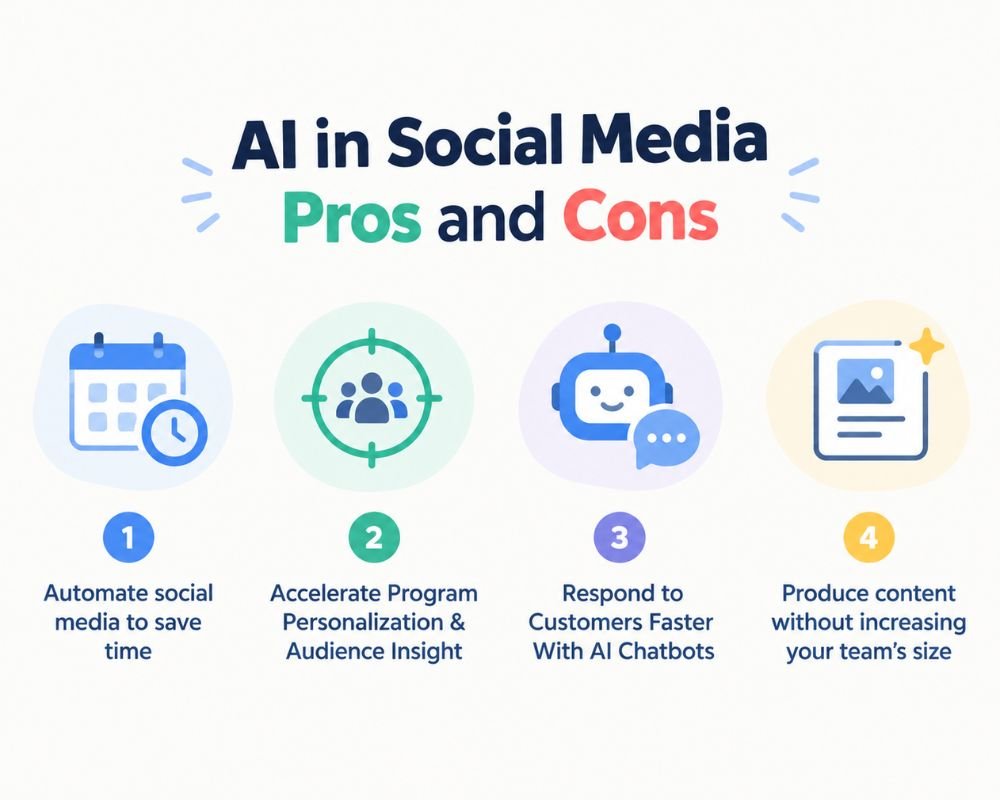
AI offers several benefits for businesses and creators looking to streamline social media management. The main advantages are saving time, better audience understanding, faster customer responses, and streamlined content production. But all these benefits are contingent on the use of AI within the current workflow.
1. Automate social media to save time.
Automation is one of AI’s most significant benefits for social media. Content ideas can be brainstormed, blog posts can be repurposed as social media posts, and AI tools can draft content captions, making them a great aid for scheduling content.
AI is most beneficial for research, brainstorming, content support, and personalization. This lets small businesses and social media managers save time on repetitive tasks and spend more time building strategy.
For instance, a small business can use a blog post to create multiple posts for Instagram, Facebook, and LinkedIn. Human editing will still be required to customize each version for their platform and audience.
2. Accelerate Program Personalization & Audience Insight
Marketers can use AI analytics to understand audience interests, engagement patterns, and content preferences. With these insights, companies can test out different formats, posting times, and messaging styles.
Personalization can make content more relevant to followers, but it should respect privacy. Companies should use appropriate data sources and avoid collecting or using sensitive information without proper consent.
3. Respond to Customers Faster With AI Chatbots
AI chatbots can answer common questions, provide product details, and direct potential customers to the right resources. They can also assist customers outside business hours and help keep small teams organized for inbound inquiries.
But not all automated responses are suitable, though. Any complaints, complicated purchase issues, and/or difficult conversations should be passed on to a human representative.
4.Produce content without increasing your team’s size
AI streamlines converting content into various formats and tailoring content for different audiences. Whether a creator needs to turn a video transcript into captions, pull out an article’s key points, or brainstorm a series of posts on the same subject, they can use the transcribe tool to get the job done.
Quality matters more than quantity. More content doesn’t necessarily mean more engagement. Human proofreading helps maintain the text’s originality, accuracy, and brand tone.
What are the cons and risks of AI in social media?
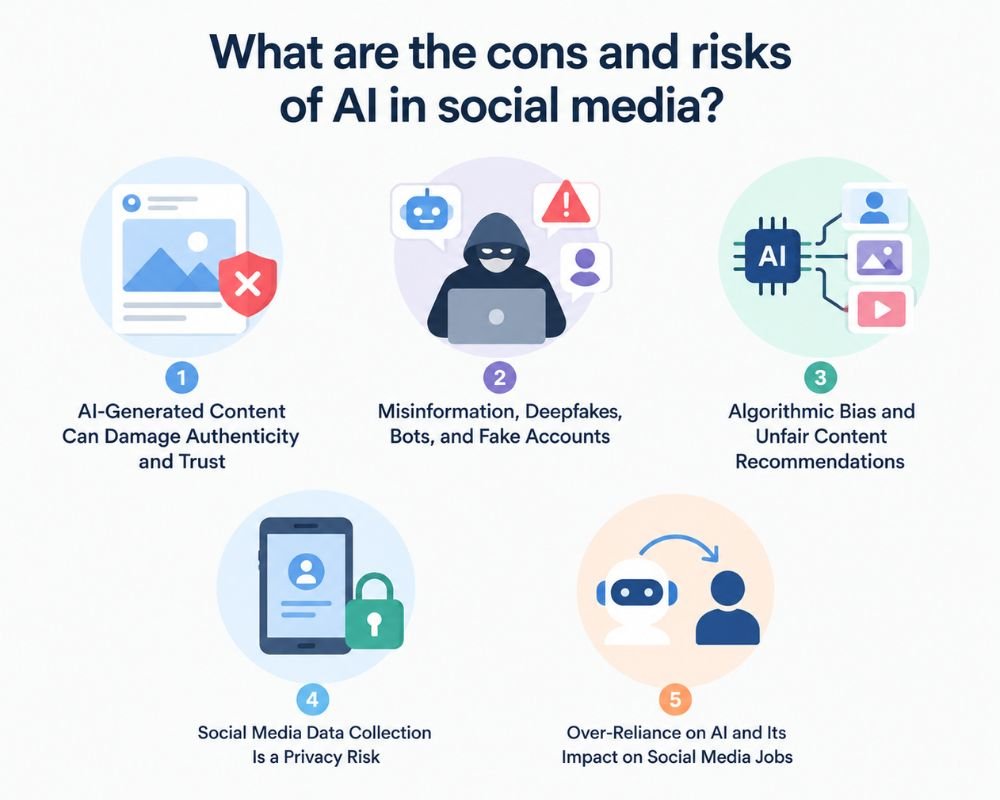
While AI has benefits, businesses and creators should understand the risks before widely implementing the technology. The most critical issues are content authenticity, misinformation, algorithmic bias, privacy, and over-reliance on automation.
1. AI-Generated Content Can Damage Authenticity and Trust
AI can generate captions, images, and replies quickly but often comes across as generic or repetitive. When a brand repeatedly posts in a similar style, followers may not recognize the brand or see the point of the posts.
An international safety report found that “AI makes a large amount of convincing content, which can manipulate public opinion and spread misleading narratives about any evidence.”
For instance, a ‘wonderful products’ general caption offers much less information. A more authentic post will describe an actual customer issue, the product’s role in addressing the issue, and a real-life example.
To minimize this risk, incorporate original experiences, customer insights, expert opinions, and brand-specific details into AI-generated content.
2. Misinformation, Deepfakes, Bots, and Fake Accounts
Generative AI can produce realistic-looking images, videos, and audio that misrepresent real events or persons. When shared without verification, this can spread misinformation and damage reputations.
A Sprout Social survey of 2,250 users found that 84% of consumers say AI-generated tools erode trust in news because they are often fake, and 34% say, “Stop the AI.”
Other issues include spam, fake users, and skewed engagement figures. Companies may report activity instead of real engagement when they rely on artificial likes, comments, or followers.
Businesses should analyze campaign results by audience segments (where available), review automated decisions, and offer users a way to appeal incorrect moderation or targeting results.
Check facts, figures, images, and sources for credibility before sharing AI-generated content. Do not impersonate and/or artificially engage to circumvent platform rules.
3. Algorithmic Bias and Unfair Content Recommendations
AI systems identify patterns in data and other signals. These systems can produce inequitable results if the inputs or system designs are biased.
For instance, a campaign may reach certain target audiences more effectively than others, or a moderation feature may misclassify acceptable content.
4. Social Media Data Collection Is a Privacy Risk
Most AI tools can ingest data, process it, and produce outputs such as content, behavioral insights, or customized customer interactions. Businesses often face conflicts when sharing sensitive data, granting too much account access, or not knowing how third-party services manage data.
Make sure to check the privacy policy, data retention, access controls, and legal considerations of an AI tool before using it. Do not type into the tool information that is sensitive, personal, or confidential to your customers or your business.
Responsible data handling helps to ensure that customers are protected and that trust is maintained in social media relationships.
5. Over-Reliance on AI and Its Impact on Social Media Jobs
While AI can handle repetitive tasks, overreliance can erode creative judgment and customer relationships. Without an automated content strategy, you could miss your content’s cultural context, fail to understand your audience’s concerns, or falter during a crisis.
AI is also transforming social media careers. Managers could spend less time writing day-to-day content and more time managing AI tools, analyzing metrics, ensuring brand tone, and strategizing.
Businesses should not view AI as a substitute for human skills but as a tool that complements and enhances human capabilities. Human accountability remains essential when making sensitive decisions, handling reputational issues, and communicating meaningfully
Pros and Cons of Using AI for Social Media Posting
Whether you’re using AI to enhance your social media posting or boost post volume, the advantages and disadvantages become clear. While AI can speed up repetitive tasks, it can also compromise your content’s uniqueness and quality if it isn’t properly edited.
| Benefits | Drawbacks |
| Faster captions and content ideation | Repetitive or generic writing |
| Consistent publishing schedules | More content without more value |
| Quick repurposing across platforms | Loss of platform-specific context |
| Faster creative experimentation | Inaccurate claims or unsuitable tone |
| Lower routine workload | Editing, verification, and oversight still required |
Should I Use AI to Write Social Media Captions?
Yes, you can use AI to write social media captions, but don’t copy and paste the generated text without thinking; use it as a starting point. Check all captions for accuracy, tone, originality, and relevance before publishing.
For instance, an AI-generated description for a skincare company could read:
Our amazing skincare products will give your skin the care it deserves. Shop now!”
Here’s what you should do if you have dry skin after you cleanse.
Edited human caption: “If you have dry skin after cleansing, here are some things to do.” Use a light moisturizer that doesn’t leave your skin greasy. Shop our skin care line to discover one that works for you.”
The second caption is more specific and more relevant. Do not use claims in product statements for which there is no evidence.
AI can speed up your writing process, but understanding your audience makes the content more valuable and trustworthy.
AI vs Human Social Media Manager Pros and Cons
By understanding the advantages and disadvantages of AI, manual, and social media management, companies can decide which tasks to automate and which still require human involvement. AI excels at generating options, processing data, and handling heavy workloads, while human managers add context, creativity, accountability, and relationship-building.
| Task | AI strengths | Human strengths |
| Content ideation | Generates options quickly | Understands cultural context and originality |
| Captions and drafts | Produces initial copy efficiently | Refines voice, emotion, and nuance |
| Analytics | Processes large datasets | Interprets business context |
| Customer support | Handles routine questions | Manages sensitive or complex conversations |
| Crisis management | Flags patterns and assists monitoring | Makes contextual, accountable decisions |
The Pros and Cons of AI Chatbots in Instagram DM
Instagram DM automation can benefit customer service when used correctly, but it can backfire if it isn’t. Among the pros and cons of using AI in social media, automated messaging is best suited for dealing with basic questions, while more complicated ones should be handled by humans.
AI chatbots in Instagram DMs can be beneficial for several reasons:
Improved response times: Respond to frequently asked questions about hours, shipping, pricing, and product availability without waiting for customers.
Lead qualification: Inquire with prospective customers about their needs and guide them to a product, service, or salesperson who can meet those needs.
Outside-hours support: Provide basic support when staff are unavailable so customers can find information outside normal working hours.
Pros of AI chatbots on Instagram DMs:
Incorrect answers: A chatbot can misunderstand a question or provide outdated product information.
Frustrating conversations: When users complain, discuss a sensitive issue, or request something unusual, automation may lack empathy.
Privacy and compliance risks: Incorrectly handling customer data or giving an automation tool excessive permissions can put your business at risk.
The bottom line is that automating simple responses is straightforward, but when you do, communicate clearly that you’re automating and provide a way for customers to contact a human. Check Instagram’s messaging guidelines, the automation provider’s permissions, and any data-protection mandates before putting it into practice.
Check facts, figures, images, and sources for credibility before sharing AI-generated content. Do not impersonate and/or artificially engage in order to circumvent platform rules.
Algorithmic Bias and Unfair Content Recommendations
AI systems identify patterns in data and other signals. These systems can produce inequitable results if the inputs or system designs are biased.
For instance, a campaign may impact certain target audiences better than others, or a moderation feature may misclassify acceptable content.
Frequently Asked Questions About AI in Social Media
Q1. What are the main pros and cons of AI in social media?
The main advantages of AI tools for social media include streamlined content creation, automated customer service, customised suggestions, and performance analysis. The disadvantages include misinformation, privacy issues, limited choice, reduced human interaction, and reduced originality. The best outcomes are achieved when artificial intelligence is supplemented with human judgment.
Q2. Should I use AI to write social media captions?
Absolutely, AI can brainstorm ideas, write captions, recommend hashtags, and tailor content for various platforms. Before publishing, however, make sure to check all of the captions for accuracy, brand voice, and relevance. Include personal anecdotes and audience-specific information to give the content a more genuine feel.
Q3. Does AI-generated content hurt social media reach?
Not automatically. Reach depends on audience interest, content quality, engagement, and each platform’s recommendation system. If it is, it may not do well if it’s low-quality, repetitive, misleading, or unoriginal, whether written by AI or a person. Do not publish too many auto posts; have useful and original content.
Q4. Can AI replace a human social media manager?
AI can handle repetitive tasks like post scheduling, answering common questions, summarizing analytics, and creating captions. But human social media managers are still crucial for creative strategy, community relationships, crisis communication, nuanced decision-making, and brand reputation. Generally, AI serves more as an assistant than a replacement.
Q5. What are the pros and cons of AI chatbots on Instagram DMs?
AI chatbots can answer common questions, respond quickly, qualify leads, and offer basic support outside office hours. But they can get confused, provide false information, or annoy customers who need individualized service. Businesses should offer a simple way to reach a human and take responsibility for customer information.
Q6. How can businesses use AI in social media responsibly?
Businesses should verify information from AI tools, review content including images and videos, safeguard customer information, ensure accurate results, and follow the platform’s guidelines. They should also indicate when content has been created or manipulated using AI software or tools when it is required or when transparency to the audience is needed. It is particularly important to review posts and public claims for sensitive content.
Q7. Is AI in social media worth the risk for small businesses?
Absolutely, AI can help small businesses with limited resources, especially for managing content and customer inquiries. Start with simple, lower-risk activities like brainstorming posts, creating captions, and analyzing engagement. Check outputs before publishing, listen to customers’ feedback, and only start automating if it yields a consistent increase in efficiency, without compromising quality or trust.
Conclusion
By weighing the pros and cons of AI in social media, businesses can make informed decisions regarding social media automation, content generation, and customer interaction. AI can handle repetitive emails, analyze performance, customize experiences, and save time. In the absence of appropriate regulation, these tools can have negative impacts on user trust if they are misused, such as by delivering misinformation, violating user privacy, using biased algorithms, and providing repetitive content.
Avoiding AI entirely and automating every process isn’t the ideal solution. Instead, enhance your workflow while keeping humans in charge of creativity, accuracy, customer relations, and key decisions. If you are wondering whether to use an AI social media manager or a human social media manager, or whether to use AI to generate Instagram captions and DMs, remember it is not all about quantity.
Ultimately, using AI for social media strategy is a gamble worth taking if it helps you create more effective posts,without sacrificing authenticity, transparency, or audience trust.