
9 Quick Google AI Overviews Content Optimization Tips

You’re spending hours writing, optimizing, and publishing content; it ranks on Google’s #1 page but doesn’t get clicks on your webpage. Because Google AI overviews give your audience answers without showing your content.
It’s frustrating when you put real expertise into your content, only to watch AI summarize it and take credit. Good news: you win visibility with Google AI Overviews content optimization tips, which demonstrate how to structure and write content so AI LLMs understand your context, intent, and conversational queries. Hence, they cite your content to the user.
In this article, I share content optimization tips to appear in Google AI Overviews. You earned Google’s trust that your content is reliable, credible, and supported by credible sources, and that it is written in clear, understandable language.
What Are Google AI Overviews and Why Do They Matter for Content Optimization?
Google AI overview is an AI-generated summary that appears at the top of the Google search page. It gives users answers in a precise, direct way, which discourages readers from clicking any web page results.
Google generates answers by analyzing multiple trusted pages that best suit the user and gives conversational, direct answers; it cites its results in the answer. When you create AI-optimized content that ranks, it’s a chance Google will show your site in its AI overview.
According to Google’s AI feature, its generative AI capabilities incorporate a method called retrieval-augmented generation, which is designed to ensure the quality, accuracy, and freshness of its AI responses by grounding them in real web content.
To recap, if you already have valuable, optimised text, then you’re already in contention for being featured.
The difference between AI Overviews and old-school featured snippets is that AI Overviews can be found on the search results page, provide direct answers, and rely on ranked websites, but they also work differently.
This move is important because now, before a reader ever even gets to the “ten blue links,” there’s an attention split. Google has highlighted that the adoption of AI Overviews has not taken away the ability for people to visit a wider range of websites for advice on more complicated queries — it’s just moved.
How Google AI Overviews Work to Generate Answers
Google AI Overviews leverage sophisticated AI to interpret the query of a user and obtain information from authoritative, high-quality web pages. When a user enters any query, an
AI overview appears for 47% of Google queries. Showing up here is significant because studies show that 68% of internet users trust AI overviews as much or more than organic Google search results.
The system doesn’t simply reproduce or plagiarize material verbatim from one source. Still, it can draw on various sources to identify key facts, gather insights from experts, and provide brief explanations to generate original responses. Content that addresses questions, demonstrates expertise, and uses logical headings is more likely to be considered for inclusion.
Why Traditional SEO Is Changing
Until recently, ranking on the first page of Google was the main objective of SEO. Rankings are still important, but Google AI search is changing how people find information. AI Overviews are now used to answer many search queries, thus eliminating the need to click through multiple websites.
This shift has made writing more challenging, as writers can no longer get away with just keyword optimization. They’re responsible for creating user-first, intent-focused content that is original and trustworthy, backed by credible information and genuine expertise.
What Google Looks for Before Including Your Content
Google isn’t selecting content for AI Overviews based solely on keywords. It focuses on pages that show Experience, Expertise, Authoritativeness and Trustworthiness (E-E-A-T).
Articles need to answer the user’s query as soon as possible, be comprehensive and complete, contain accurate, up-to-date information, and be easy to read.
Content with well-structured headings, brief paragraphs, fresh examples, and citations to authoritative sources will be more likely to be included in an AI-generated summary. Content marketing that emphasizes quality over quantity can be optimized to deliver results in both traditional search and Google’s new AI-powered search functionality.
9 Google ai Overviews Content Optimization Tips for Better Visibility
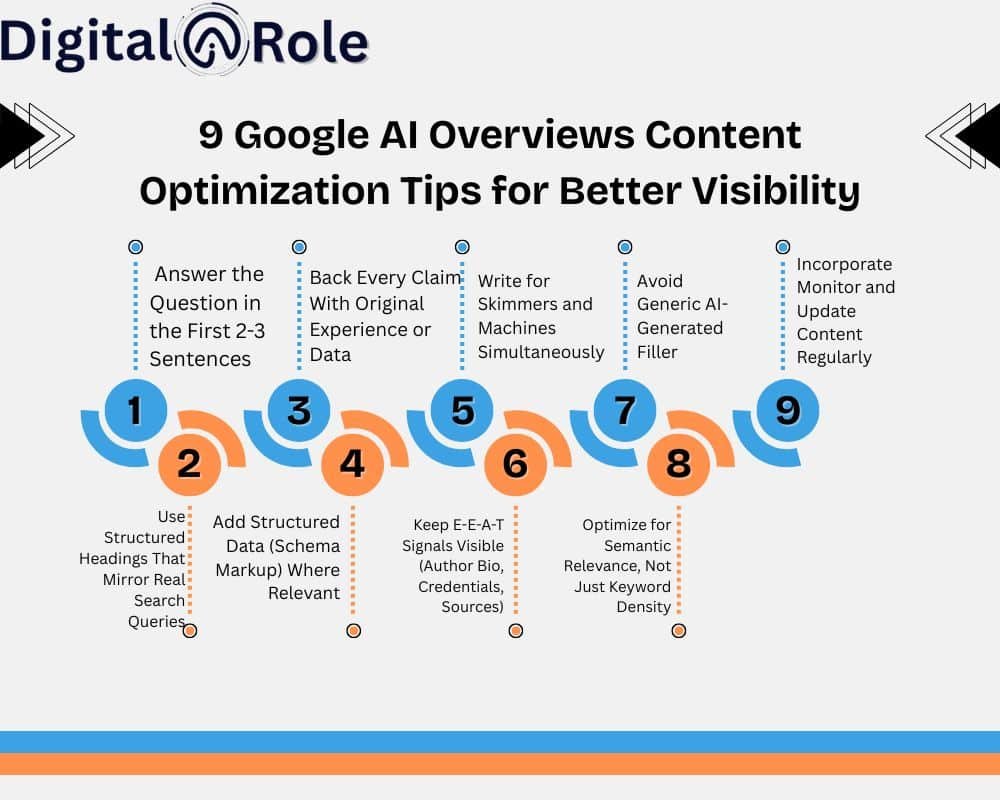
When it comes to Google ai overviews content optimization tips, you have to learn about creating AI-friendly content for feature snippets because AI overviews and feature snippets correlate with each other with minor differences.
So here I share my personal ai overview content optimization tips. When you implement them, your webpage will definitely be cited in search results.
1. Answer the Question in the First 2-3 Sentences
Make sure to pack your most important insight in the fourth paragraph, and you’re already finished. Write in a journalistic fashion using the inverted pyramid; begin with the answer, go into the “how” and “why” later.
But if someone is Googling the question, “how long should a meta description be,” your first sentence should be just that — not teach them a history lesson.
This is not only good writing or writing practice.
It’s the structure that AI Overviews thrive on. Because Google’s generative AI solution is built on a foundation of pre-existing, clear, and organized content, a solid “answer first” introduction helps provide the model with a clean foundation.
2. Use Structured Headings That Mirror Real Search Queries
Your headings should not only structure the post, but actually reflect the questions your reader typed into Google. Don’t use a generic H2 such as “Content Tips” but instead use “How Do I Optimize Content for AI Overviews?”. This slight change is one of the most effective ways to learn how to generate content that boosts their rankings in the AI-generated summaries, since you are literally formulating your page around the query itself.
Consider each H2 and H3 as a mini search result awaiting. If it sounds like a question someone might ask, then you’re on the right track.
3. Back Every Claim With Original Experience or Data
There are tons of generic pieces of advice. What is rare and what really earns trust is a claim accompanied by proof that one has personally tested, measured, or experienced. This is where a quality checklist helps you a lot. Both Google’s quality systems and Google AI Overviews prefer content that shows genuine expertise over talking points.
In terms of practice, the message becomes: “Engagement is better with shorter paragraphs, as studies demonstrate, but in my experience, short paragraphs led to a 22% increase in my average time on page on this exact post. Add screenshots. Use your own case studies as references—the only way to tell if a source is reliable or junk is by its specificity.
4. Add Structured Data (Schema Markup) Where Appropriate
Not only does the machine understand what it reads, it understands what it is. FAQ, HowTo, and Article are examples of schema. It cannot ensure that your page will appear in an AI Overview; however, it reduces friction for any crawler attempting to classify the page appropriately.
For a step-by-step guide, it’s worth the 10 minutes you’ll spend adding HowTo schema. Use your FAQ section (if you have one, be sure to have one) to get it marked up. Not much money to invest, but a huge amount to learn.
5. Write for Skimmers and Machines Simultaneously
Short paragraphs. Bullet points. Bolded key terms. Rather than being “SEO-y,” it is because both humans and AI extraction models are looking for the same thing: easily identifiable, self-contained pieces of information.
The key is to do this without sounding like a robot! You don’t write in fragments for the sake of it; you’re just cutting the throat. Eliminate sentences that don’t provide new information.
6. Make sure E-E-A-T Signals are visible (Author Bio, credentials, sources)
Would you believe a health statement that is anonymous and in a byline? Neither would Google. AI Overviews and the helpful content systems of Google both rely on elements of visible expertise—such as an actual author bio, credentials, and links to genuine sources.
Say you’re a SaaS marketing content writer with 5 years of experience. Link your LinkedIn. Quote the source(s) of your data. This isn’t vanity; it’s the trust layer that will persuade audiences and algorithms that your content is worth quoting.
7. Avoid Generic AI-Generated Filler
The harsh reality is that content that feels like it could be anywhere on the internet is not the most valuable, so users will deprioritize it. AI Overviews seek valuable, specific content. Red Flag Sentence: “In today’s fast-paced digital landscape”.
The first test: Read your draft out loud. If it sounds like it was written for a template and not for your actual reader, rewrite it. State the particular object. Name the particular tool. Provide a specific number.
8. Optimize for Semantic Relevance and GEO (Generative Engine Optimization)
Rather than repeating the same keyword phrase over and over, semantic SEO involves naturally writing around a specific topic, incorporating similar terms, answering related questions, and addressing the full range of information a user seeking this topic would like to learn.
Incorporate the long-tail keywords in your content because “57% of long-tail keywords appear in Google AI overviews“.
Do this with more sophistication using GEO (Generative Engine Optimization): Create sentence-level, standalone quotes and prioritize your facts to be “front-loaded” so that any generative engine — not just Google’s AI Overviews, ChatGPT, Perplexity, or Gemini — can pick up and deliver your facts accurately.
The good news? Again, Semantic depth and GEO-readiness are not two distinct tasks. Content organized in a way that addresses a topic well is much simpler to extract and cite.
9. Monitor and Update Content Regularly
Now more than ever, freshness is important. This is not only a ranking benefit but also a positive view by readers: Traditional rankings and AI Overviews both prefer content that aligns with the latest information, and dated statistics or dead links subtly tell Google (and readers) that a page is abandoned.
Develop a basic habit – check your best-performing posts every 3 months. Add anything new you learned since the book went out, update stats, fix broken links. It does not have to be an entire rewrite, but an indication that the page is being updated.
How to Create Content That Ranks Higher in AI-Generated Summaries
You may have observed a trend in these tips: they all require that you do not “trick” an algorithm in any way. That’s intentional. It’s not just about what you write to AI; it’s about what you write that AI can read — and only one of those will work in the long run.
Writing ‘for AI’ typically involves using methods that the tool says will lead to an AI Overview – keyword-stuffed headlines, robotic language, checklist-style content as opposed to reader-centric content.
With people-readable content, it goes the other way round: You draft a real answer to a real question, and then make sure that it’s well-formatted so that an AI can understand it.
This is directly supported by Google’s own advice: “The use of AI doesn’t provide content with any additional benefits, because it’s only content, and if it’s useful, helpful, original, and meets parts of E-E-A-T, it could perform well in Search.”
It’s the quality of the argument that will determine whether you are cited or not, not how you produced it.
The AI Overview Readiness Pre-Publish Checklist is a straightforward document that outlines the necessary steps to ensure a successful AI overview.
Before you publish, you should run your draft through this:
Answer-first intro: Do the first 2-3 sentences address the main question without any background or context?
Schema check: Where applicable, does FAQ, HowTo, or Article schema exist?
Is there a true byline with relevant experience or expertise linked?
Freshness date: Did you update or publish recently, and are the stats/links up to date?
Semantic breadth: Does the piece address similar questions and subtopics that a reader might consider pursuing next?
No filler: Does this paragraph contain any unnecessary or filler sentences? If yes, cut it.
Conclusion
Bookmark this list. Use it every time you’re attempting to publish, and you will always create content that is optimized for readers and AI Overviews, never for the algorithm.
AI Overviews are not to outsmart; they are a mirror. They’re produced in a fashion that’s aligned with Google’s incentives over the past few years, which is to provide clear answers, real expertise, and material designed for a real reader, not a search engine. If you have been following these Google AI overview content optimization tips, you have all you need: no gimmicks, no special schema hacks, just good writing a little bit better organized.
Before you move on, choose one of the posts you already have and check it for the above pre-publish checklist. There may be only one freshness update, or one added byline between your next AI Overview citation.