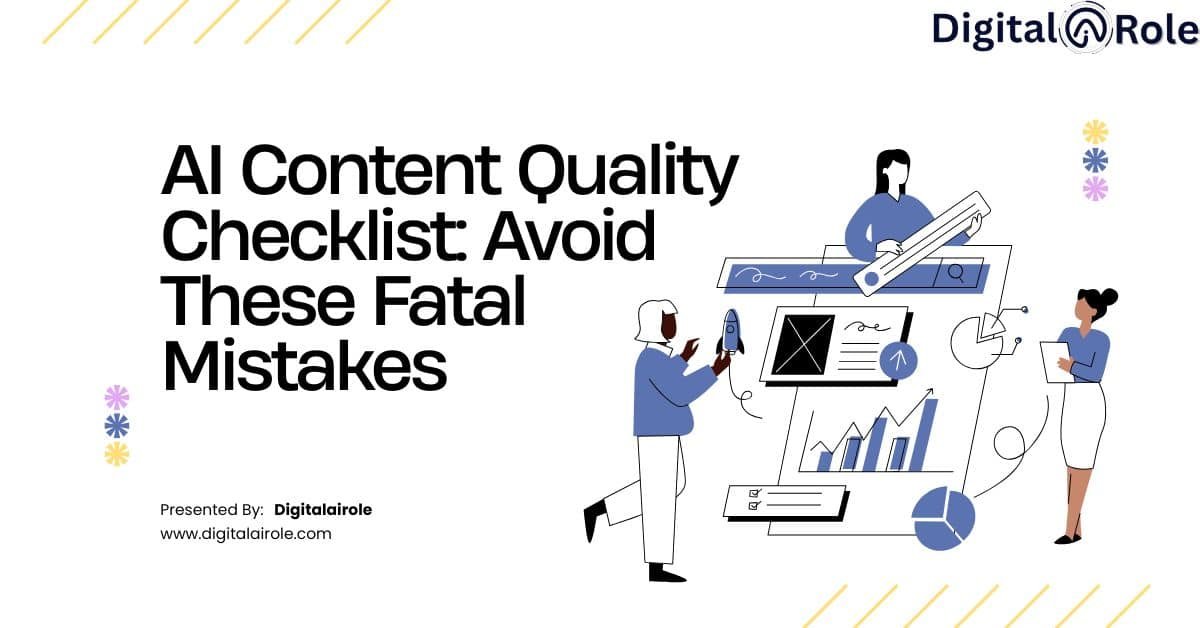
AI Content Quality Checklist: Avoid These Fatal Mistakes
As AI grows, writers incorporate it into their work; now they write full blog posts using AI models. AI models have data but not their own emotions and information. When a writer writes a full article using AI and hits publish, weeks later Google quietly tanks their rankings.
Because they’re not editing their content, this happens because you don’t focus on an AI content quality checklist.
Your grammar is correct; you optimize the content, humanize it, and use keywords in the title with proper structure. But under content, you’re not checking proper source claims, providing real insights, or following E-E-A-T guidelines.
AI models hallucinate, meaning they produce incorrect facts and statistics. Google’s quality system and readers spot it immediately, and Google de-ranks the content. This increases the bounce rate and crawl but is not an index issue.
If you’re a writer facing the same issues, you need to improve the quality of AI-generated content with an AI blog post quality checklist. In this guide, I explain the mistakes you make when publishing AI content without proper editing and fact-checking.
Why Most AI Content Fails Before It’s Even Published
AI content doesn’t fail because a machine writes its first draft. It fails because no one edited it in a meaningful way afterward, which it needs. When you create AI-friendly content, the problem is unedited AI content that you paste from the chat window into the CMS, fix simple errors, and publish.
This distinction is important as Google has been quite clear about it. In its official guidance on AI-generated content, Google Search Central has said that using automation or AI isn’t against its guidelines. What violates its spam policies is using automation primarily to manipulate rankings, regardless of whether a human or a machine produced the words. Whether or not you choose to use content, the same keyword standards will be met: Experience, expertise, authoritativeness, and trustworthiness.
The trick, though, is that AI fails E-E-A-T based on the quality of its training. It doesn’t work because it has a tendency to omit from the writing those things that are hard for you: substantiating claims, introducing something only you could know, and altering the flow of the prose. That’s the hole that this checklist fills.
The AI Content Quality Checklist
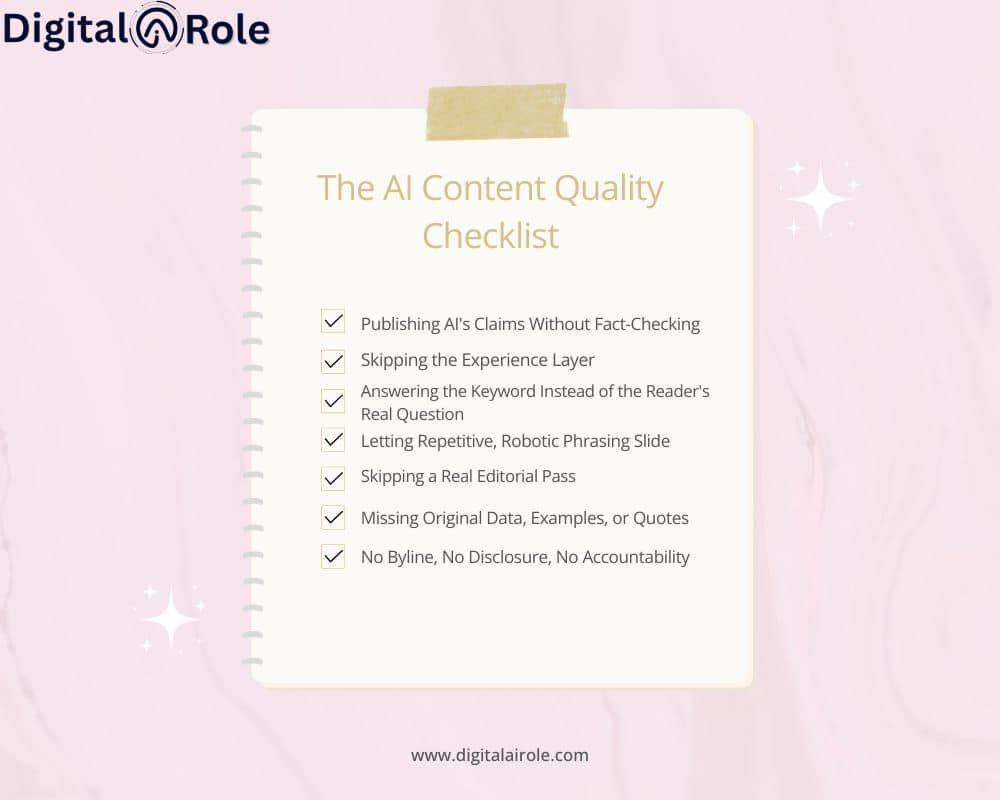
Let’s face it: here are some of the errors you’ll find in AI-generated content if you’re honest about your last few drafts.
1. Publishing AI’s Claims Without Fact-Checking Them
Confident-sounding statistics, dates, and quotes come from AI models that aren’t always correct. “81% of consumers value human-written content more than AI-generated.
It’s not that you should never use AI—it’s that you should check anything specific before it is shipped: numbers, names, dates, product information, findings of a study, or claims. Even one false statement in a well-written article can destroy its credibility with readers and with Google’s quality systems.
2. Skipping the Experience Layer
AI can accurately explain a process. It simply couldn’t have been done. It is the “first E” in E-E-A-T, and it is the one thing that AI can’t fill on its own; there’s no actual result, no real error that has been learned, no actual number that has been pulled from real work.
The solution
Each piece written with the help of the AI must include at least one paragraph that would have been impossible to write without the writer’s help, such as a result, an opinion based on doing the thing, or a detail too specific to have been generated.
3. Answering the Generic Version of the Question
AI will reply with the most common, most written answer to a subject—it’s what it thinks most other content is saying.
The solution
Read the draft and ask whether someone who has searched for this question five times would learn anything new. If you answered no, it’s superficial, and superficial is what is overwhelming the web these days.
4. Letting Robotic Phrasing Slide
The structure is familiar to the AI, including lists of three, the use of transition words like “moreover” and “furthermore,” and sentences of similar length. This is something readers perceive, even if they don’t know why it doesn’t feel right.
The solution is easy and quick—read the piece out loud. When you humanize AI content, removing robotic phrasing is never more obvious than when spoken aloud; it doesn’t show up on the page.
5. Skipping a Real Editorial Pass
This is the number-one mistake, and it is probably the only one that matters if you don’t make any others.
Solution
The key to boosting the quality of AI-generated content lies in viewing the AI-generated draft as a starting point, not as the final product—reformulating weak paragraphs.
Edit to remove filler sentences that are only included to meet word counts, and rewrite transitions to make them actual logic and reasoning, not a template.
6. Missing Original Data, Examples, or Quotes
An AI-generated draft will be full of information but lacking in insight; it will summarize what already exists.
According to a study by Ahrefs that analyzed 900,000 new web pages, 74.2% contained some AI-generated text, and 25.8% were written entirely by humans.
If three of four pages on a page about a given subject seem to be similar, the article that contains one original data point, internal example, or expert statement is the one that will stand out to readers and to search engines that value originality.
7. No Byline, No Disclosure, No Accountability
Google’s guidance explicitly states that “who wrote this” bylines are important wherever a reader would reasonably ask that question and “how was this made” is helpful when a reader is likely to ask it. Lower-trust content is content that is anonymous and unaccountable to both human skimmers assessing trustworthiness and systems evaluating trustworthiness.
8. Ignoring Google’s Helpful Content Signals
The typical result is a technically correct but somewhat lacking AI draft: one that’s correct but not really useful enough, because the reader didn’t come for that. The difference between whether the reader was satisfied and whether they are now seeking to return to Google and bounce back to search.
Whether the article is complete as a stand-alone piece, whether it provides genuine value beyond simply restating what readers already know, and whether the angle is original and not taken from one of the top ten articles that everyone is summarizing would be weighed by Google’s helpful content systems.
The solution
When preparing to publish, ask yourself if this piece would make someone feel as if they were “full” after reading it, not just “full of information.
9. Weak Internal and External Linking
AI-generated drafts often lack links or have generic, low-quality ones tacked on at the end. The cure: anchor your internal links to other relevant articles on your website—this indicates that there’s real meat on the bone for that topic and helps you establish efficient website architecture. Link out to authoritative sources to support specific claims—this is used to give context to the specific claim you’re making. Avoid using “click here” or awkwardly stuffed keyword anchor text—use an actual word or phrase that would make sense in a natural sentence.
10. Skipping a Genuine Human Editorial Pass
This is the final filter and the last place where an AI article editing checklist comes into play. Read for grammar and punctuation accuracy, clarity (keep sentences short and eliminate anything that makes the reader have to work to understand).
Repetition (AI will repeat the same thing a few times in different words), and logical structure of paragraphs (make sure that paragraphs move in a logical sequence rather than just a side-by-side list of related facts).
This pass distinguishes between content that’s AI-assisted and content that’s AI-generated and never written by a human.
How to Improve AI-Generated Content Quality

AI generates strong drafts, but you can’t publish them without editing because Google checks for authenticity; if it is inaccurate or false, it penalizes you. So if you’re wondering how to improve the quality of AI-generated content, it lies in AI intelligence, human emotions, creativity, and expertise.
Follow the following steps accurately, and you can easily generate high-quality content.
1. Start with better prompts
AI output depends on the prompts you use to command AI models. Unspecific inputs result in repetitive filler, whereas specific inputs result in highly structured and relevant drafts.
Essential Prompt Elements:
- Set up a clear target audience and search intent.
- Naturally incorporate primary and secondary keywords.
- Control the tone, the form, the number of words, and the demands
Use real examples rather than general theory.
The transformation occurs when the prompt becomes more specific and is changed from
“Write about AI content” to a clear and specific direction such as “Write a 1,500-word conversational blog for content writers on how they can enhance the quality of AI-generated content, including actionable steps, examples, and Google E-E-A-T best practices.
The Bottom Line
It takes half as long to edit the document if you invest the time in the prompt and you get a stronger basic draft.
2. Add Expert Opinions
AI is based on prediction, not on personal experience. Human review is required for authorities.
How to Inject Authority:
- Google has officially stated helpful content guidelines, and anchor to these guidelines.
- Incorporate insights from trusted industry experts, such as SEO professionals and content strategists.
- Support strong statements with information from credible, reliable sources.
- So, not only do you list tips, but you also explain why they work.
Bottom Line
When it comes to meeting the E-E-A-T guidelines, grounding text in expert insights goes a long way toward establishing trust with search engines and humans right away.
3. Include First-Hand Experience
The Unfair Advantage: AI cannot replace your own work processes, trial-and-error experiences, or real-world project information. This will be your best protection against plagiarized material.
What to Layer In:
- True points of conflict you’ve encountered in the process of editing with AI tools.
- Concrete pre/post-text changes.
- Forecast actual performance data or share client success stories without the need for identifying details.
The Lived Example
“I’ve been correcting every statistic my AI created before it got published, and it seems that it is making fewer mistakes and readers are more inclined to trust them.
The Bottom Line
The personal writing voice produces highly creative content that competitors can’t replicate.
Rewrite Instead of Paraphrasing
The Common Pitfall
Adding just a few words to a draft doesn’t eliminate robotic phrases or add any real content.
Active Editing Playbook:
- Explain difficult or complex definitions in simple terms.
- Avoid repetitive, robotic AI sentence structures and create conversational, natural sentences.
- Make your general statements more specific and actionable.
The ultimate litmus test
Ask yourself, “Would a competent human being naturally write this?”
AI Blog post Quality Checklist
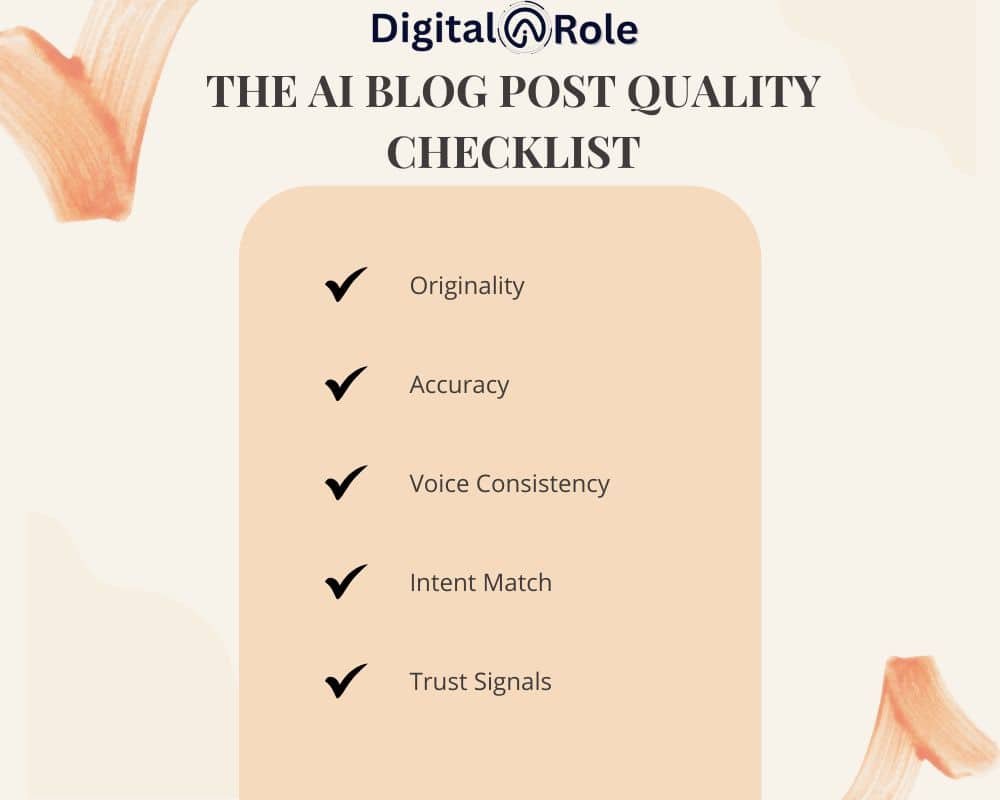
In AI detection statistics, it is found that “72% of businesses use AI in content creation.” This means AI is widely changing working patterns. But writers need originality, accuracy, quality, and trustworthiness in their content. Without these quality checklists, you lose credibility with readers and search engines.
Here is the AI blog post quality checklist.
1. Originality
- Does the content use a unique approach as opposed to copying content from someone else’s article?
- Have you added your own insights, examples, or experience
- Are repetitive AI-generated phrases removed?
- Does every section provide fresh value to readers? Is plagiarism checked before publishing?
2. Accuracy
- Are all facts, statistics, and claims verified from reliable sources?
- Are the dates, figures, and product details up to date?
- Are examples technically correct?
- Have misleading or hallucinated AI statements been removed? Are links pointing to trustworthy sources?
3. Voice Consistency
- Does the article maintain the same tone from beginning to end?
- Does it match your brand voice (professional, friendly, educational, etc.)?
- Are sentence styles consistent throughout the post?
- Have robotic or overly formal AI phrases been rewritten? Does the content sound like one author wrote it?
4. Search Intent Match
- Does the introduction immediately answer what readers are searching for?
- Does the content satisfy the target keyword’s intent (informational, commercial, navigational, or transactional)
- Does the article provide actionable solutions instead of filler?
- Is the conclusion aligned with the reader’s goal?
5. Trust Signals
- Is the author’s expertise demonstrated with examples
- Are credible sources or references included where appropriate?
- Are statistics properly cited? Is the content transparent about AI assistance if required by your policy?
- Is the information helpful, honest, and free from exaggerated claims?
Conclusion
None of this is AI; it is merely a method of improving a human being. Really, it’s whether or not the editorial step (the one that always distinguishes good content from filler) occurred before publishing. If no one is aware, AI makes it even easier to skip that step. Your next draft should go through this checklist before it’s published, and you’ll see the results in the quality of the content, its ranking, and whether anyone trusts it enough to read it to the end.