What is creative copywriting? 7 Rules to Turn Dull Words into Conversions
Creative copywriting isn’t about writing words that sound clever. It’s about finding a fresh way to communicate a valuable idea to the right audience, which notices, understands, relates to, and acts on it. Your product is excellent, but you still get ignored because your words are ordinary, which everyone else uses.
So, here is the question: What is creative copywriting? It’s the art of writing words that turn an ordinary marketing message into persuasive, memorable copy that attracts an audience and moves them to act. Instead of listing product features or making generic claims, creative copywriting combines storytelling with emotion, originality, audience insights, and business goals. In the end, the audience understands what your product is and what they should do next.
Good ad copy isn’t about words sounding good; it’s about audience, storytelling, emotion, claims, and CTR.
In this guide, I explain seven creative writing tips that turn dull words into conversion-focused copy. You’ll understand your right audience, use specific language to write stronger headlines, build trust, and create CTR that encourages action.
What is creative copywriting?
Creative copywriting is strategic marketing writing that uses originality, emotional relevance, storytelling, distinctive voice, and audience insight to persuade people to take the desired action.
Ogilvy’s famous reminder that “the consumer isn’t a moron” reinforces a fundamental copywriting principle: your audience doesn’t need hype; they need relevance, clarity, and a reason to believe you.
Unlike technical or traditional copywriting, creative copywriting targets a specific audience and gives them a reason to care. It turns a sales message into something relevant, memorable, and compelling.
Keep this formula for creative copywriting:
Creative idea + audience insight + persuasive message + business objective = creative copywriting.
The copywriting market is estimated at $30.29 billion in 2026, and it will reach $45.24 billion in 2032. This highlights copywriting’s strong potential, as industries invest in ad campaigns and hire copywriters for ad copy.
The key word is strategic. Creativity comes from using clean, accurate, and easy vocabulary. Don’t use useless jokes, complicated sentences, or unusual phrases to sound different. Every creative element should support the message with imaginative storytelling and resonant feelings to drive engagement and move the reader to a closer action, such as buying a product or booking a demo.
For a complete breakdown of how a professional industry works, check out our best B2B content creation services, which highlight which companies are best suited to your target, budget, and conversion rate.
What is “creative” about copywriting?
Creative copywriting is unique when it includes a few elements:
- Original angles: Show a familiar product or problem in a new way.
- Identify brand voice: Assign a brand “personality” to the message.
- Language that will stick with the reader: Use words that will stick with the reader.
- Storytelling: Contextualize the customer, the problem, and the transformation.
- Emotional relevance: Link with emotions, wants, frustrations, and aspirations.
- Audience language: Use the terms and phrases the audience uses.
- Creative persuasion: Make sure the end goal supports a business goal.
- Contrast, analogy, or surprise: Use creative devices when they make the message clearer or more compelling.
The important distinction: Creative ≠ complicated.
What is the difference between creative copywriting and traditional copywriting?
Both traditional and creative copywriting aim to convince, but they do so differently.
Traditional copywriting focuses on conveying the offer.
When you are copying traditionally, you will focus on the information that the customer must understand about the offer, including:
- Product or service features
- Benefits
- Pricing or offers
- Product specifications
- Reasons to buy
Make sure that your call to action is prominent and compelling.
For example:
Our project management software has automated task reminders.
It’s clear and informative. The reader knows about the product, but the message is unlikely to elicit a strong emotion.
Original persuasive angle with creative copywriting.
Creative copy does the same thing—it sees the same underlying benefit and communicates it more interestingly.
Traditional:
We have automated task reminders in our project management software.
Creative:
Don’t rely on your project manager being your memory.
The second version doesn’t abandon the product’s actual benefit. Instead, it frames the feature as a familiar customer problem and gives the product a more memorable edge.
A useful transformation is
Feature → Benefit → Emotional meaning → Action
That’s why creative copywriting is especially important in advertising. Your product needs to stand out in a confined area; it’s not enough to just explain the product. Your research also finds this shift from basic information to storytelling, emotional relevance, and persuasion as a key trait of creative copy.
When is creative copywriting effective?
The trick with creative copywriting is to catch attention, stand out from the competition, or inspire action, such as selling a product or service:
- Paid ads
- Landing pages
- Product pages
- Email campaigns
- Social media ads
- Brand campaigns
- Headlines
- CTAs
- Sales pages
The ad-writers’ rule of thumb is: Don’t be creative just to amuse; be creative to help the selling message resonate, stick, and sell.
Creative Copywriting vs. SEO Copywriting: What’s the Difference?
Creative copywriting vs. SEO copywriting isn’t an either/or choice. Actually, both have benefits. SEO copywriting helps search engines find and rank content, while creative copywriting focuses on persuasion and attracting the audience.
| Factors | Creative Copywriting | SEO copywriting |
| Primary focus | It is persuasive and engaging | Main focus on search visibility and relevance to the audience. |
| Core input | Main input: audience, voice, idea, and emotions. | Write around keywords, topical relevance, search intent, queries, and entities. |
| Main objective | Influence action. | Satisfy search intent and achieve higher rankings. |
| Writing style | Distinctive and flexible | Clear, relevant, and search-focused. |
| Success Metrics | When users perform any action, such as purchasing or signing up for a tool. | The content ranks higher in organic search with high CTR. |
| Best Approach | Make the message memorable. | Make the information discoverable for users and search engines. |
| Modern Strategy | Now copywriters combine creativity with persuasion. | Combine SEO copywriting with helpful content. |
Why Creative and SEO Copywriting Work Better Together
An SEO copywriter gets the right person to the page, and creativity gives them a reason to convert or take action.
A page that ranks well in search engines can still struggle to write compelling headlines, offer vague benefits, and give readers no compelling reason to keep reading. Likewise, the desired audience can’t discover creative copy through search.
That’s why modern copywriters should combine SEO writing and creative copywriting to match search intent with a persuasive message. Your keyword helps you understand what people are actually looking for, while research helps you understand why people want it.
The main goal is GEO and AEO, so humans and answer engines both understand your copy.
So why is creative copywriting important for conversions?
Creative copywriting matters because it attracts readers’ attention, conveys value, and motivates them to act. Rather than making general claims, it gives the audience a reason to care about a product or service.
For a deeper dive into tailored solutions, explore our guidance on B2B writing services.
It Turns into Advantages
Creative copy links the product with why the customer should care.
- Feature: 24/7 customer support
- Benefit: Get help whenever you need it.
- Emotional value: Don’t wait until Monday.
- Objective: Maintain your business operations.
This makes the message more relevant than simply stating a feature.
When used, it makes marketing messages memorable.
Unique language, storytelling, emotion, and offbeat approaches can differentiate a brand from other messages. For example:
Dull: “This is an effective method for enhancing productivity.”
Creative: “Save half of your morning to software tasks.”
The second version establishes a recognizable situation and simplifies the benefit.
It Establishes Credibility and Influences
Creative copy should not be based on hype. Claims are more compelling when backed by specific numbers, testimonials, reviews, demonstrations, or case studies.
For example:
Weak: “We work very hard to provide good results.”
Stronger: “Watch how we’ve cut down our clients’ reporting time with automated workflows.”
In the end, creative copy marries relevance, clarity, emotion, and credible proof to make someone pay attention and take action.
7 Rules of Creative Copywriting That Turn Dull Words Into Conversions
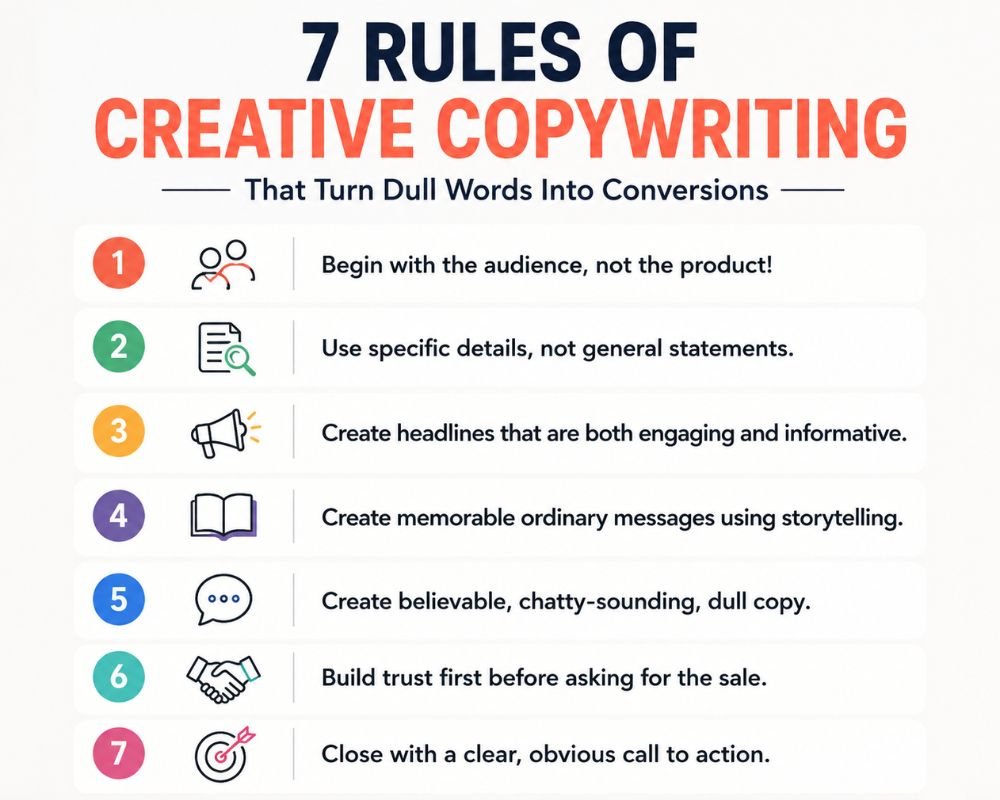
It’s not all about being clever in every sentence. It’s about making the message relevant, specific, memorable, and persuasive so readers appreciate it and feel motivated to act.
Here are seven rules to make your ad copy more attractive, persuasive, and audience-focused.
1. Begin with the audience, not the product!
The best copy starts by understanding your customer’s thoughts, not by listing product attributes; it starts with their pain points, desires, fears, motivations, buying stage, awareness level, and vocabulary.
Take note of this basic structure:
Problem, Desire, Consequence, Desired Outcome.
“80% of consumers say that great ad copy makes them more likely to buy a product. Worldmetrics.
So, rather than looking at the features of a project-management application, look at the actual problem:
“I’m always missing deadlines because tasks are spread out on various spreadsheets and in various e-mails.”
The desired outcome is “I want everything to be in one place so I can know what to do next.”
Use voice-of-customer research.
Discover customers’ preferred language by means of:
- Customer reviews
- Reddit discussions
- Interviews and surveys
- Support tickets
- Sales calls
- Social media comments
This makes your copy sound like the customer, not the business.
In Copyhackers’ approach to copywriting, the focus is on the customer first, which means understanding the conversation already taking place in the prospect’s head and crafting copy around the customer’s needs. It also emphasizes engaging visitors rather than focusing on the business.
2. Use specific details, not general statements.
Generic claims are easy to dismiss because they offer no evidence or context.
Weak: We provide you with software that saves you time.
Stronger: “Automate your weekly reporting in 10 minutes, rather than rebuilding that spreadsheet each Friday.”
The second version gives the reader a tangible image to picture. Include numbers, specific outcomes, examples, timeframes, situations, and evidence as appropriate.
A good guideline: If another competitor can duplicate your sentence and use it verbatim, your claim is likely to require further specificity.
3. Create headlines that are both engaging and informative.
Your headline should draw a reader’s attention and shouldn’t leave him guessing what the page is about. Great creative headlines tend to mix a benefit with a recognizable problem or angle.
Start by stating the main improvement you’ll offer your readers.
Demonstrate to the reader what they can do!
Slightly below average: “Improve Your Marketing”
Better: “Convert More Website Visitors into Qualified Leads”
Explain the problem that is causing pain.
Talk directly to an issue that the audience has heard about before.
Example: “Still spending hours creating reports manually?”
Avoid clickbait headlines
Give readers a reason to click through without hiding the real value.
Make the reader feel like himself. Let the reader know that he is himself.
A headline can be of the moment if it is for a particular audience or in a particular context.
The formula for writing a news story is
a desired outcome + a specific problem + a compelling angle.
Creative does not equal confusing. Nielsen Norman Group research on web writing highlights the need to make writing easy to scan and to use descriptive headings. When cleverness and clarity collide, as writing cleverly and writing descriptively do, I suggest choosing clarity.
4. Create memorable ordinary messages using storytelling.
Storytelling gives readers a situation they can relate to, instead of making them work through another abstract product claim.
A simple formula is
Character → Problem → Tension → Solution → Transformation
Make the customer the subject of the narrative. Use the customer as the main character of the story.
Dull: “Business finances can be simplified with our accounting software.”
Creative: “It’s 6 p.m. You finally put down the laptop, and then you realize that you didn’t send the invoices.”
The second version establishes a familiar set-up and makes the product the answer. A 1,000-word brand story isn’t necessary; a few sentences will provide context, tension, and emotional relevance.
5. Create believable, chatty-sounding, dull copy.
The copy should be creative, written in the voice of an actual person, and not corporate mumbo-jumbo.
Prioritize:
- Active voice
- Short sentences
- Strong verbs
- The shift from “we” to “you. The use of “you” rather than too much “we.”
- Natural phrasing
- Concrete nouns
- One concept per sentence/paragraph
- This is not a checklist of items, but rather a collection of ideas.
Before vs. after
Dull:
“Our platform is unique and helps to optimize business processes.”
Creative:
“Don’t waste Monday mornings on chasing spreadsheets.”
The second one is more tangible, straight to the point, and targeted to the audience. It uses concrete business jargon instead of a problem statement.
Concise, scannable copy also supports web usability, so clarity is an important part of conversion copy.
6. Build trust first before asking for the sale.
Proof gives your readers a reason to believe the claim, but creative copy can get their attention.
Use:
- Testimonials
- Reviews
- Case studies
- Statistics
- Product demonstrations
- Credentials
- Guarantees
- Transparent pricing
- Specific claims
Avoid just saying, “Our service gets great results.” Instead, demonstrate what has occurred, who has done what and, if possible, what has changed.
Address objections within the copy.
Answer questions such as
- Does it provide a good value?
- Will it be helpful to me?
- Does it require a lot of effort to use?
- Why should I go with this brand?
- What if it doesn’t go?
Follow the framework for conversion:
Claim, Proof, Objection, Reassurance, CTA
This helps neutralize uncertainty before the reader is asked to commit.
7. Close with a clear, obvious call to action.
A creative CTA still needs to let the reader know what to do. Don’t use fancy language when it confuses what is going on.
A good CTA must include:
- One primary action
- Clear language
- A relevant benefit
- Low friction
- Appropriate urgency
- Use of the passive voice.
- Interest of the reader
| Buyer stage | CTA example |
| Awareness | Learn how it works |
| Consideration | Compare options. |
| Evaluation | See the demo. |
| Decision | Getstarted |
| High-intent B2B | Request a quote |
For instance, the CTA “See how it works” is generally more descriptive than the generic “Unlock your potential.”
The idea behind creative copywriting isn’t to use a special word for every word. Its purpose is to make the RIGHT words more relevant, specific, memorable, credible, and actionable.
Conclusion
When it comes to producing messages that resonate, persuade, and convert, it’s important to understand what is creative copywriting.
The best creative copywriting starts with the audience, avoids general statements, uses storytelling, sounds human, builds trust, and includes a call to action. These rules turn drab words into copy that compels people to care and act.
The creative copywriting is not a choice between creative copywriting and SEO copywriting. SEO makes your content visible, and creative copywriting makes your content captivating and persuasive.
When writers combine audience insight, clarity, creativity, evidence, and conversion focus in the writing process, they can produce attention-grabbing copy that builds customer trust and, ultimately, drives more conversions.