Stop Wasting Budget: B2B Content Writing Services Guide

Content marketing generates 3x more leads at 63% lower cost. But this advantage disappears when your budget goes towards content nobody trusts, likes, or acts on.
Mostly B2B teams fail not because of a lack of effort. They optimize their content for the wrong keywords, which never understand the buyer persona and their problem. Mostly, cheap publishers generate thin AI-generated articles, irrelevant newsletters, and gated whitepapers only to increase the content volume, which drains your budget without getting traffic, leads, and conversions.
That’s where B2B content writing services make your ordinary, simple marketing into a high-conversion, extraordinary campaign. The service providers write your content, newsletter, landing page, product page, whitepaper, and other formats around your customers’ questions and buyer journey, not just count words and apply SEO.
In this guide, I explain to you what a B2B content writing service is, what formats it includes, and how to choose the best provider for your company. Invest on right pipeline, not only to fill your content calendar.
What is B2B content writing?
B2B content writing is the creation of educational, persuasive, SEO-optimized, decision-driven content to sell products to another business, not for a consumer. Its main job is to educate the full room of stakeholders (IT, finance, procurement, and end-user) to move them towards a decision over weeks or months, not to impulse buy in seconds.
Effective B2B writing helps potential buyers understand the problem, evaluate possible solutions, build confidence in the provider, and justify the purchasing decision. Because of that, B2B writing is more formal, technical, and data-driven because buyers need detailed information before buying any product or service.
B2B buyer statistics indicate that “70% of B2B buyers say content quality influences their final purchasing decision.” That means content quality has a major impact for every business because it tells them about the company, what they sell, what the ROI is, and whether their products solve their problems.
So there is a need to educate the purchasing committee throughout the longer sales cycle.
This means a B2B writer considers the following:
Extended buying cycles: Prospects may “go on a research mission” for a period of weeks or months before reaching out to a vendor.
Multiple decision-makers: Content needs to meet the needs of marketers, technical managers, executives, and procurement.
Context and technical terms: The technical terms and context must be accurate, not generic.
Evidence and data: Statistics, research, examples, and case studies can add to credibility.
Various stages in the funnel: A blog can engage an early-stage researcher, but a case study or comparison page can help the later-stage buyer in the funnel.
Business decisions: Present material that will enable the reader to grasp options, assess risks, determine value, or make an internal purchase decision.
B2B vs. B2C Content: Key Differences
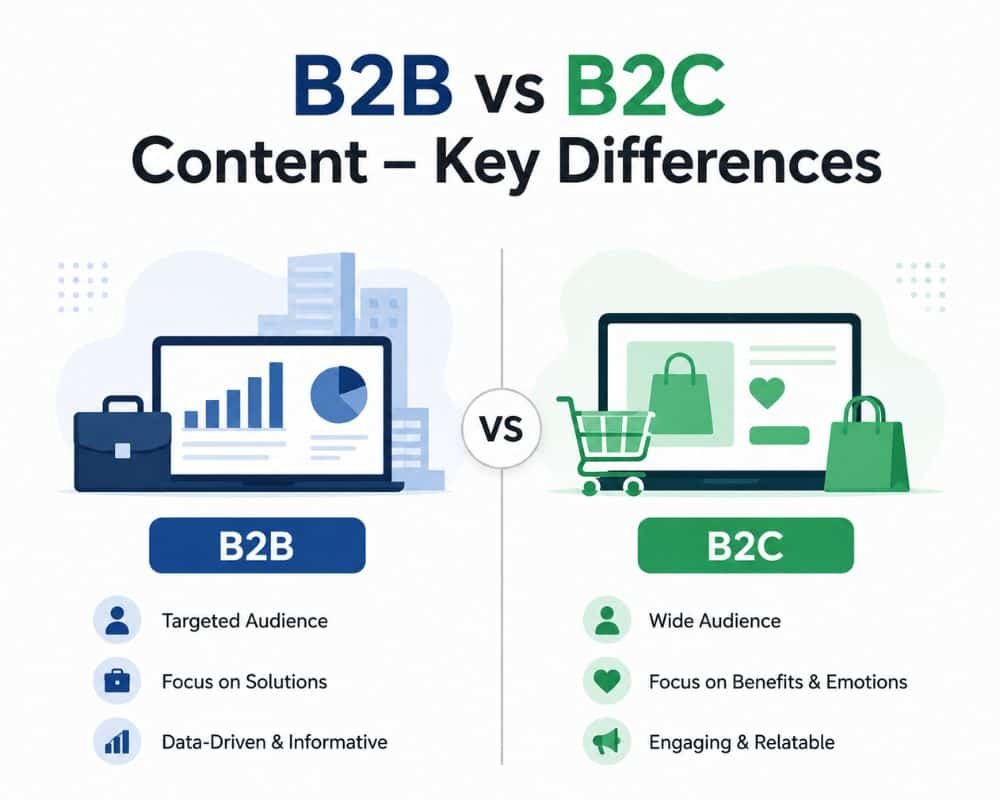
Although both types of content are informative and persuasive to their audience. The information and buyer journey are different—there is a difference between B2B vs B2C.
| Factor | B2B Content | B2C Content |
| Buyer | Multiple stakeholders | Usually an individual consumer |
| Buying cycle | Longer and research-heavy | Often shorter |
| Tone | Expert, evidence-led, professional | Emotional, conversational, relatable |
| Decision drivers | ROI, efficiency, risk, expertise | Price, convenience, emotion, benefits |
| Content depth | Often detailed and technical | Usually faster and easier to consume |
| Proof | Data, research, case studies, demonstrations | Reviews, ratings, testimonials, social proof |
| CTA | Request a demo, consultation, quote, or sales call | Buy, subscribe, order, or sign up |
| SEO focus | Problems, solutions, industry topics, commercial research | Products, categories, comparisons, transactional searches |
The “Committee Test” for Better B2B Content
Many B2B guides forget about this important distinction: B2B content usually needs to go through a committee.
Consider what happens if someone is looking for your product. The individual who reads your blog may not be the individual who signs the contract. Implementation details may be requested by a technical evaluator, efficiency improvements may be sought by a manager, and ROI and risk reduction may be desired by an executive.
That’s why it’s important that B2B content can answer these four questions:
Researcher: Will the information on this page help me with the problem I’m trying to solve?
Evaluator: Is this going to be a successful strategy?
Manager: Does it make the money?
Executive: What is the impact of the business?
Hence, specialized B2B content writing services could be more beneficial than general writing because they can build content around various inquiries and concerns that affect complicated B2B buys, instead of composing for one person or keyword.
Why do companies need B2B content writing services?
When you’re creating B2B content, it’s not just about getting more articles written; it’s about educating the prospective customer about a problem, helping them to consider the solution, and convincing them they are not taking a chance if they reach out to your business.
However, in B2B, we’re typically dealing with multiple stakeholders and do a lot of research before the purchase, so generic content can get very costly as a traffic generator and never convert into revenue.
You can also explore dedicated seo writing services that align search intent with target audience needs to consistently drive qualified organic traffic.
Why companies need them:
Subject-matter complexity: Often, B2B products (SaaS, industrial equipment, compliance software, etc.) require writers with the ability to convert technical information into content that an engineer as well as a CFO can understand.
Volume vs. bandwidth: When it comes to publishing (blogs, whitepapers, case studies, email nurtures), it takes more hours than most marketing teams have available in addition to their other marketing responsibilities.
Knowledge and skills in Search Strategy and SEO: Keyword research, search intent mapping and technical on-page optimization are a specific skill set and not “just good writing” that is needed when ranking content.
Sales enablement needs: Case studies, one-pagers and comparison content are a constant need of sales teams and run out quickly without dedicated writing support.
Consistency at scale: Without a writing process, it becomes more and more difficult to keep a single brand voice as companies grow and expand their writing library.
Thought leadership: Being an industry expert (bylines, LinkedIn articles, research reports) demands strong writing skills and strategic framing, which can be beyond a founder/exec’s repertoire or time constraints.
The Benefits of B2B Content Writing Services
- More effective content quality
Professional B2B writers understand how to structure an argument, provide data to support claims, and write for a thoughtful, multi-stakeholder buyer.
- Faster turnaround
Dedicated writers get to work quicker than a marketer with five other duties.
- Improved SEO results
This will add up to organic traffic and inbound leads over time.
- Better credibility with technical buyers
When technical buyers do their homework before striking up a conversation with sales, well-researched, accurate content adds to credibility.
- Free up internal bandwidth
Your marketing team can concentrate on strategy and campaigns, not writing all assets.
- Measurable ROI
Linked back to what we covered last: Targeted content is no longer page views; it’s pipeline and revenue.
The result: businesses are provided with content that truly drives their customers down a long, complicated B2B sales cycle without overburdening their sales team.
Consider the process to be:
The road to sales is paved with leads, leads, and more leads. The path to sales is paved with leads, leads, and more leads.
The lesson which you learn is that quality content is not a single-use expense for your business; it’s an asset.
Rather than purchasing additional articles on a regular basis, businesses may update and reuse their best articles to maximize their value.
ROI of Content vs. Other Marketing Channels
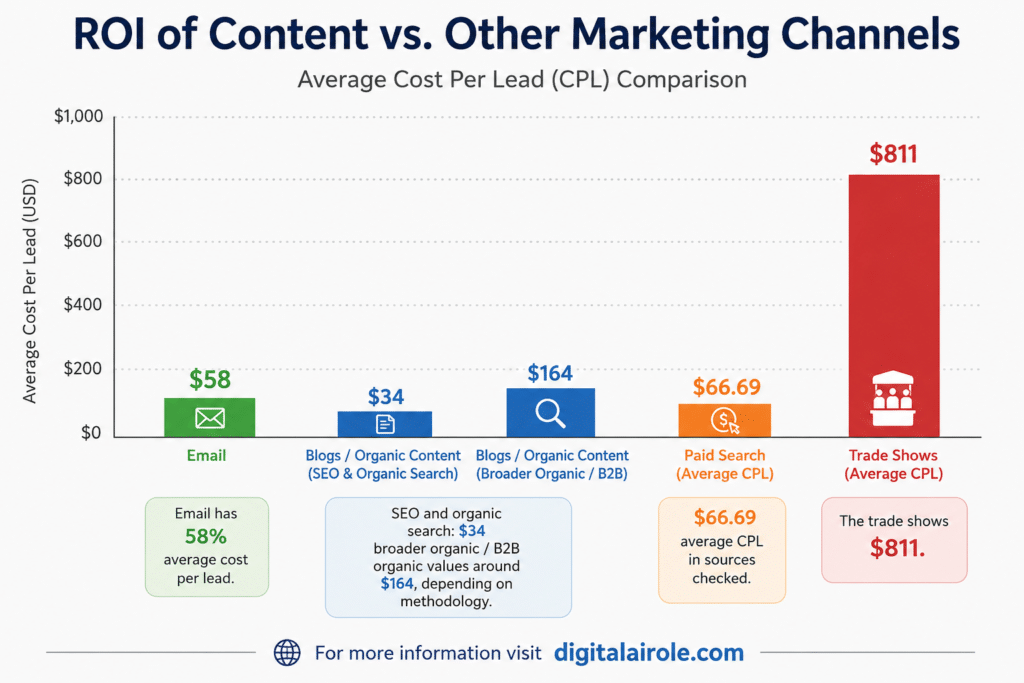
But alone lowe cost does’t makes a content successful. This shows that publish the content across the full journey of the customer, pairing paid ads with SEO blogs and written content which attracts the right audienceand move qualified prospects to move towards revenue.
Types of B2B Content Writing Services you can purchase
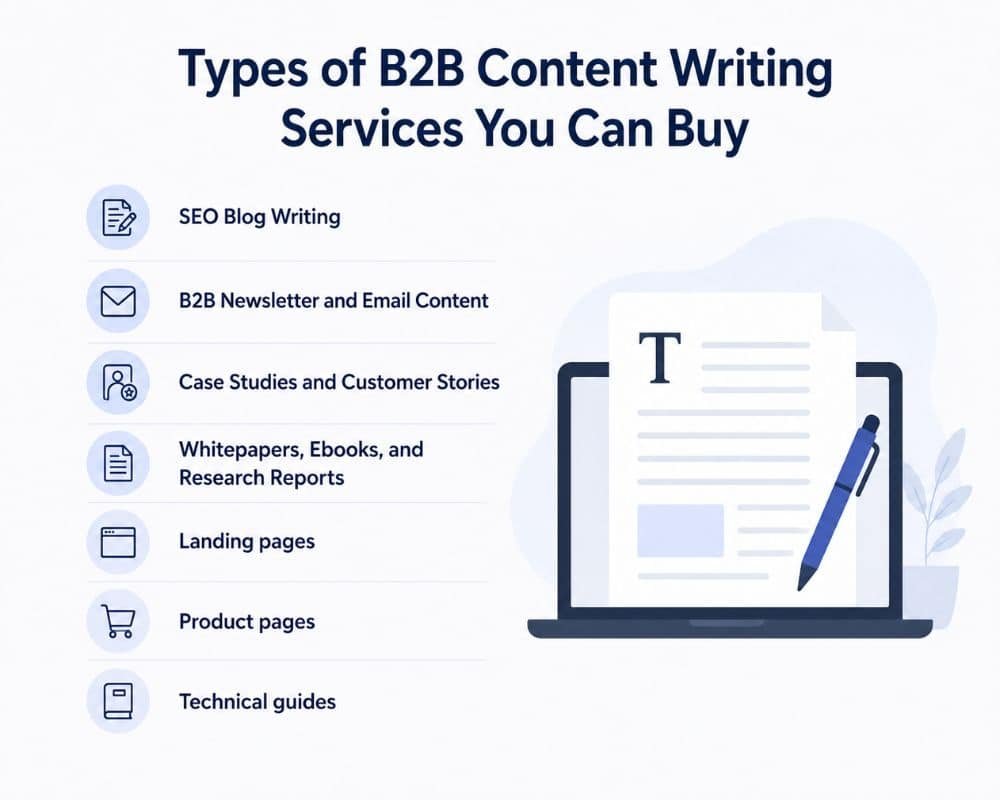
Not all types of B2B content are worth the same effort. One of the common pitfalls is assuming that all the blog posts, whitepapers and emails are the same. In fact, both formats cater to a certain phase in the buyer’s journey.
You know that SEO-friendly content writing is especially effective at capturing buyers who are in the research stage, and case studies can sway prospects who are close to making a decision.
Therefore, the right B2B content writing services should build a content mix around your audience, funnel stage and business goals, rather than churn out just as much content as possible.
1. SEO Blog Writing
The first step of a B2B content strategy is often SEO blog writing since it can attract prospects who are looking for solutions to their problems that your product or service offers. “79% of B2B marketers use blog posts as the central part of their content and strategy to generate leads.”
A specialist writer should link search intent with buyer intent as opposed to writing only around keywords.
A good B2B blog strategy is going to have the following in place:
Informational search intent: Address questions that the prospect asks before they’re ready to purchase.
Topic clusters: Create a variety of articles on a general theme to develop topical depth.
Bottom-up traffic acquisition: Lure people with a specific problem and question.
Internal linking: Link information pages to product, services, comparison, and case study pages.
Commercial CTAs: Provide a logical next step, like request a demo, download a guide or reach out to sales.
You should start with SEO blog posts, as they are a great way to attract buyers who are actively looking for answers, according to your dossier.
What is significant is not quantity, but quality. 20 articles published that rank and don’t convert cost more than 5 well-researched articles.
2. B2B Newsletters & Emails.
Blogs can be helpful in attracting potential buyers, whereas newsletters and email sequences can be very helpful in keeping them engaged after you have already interacted with them.
Email content for b2b can back up:
Prospect nurturing: Take prospects from the initial interest stage to the sales stage.
Product education: Share but don’t push features, uses, and benefits.
Newsletters: Deliver value-added industry information, research and company knowledge regularly.
Sales enablement: Provide information that allows prospects to consider your solution.
Re-engagement sequences: Reach out to leads who aren’t actively engaged.
In b2b content marketing email nurture sequence converts 20-30% of MQLs within 90 days when it trigger to download of content for more qualified leads.
What matters is to offer everything useful in each email. A newsletter that only sells your products will not likely engender trust in the B2B purchasing process, which is lengthy.
3. Customer Stories and Case Studies
Case studies help prospects understand that a solution they are looking for can work for them if they have read about it on blogs.
A good case study will avoid the use of generic verbs like “Improved” in the case of company X. Rather, it should demonstrate:
The process of challenge, solution, implementation, results and lessons.
58% of case studies are particularly useful to mid- and bottom-of-the-funnel prospects for lead generation who are shopping around for vendors or seeking to lessen the perceived risk of the purchase.
Use them for:
- Demonstrating measurable results
- Handling common objections
- Showing real-world implementation
- Supporting sales conversations
- Providing decision makers with evidence they can share internally
Your research actually singles out case studies with real data as an underused, but convincing format for a prospect who is advanced in the purchasing process.
4. Whitepapers, Ebooks, and Research Reports
Whitepapers and research reports build authority and provide much-needed information that potential customers can look at to internally justify a purchase or determine if they have a problem.
They are especially suited for:
Thought leadership: Show original understanding and industry knowledge.
Lead generation: Offer an actual, helpful resource for contact details if suitable.
Internal buyer justification: Provide champions with supporting evidence to show managers/executives.
Technical, regulatory and strategic complexities: Provide a more detailed explanation of technical, regulatory and strategic issues.
More gated doesn’t necessarily equal leads, though. An interesting thing you’ve got in your dossier is that, as reported, 86% of B2B marketers are creating whitepapers, and only 27% of buyers find them useful.
The gap implies that companies need to ask a new question: “Is this resource worth someone’s time – and email address – to access?”
Other B2B Content Formats
A full-fledged B2B content writing service can also produce:
- Landing pages
- Product and service pages.
- Technical guides
- Thought-leadership articles
- Sales enablement content
- LinkedIn posts
- Webinar scripts
- FAQ content
- Comparison pages
- Lead magnets
The answer is that it is dependent on the customer’s position in the journey.
Example buyer journey:
What are the other strategies for building your homepage’s reputation?
What other means are there to establish your reputation on the homepage?
This way, people can avoid another major budget pitfall: producing content because the competition is doing it. On the other hand, each asset plays a particular role in the buyer journey.
The B2B Content Writing Process: Brief to Pipeline
A good B2B content writing business should have a process which links research and writing to a measurable business outcome. The research suggests that you should seek providers who have industry experience, in-depth knowledge of the subjects, an understanding of SEO, and a process in place, rather than providers who simply offer high volumes of content.
Do research on Audience, Industry, and Buying Committee.
The writer should know before they begin composing a paragraph that:
- Ideal customer profile (ICP)
- Buyer pain points
- Search behavior
- Customer questions
- Sales-team insights
- Industry terminology
- Competitor content gaps
It is especially important in B2B if a single piece has to please multiple individuals in the buying process.
Create a Search + Buyer-Journey Brief
The content brief should be well structured and align with business goals as well as SEO needs. Include:
- The first and second level of keywords are Primary and Secondary keywords.
- Search intent
- Target questions
- Buyer/funnel stage
- Conversion goal
- Internal-link opportunities
- Credible sources
- Input from subject matter expert (SME)
- Desired CTA
This means that writers can avoid creating an article that ranks in the search engine for a keyword but is not relevant to any business.
Write it, then review it, and then optimize and publish it.
A workflow that sticks to quality should be like:
Research, SME input, Draft, Fact-check, SEO optimization, Editorial review, Publish, Measure, Update
The research dossier suggests that attention be directed towards an editorial process and revision rather than towards content as a mere transaction of the writing.
How to Choose a B2B Content Writing Service Without Wasting Money
When selecting a B2B content writing agency, it’s not just about the rate or volume of articles per month. The right agency should know your industry, your audience, your buying journey, your SEO objectives, and your business objectives and use that knowledge to create content that can attract qualified prospects and help fuel your sales pipeline.
I suggest that you should be looking into the agency’s industry expertise, knowledge in your field of interest, its SEO skills, its brand fit, the quality of its content, and its measurable KPIs, but not the volume of content.
1. Look at Industry Expertise and Subject-Matter Knowledge
B2B topics can be more detailed and technical than consumer topics. When considering an agency, verify that their writers grasp your business or industry, or have a method in place to learn it.
When searching for an agency, make sure it has the following:
- Knows how to write in your industry.
- Understands your target audience and ICP.
- Interviews with experts in the field on the subject matter.
- Identifies reliable and trustworthy sources from the industry.
- Understands technical terminology.
- Is able to write for various decision-makers.
Because it’s possible for an agency to write grammatically correct text that simply doesn’t work, they don’t know the problems your customers are experiencing or how your industry works when it comes to buying.
2. Analyze its SEO and content strategy
A good B2B content agency must do more than just produce articles on keywords. It should relate the SEO strategy to the buyer’s journey.
Discuss with the agency whether they offer:
- Research for keywords and topics.
- Search-intent analysis.
- Competitor/SERP research.
- Topic clusters.
- Content briefs.
- Internal-linking strategy.
- On-page SEO.
- Content updates.
- Conversion-focused CTAs.
The idea is to ensure that each piece plays an active role: to draw in the right searcher, to provide them with a response to their query, to gain their trust, and propel them to the next step in the buying cycle.
3. Focus on Content Quality, NOT Just the Portfolio
A portfolio can demonstrate that an agency publishes content—it doesn’t demonstrate that the content was successful.
To evaluate samples, consider:
- Does the information include specific details, or does it include general details?
- Are there any original insights in the content?
- Do claims have credible sources?
- Is the writing knowledgeable about the industry?
- Is the information organised for people or for search engines?
- Does it make sense in the context of the story?
Research is a key element of your work, and you stress that good B2B content should show its mastery of the subject, research, SEO, and its connection to the client’s brand.
Ask how the agency measures results.
That’s where you’ll be able to distinguish between a strategic agency and a content factory.
Avoid monthly reports that include only:
- Number of articles published
- Word count
- Pageviews
- Impressions
- Rankings
Inquire with the agency about how it measures:
- Qualified organic traffic
- Leads
- MQLs and SQLs
- Conversion rates
- Pipeline influenced
- Assisted conversions
- Revenue
The amount of money you have to spend to acquire one lead.
You also touch on KPI-driven content, and content that has no metrics is “shots in the dark.”
Check the Agency’s Content Production Process
When you sign a contract, ask yourself what’s happening between you getting your short piece and it being published.
The reliable process should be similar to:
Audience research, Topic/keyword research, Content brief, SME input, Writing, Fact-checking, SEO optimisation, Editorial review, Client review, Publishing, Performance tracking
This process is important in this sense that B2B content can’t be just good writing. It must be researched, accurate, subject-matter expert, SEO, and well edited.
B2B Content Writing Cost: What Should You Budget?
There is no universal price for B2B content because it depends on research depth, subject matter, expertise, content format, SEO requirements, and level of strategy involved.
Typical B2B Content Writing Pricing
The ranges in your research dossier provide these indicative benchmarks:
| Content/service | Reported benchmark |
| Generalist blog post | $300–$700 |
| Specialist SEO/research article | $800–$2,500 |
| Whitepaper/guide | $2,000–$8,000 |
| Agency retainer | $5,000–$7,000/month |
| Premium agency writing | $0.50–$2.00/word |
Measuring B2B Content Marketing ROI: Track Revenue
“Producing content can only be worthwhile if you can measure it and see that it helps your business grow.”
So ROI for B2B content marketing shouldn’t just be about page views, impressions or rankings. You should measure not only traffic but also the performance of content in your pipelines and link it to income and expenses per SQL.
The B2B Content Marketing ROI Formula
Here’s the formula for finding out the ROI on your content investment:
Content ROI = (Content-attributed revenue – Total content investment) / (Total content investment) x 100.
Here is an example using U-shaped attribution
Scenario: A B2B SaaS company spends $50,000 on content in Q2 (writers, design, promotion) and closes 3 deals that had content touchpoints in the buyer’s journey.
| Deal | Contract Value | First Touch (40%) | Last Touch (40%) | Middle Touches (20%) |
| Deal 1 | $80,000 | Blog post → $32,000 | Case study → $32,000 | Webinar + 2 emails → $16,000 |
| Deal 2 | $60,000 | LinkedIn article → $24,000 | Comparison guide → $24,000 | Nurture email → $12,000 |
| Deal 3 | $40,000 | SEO guide → $16,000 | Demo page copy → $16,000 | 2 emails → $8,000 |
| Total | $180,000 |
Total revenue attributed to content: $180,000
Total content cost: $50,000
ROI = [(Revenue − Cost) / Cost] × 100
= [($180,000 − $50,000) / $50,000] × 100
= 260% ROI
The 260% is what you’d report; you can further breakdown it down by content format on which you spent dollars.
The amount of content you invest goes beyond the writer’s bill.
Count:
- Writing and editing
- Time for SMEs or employees
- Effortless SEO and keyword research, but no more.
- Design
- Content distribution
- Paid promotion
- Content Analytics and tools.
Which B2B Content Metrics Truly Count?
Various metrics serve different purposes at different points in the funnel. Avoid seeing traffic as an end goal and ensure each metric is linked to a business outcome.
Tracking the growth of branded search: Organic impressions and organic growth will reveal if your content reaches the right people.
Engagement: Look at engaged sessions, emails engaged, returning visitors, and meaningful interactions to determine if people are finding content helpful.
Track form submissions: marketing qualified leads (MQLs) and sales qualified leads (SQLs).
Pipeline: Identify opportunities generated, affected pipeline, and helped conversions to gain insight into opportunities pipeline can support sales.
Revenue: Ultimately, track content-attributed revenue, customer acquisition cost, and overall ROI.
This helps to streamline the journey of content → qualified audience → leads → opportunities → revenue.
The main reason is that Content ROI takes time.
B2B content is seldom an overnight success. The process of a new article getting indexed, gaining visibility, attracting quality visitors and developing authority takes time before a new article can often create consistent leads.
You can use this simple timeline:
Month 0 → Investment
Come up with the ideas and post them online.
Month 3 → Early visibility
Monitor impressions, rankings, traffic and qualified traffic.
Month 6 → Lead generation
Monitor for conversions, MQLs, SQLs and early pipeline contribution.
The compounding traffic includes pipeline. Pipeline is included in the compounding traffic in Month 12.
Now that you’ve created successful content, you can continue to build organic traffic and conversions.
Year 2+ is mature content.
Strong evergreen content can be turned into an asset for acquisition if regularly updated and linked to relevant conversion paths over time.
Conclusion
The decision of which B2B content writing services to select is not just about purchasing a number of articles. Content that addresses audience needs, the intent behind the search, industry knowledge, and measurable business goals is best suited.
It doesn’t matter if you’re creating blogs, newsletters, case studies, whitepapers, or technical content; it’s the quality, not the quantity.
Test agencies and processes for research, SEO strategy, editorial and reporting before you invest your money. Most importantly, use qualified leads, pipeline, revenue and ROI as metrics, not vanity metrics.
With all content assets having a clear purpose, measurable outcome, your investment becomes a marketing asset that can become a long-term growth engine instead of another wasteful spend.