9 Best B2B Content Creation Platform Tools to Fuel Growth (2026)
More B2B content doesn’t mean more growth. Better connected content apps workflow can do. The best B2B content creation platform tools turns scattered ideas, teams, and tools into one streamlined content engine where you can execute your ideas easily.
When the platform isn’t consistent, you jump from task to task; productivity slows, work becomes boring, and you lose visibility into what actually drives growth. “4 in 5 marketers use content marketing rather than traditional marketing, and 73% of B2B companies use content marketing. It highlights the importance of efficient content operations.
Modern B2B content marketers rely on integrated stacks of content marketing tools, including content creation software (B2B), content analytics, AI writing and automation tools, visual and video tools, interactive content platforms, and all-in-one content workflow tools such as HubSpot.
In this article, I share 9 content creation platforms that stand out from the ordinary. Instead of treating planning, writing, collaborating, and publishing as disconnected tasks, these platforms can bring multiple stages of the content workflow into a more coordinated system.
What is a B2B content creation platform?
A B2B content creation platform is a software solution that helps marketing teams manage content beyond just writing. It brings content ideation, editing, visual creation, interactive video experiences, SEO optimization, collaboration, publishing, and analytics into a connected workflow.
“The B2B marketing software market is valued at approximately $6.48 billion and projected to reach $14.06 billion by 2030.”
Teams can create, review, approve, distribute, and measure content from a more centralized system without moving files between disconnected tools. These AI content creation tools help teams produce, monitor, manage, approve, and comment on content, increasing productivity and quality.
These platforms actually work with
- Content creation software B2B can assist in creating content for:
- Creating ideas and planning content.
- Writing and editing
- Content in other forms, including images, interactive content, video, and audio.
- Content optimization and SEO.
- The participant and the coach should consider how to collaborate, comment, and approve.
- The publications and multi-channel distribution are also included.
- Performance monitoring and content analysis.
A B2B content creation platform vs. a simple AI writing tool.
The main use of an AI writing tool is creating content, such as a blog draft, email, or social post. A broader platform can tie in planning, collaboration, SEO, publishing, distribution, and measurement. This increases the value of content workflow tools for teams that need to scale an entire content operation, not just write more content.
“60% of B2B buyers made a buying decision when they saw their digital content,” Sellers Commerce B2B Marketing Statistics. This includes investing in content like testimonial blogs, videos, and product specifications.
AI writing, content hubs, interactive platforms, collaboration, analytics, and distribution are unique, interconnected elements of today’s B2B content marketing landscape.
Why B2B Teams Need Content Creation Platforms for Growth
More content doesn’t always mean more growth. If marketers spend more time managing idea generation, production, approvals, publishing, and reporting, they have less time to improve the content.
A central platform can be used to help teams create repeatable workflows, ensure they’re consistent, deliver content efficiently, and tie performance metrics back to business objectives.
Create a workflow without causing any chaos.
Approximately one in three B2B marketers has a scalable content creation model. A structured platform can remove this fragmentation by providing common workflows for planning, creating, reviewing, approving, and delivering.
Turn Content Into a Measurable Growth Channel
Content for B2B isn’t just about driving traffic. It can connect to the right workflow to drive lead generation, influence the pipeline, increase engagement, support distribution, improve conversions, and deliver measurable content ROI. One effective blog post, landing page, report, or video can attract leads, inform them as they move down the funnel, and put them in front of a salesperson.
That means content measurement is something as vital as content production. Teams should be able to identify which assets to focus on, which channels drive engagement, and which content can drive conversions and revenue.
Content marketing generates about 3X more leads for every dollar spent and costs about 62% less than traditional outbound marketing. It’s not about content quantity; it’s about quality. Instead, B2B teams need a workflow that lets them create and improve content over time with ease.
Comparison Table: 9 Best B2B Content Creation Platform Tools
The best B2B content creation platform depends on the marketing team’s goals, content format, workflow, and specific needs. Choosing the best B2B content creation services helps companies align their content strategy.
Use this table to compare platforms when choosing one for your marketing needs.
| Tool | Best for | Key strength | Main limitation | Pricing model |
| HubSpot Content Hub | All-in-one B2B marketing | Content, CRM, publishing, and analytics | Can become expensive at higher tiers | Free to Enterprise |
| StoryChief | Content workflow and distribution | Editorial planning, collaboration, multichannel publishing | Not a complete CRM ecosystem | Subscription |
| Foleon | Interactive documents | Engaging reports, brochures, and digital publications | Specialized use case | Quote-based |
| Ceros | Interactive digital experiences | Rich media and interactive storytelling | Less suited to routine blog production | Free trial to custom |
| Jasper | AI writing and marketing | Brand-consistent marketing content at scale | Not a complete publishing and analytics platform | Subscription |
| Copy.ai | AI workflow automation | Automating repetitive content and GTM tasks | Workflows may require setup | Subscription |
| Uberflip | Personalization and ABM | Personalized content experiences and engagement insights | Better suited to mature B2B teams | Custom |
| Canva | Visual content production | Graphics, presentations, videos, and branded assets | Limited as a standalone B2B analytics solution | Free-to-paid plans |
| Synthesia | AI video and audio | Training, product explainers, and multilingual videos | Focuses primarily on video | Free to Enterprise |
9 Best B2B Content Creation Platform Tools
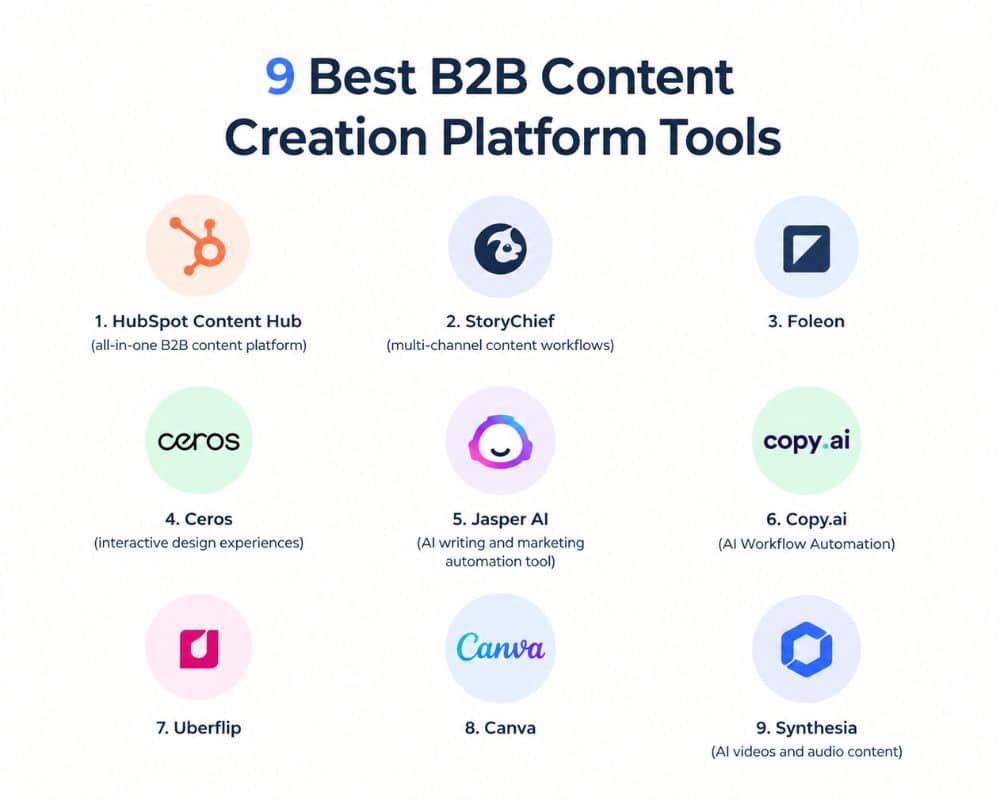
Below are the platforms addressing different aspects of the B2B content workflow. We assess tools based on use cases, content capabilities, AI capabilities, SEO support, workflow, integrations, pricing, and limitations, rather than assuming one has all the best features.
Content Workflow Tools
1. HubSpot Content Hub: all-in-one B2B content platform
The category is the content hub/CMS/marketing automation/analytics.
Best for: Mid-size B2B teams desiring content creation, CRM, publishing, and analytics in one ecosystem.
Key content capabilities:
HubSpot Content Hub enables blogs, landing pages, website content, podcasts, video, content remixing, and multilingual content. This makes it accessible to teams that want multiple content formats without relying solely on multiple platforms.
AI features:
AI features include content creation, content remixing, AI agents, and brand voice/content support. These features help teams create content faster and keep it aligned with their marketing workflow.
SEO/optimization:
More SEO recommendations, Google Search Console integration, content optimization, and site auditing are offered on higher plans.
Collaboration/workflow:
Content can be centrally managed by teams, have multiple users, have content approvals, and have governance controls for enterprise offerings.
Integrations:
HubSpot integrates content activity with its CRM, marketing automation, CMS features, and other marketplace integrations.
Pricing:
HubSpot offers Free, Starter, Professional, and Enterprise plans. Prices and what is included may be subject to change; please check plan information before publication.
Pros: The broad end-to-end B2B marketing ecosystem is well connected to CRM and analytics.
LIMITATIONS: Teams may find the costs and complexity of higher plans to be prohibitive.
Perfect B2B user: Growing SaaS, tech, and service businesses looking to integrate content experience into their marketing and sales funnel.
2. StoryChief is ideal for multi-channel content workflows.
Subcategory: SEO / distribution.
Ideal for: Marketing departments and marketing agencies with a content management workflow spanning websites and social networks.
Key content capabilities:
StoryChief offers article writing, social posts, editorial plans, content campaigns, and multi-channel publishing. Instead of remembering to use separate tools for each piece of content, it helps you manage everything from creation to distribution.
AI features:
It includes AI tools for research, writing, image generation, video generation, and AI visibility tracking.
SEO/optimization:
SEO publishing features, GEO publishing, SEO insights, and content audits help teams enhance content before and after publishing.
Collaboration/workflow:
For teams with multiple people involved in the same content process, StoryChief lets you add tasks, deadlines, approvals, comments, and editorial workflows.
Integrations:
The platform connects with tools and channels such as WordPress, Webflow, LinkedIn, HubSpot, Salesforce, and Mailchimp. The pricing page also lists 450+ supported integrations.
Pricing:
The following plans are in effect: Starter, Growth, Scale, Agency, and Enterprise (the Starter plan is listed here at €49/month).
Pros: Strong combination of content workflow, publishing, and multichannels to do marketing tasks at one platform.
Limits: Not ideal for teams that primarily need a full CRM and CMS environment.
Best for B2B users: Content teams, agencies, and distributed marketing teams that require centralized planning, collaboration, and publishing.
Interactive content platform
3. Foleon
A platform that offers interactive content.
Ideal for: B2B teams looking to convert documents like PDFs, reports, brochures, etc. into interactive digital experiences.
Key content capabilities:
Foleon features interactive reports, digital brochures, presentations, product content, interactive documents, and embedded multimedia. It can be a big asset when your webpage isn’t interesting enough for your B2B audience.
AI features:
The platform can localize and assist with content (when applicable) using AI.
SEO/optimization:
Web-based publishing and responsive experiences enable interactive content that can be delivered digitally, and audience analytics provide insight into audience engagement with their assets.
Collaboration/workflow:
Reviewers, templates, brand controls, and shared workspaces are integrated into higher-level plans to assist teams that require review and brand consistency.
Integrations:
Provides native integrations and connections to analytics/marketing ecosystems.
Pricing:
Foleon employs quote-based Grow, Scale, Team, and Enterprise plans.
Pros: Good choice for building interactive, branded B2B content experiences.
Restrictions: It may not be as comprehensive as an all-in-one content creation or marketing platform.
Perfect B2B user: Enterprise marketing, sales enablement, communications, and teams that frequently create reports, presentations, or digital publications.
Users engage with Foleon Docs about 4 times longer than a standard web page
4. Ceros: good for interactive design experiences.
Type: Digital content / visual experiences
Ideal for: Designers and marketing teams with high interactive digital experiences.
Key content capabilities:
Ceros is all about interactive webpages, presentations, campaign experiences, digital stories, and rich media. In particular, it is ideal for teams that want content to feel more like a digital experience than a regular article or static document.
AI features:
Ceros’ capabilities include Flex AI.
SEO/optimization:
Web publishing features let teams create interactive online experiences, and engagement analytics can help determine how engaged users are.
Collaboration/workflow:
The platform supports creators, editors, reviewers, workspaces, and templates, helping creative teams oversee production and review processes.
Integrations:
Ceros can be embedded and published within a larger marketing and content ecosystem.
Pricing:
Starter, Growth, and Enterprise options are listed in the sources. Sales-led Starter, Growth, and Enterprise are available for trial, and Growth and Enterprise are sales-led options.
Pros: It contains strong interactive designs and digital storytelling capabilities.
Limitation: It may not be the best option for those who need to produce lots of blog posts or SEO-related content. With professional SEO writing services, you can create optimized articles that match user intent and rank high in Google.
The perfect B2B user: Brand, creative, and enterprise marketing teams creating interactive campaigns and digital experiences.
Ceros is focused on interactive design and engagement analytics, not content production.
AI writing and automation tools
5. Jasper AI: AI writing and marketing automation tool.
AI writing and automation tools
Ideal for: Marketing teams generating a lot of brand-consistent content.
Key content capabilities:
Jasper features blog posts, copy for ads, email copy, social media, and campaign assets. It is geared toward marketing and is ideal for any team creating promotions.
AI features:
Brand voice, marketing workflows, artificial intelligence (AI) agents, and research and campaign orchestration are among its main features. These features expedite repetitive marketing tasks and help ensure consistent content.
Before publishing AI-generated content, use this AI quality checklist to ensure it is accurate, high-quality, and enjoyable for readers.
SEO/optimization:
Jasper offers SEO-friendly workflows and GEO features in its higher-tier or business offerings.
Collaboration/workflow:
You can coordinate AI-assisted content production through shared workspaces, campaign collaboration, brand knowledge, and marketing workflows.
Integrations:
APIs and integrations are part of Jasper’s marketing technology landscape, depending on the plan.
Pricing:
Pro and custom business pricing are available, and Pro costs $69/month per seat. Please check current rates before publishing.
Pros: Customization options make it excellent for integrating with current marketing tools and processes.
Limitation: Jasper isn’t a standalone publishing and analytics platform; it’s an AI-optimized content-writing and marketing platform.
Best for B2B users: Content marketing teams who want to speed up content creation and keep the brand consistent.
Jasper in the role of a “speed layer” for more advanced writers, not as a substitute for human editing. Human editing remains necessary to ensure factual accuracy, originality, brand tone, and overall quality.
6. Copy.ai: Best for AI Workflow Automation
AI writing / GTM automation
Ideal for: B2B teams looking for automation of repetitive content and go-to-market workflows.
Key content capabilities:
Copywriting content, marketing content, sales content, campaign content, and content generated from workflows are all supported by Copy.ai. Its biggest advantage is linking content creation to repeatable GTM processes, rather than relying entirely on AI.
AI features:
It has multiple AI models, automated workflows, and AI agents to automate repetitive marketing and sales tasks.
SEO/optimization:
Content generation workflows, research, and content repurposing can all be supported by Copy.ai. It comes in handy when teams need to transform existing knowledge into various content assets effectively.
Collaboration/workflow:
Teams can leverage team seats, workflow automation, and enterprise controls to streamline content processes across teams.
Integrations:
Teams can integrate Copy.ai with their current marketing stack, including CRM systems, GTM tools, APIs, and enterprise integrations, so AI-powered workflows fit seamlessly into existing marketing systems.
Pros: Strong ability to customize workflows.
Restrictions: It can be more complex to set up and configure workflows than simple AI writing tools.
Best suited for B2B users focused on revenue generation: Marketing, Sales, and GTM teams looking to automate repetitive content-related activities.
Pricing:
Self-service pricing now includes a $29/month chat plan, plus growth and enterprise options. The price and plan structures must be checked before publication.
Content Analytics and Personalization
7. Uberflip
Goal: Content experience/personalization/analytics.
Ideal for: B2B teams who are mapping content experiences to a buyer journey and/or account-based marketing.
Key content capabilities:
Uberflip enables content hubs, buyer experience, personalized content journeys, and content recommendations. It doesn’t just focus on content creation; it also helps teams plan and execute content to meet buyers’ needs at different stages of the buying process.
AI features:
It offers AI-powered recommendations and personalization, helping marketers create more personalized content experiences for specific target audiences and accounts.
SEO/optimization:
Uberflip focuses on optimizing the content experience and analyzing engagement to understand how audiences interact with content throughout the buyer journey.
Collaboration/workflow:
The platform enables content management, campaign workflows, and buyer-journey organization, providing a structured approach for marketing teams to manage content experiences.
Integrations:
Uberflip integrates with CRM, marketing automation, and analytics platforms.
Pricing:
Uberflip is an enterprise/custom pricing product. Don’t publish an unsupported figure; rather, prospective buyers should contact the vendor for an up-to-date quote for their needs.
Pros: Strong ability to personalize the content.
Limitations: It works well for more complex B2B marketing operations, but not for very small teams that only require some basic content.
The best B2B users are ABM, demand generation, and enterprise marketing teams that need custom content experiences and enhanced engagement data.
A key feature of Uberflip’s AI-powered recommendations and personalization that it improves content relevance for targeted accounts.
Visuals and Video Content Tools
8. Canva
Tools for creating visuals and video content.
Ideal for: B2B teams creating social graphics, presentations, videos, ebooks, reports, and branded marketing assets when they don’t have a dedicated designer for each project.
Key content capabilities:
Canva supports a wide variety of visual and multimedia formats—from social graphics and presentations to infographics, video and audio, documents, and marketing materials. It is especially helpful for groups that need visual content regularly.
AI features:
Its AI features let non-designers streamline marketing asset creation and editing with AI design tools, AI content generation, and AI-powered editing.
SEO/optimization:
Canva helps maintain brand consistency, publish on social, and resize/repurpose content. These capabilities let teams adapt one asset for multiple channels and formats.
Collaboration/workflow:
Design teams can collaborate on designs, manage brand kits, oversee approvals, and organize shared assets in a single central space.
Integrations:
Canva integrates with social media, marketing, and business tools, allowing users to seamlessly transfer completed content into their workflows.
Pricing:
Currently, there are plans for Free, Pro, and Business. Business is offered at $250 per person per year. Check the current rates for publication.
Pros: It offers wide-ranging coverage, including visual, video, audio, presentations, and branded content.
Limitations: Canva is not a CRM, CMS, or advanced B2B content analytics platform.
Perfect for B2B users: small to mid-size marketing teams who want to create lots of visual content without constantly having to go to the designer for each piece.
9. Synthesia is an amazing tool for creating AI videos and audio content.
Creating video/audio content.
Ideal for: B2B teams that produce product explainers, training content, sales enablement, onboarding videos, and multilingual video content.
Key content capabilities:
Synthesia specializes in AI-generated videos, avatar videos, training videos, product explainers, sales enablement videos, voiceovers, AI dubbing, and multilingual content.
AI features:
Its AI features include AI avatars, AI voices, video generation, AI dubbing, and a video assistant. These features let teams produce professional videos without a traditional video production process.
SEO/optimization:
Synthesia can help teams turn written content into video and generate multimedia assets to support broader content campaigns. This helps marketers repurpose existing content into other formats.
Collaboration/workflow:
It can be used by editors, guests, and enterprise workspaces to collaborate on video creation and editing.
Integrations:
Synthesia offers API, enterprise workflow, and content/learning ecosystem integration.
Pricing:
The provided sources state that Basic is free, Starter is $29 per month, Creator is $89 per month, and Enterprise is priced according to the company. Properly check current plans and restrictions before publication.
Pros: Make video production more accessible without requiring a traditional team.
Restrictions: Synthesia is not a full-fledged content planning, publishing, and analytics platform, but it is focused on video.
B2B users who can benefit from scalable video production and multilingual content include SaaS businesses, training teams, sales enablement teams, and global B2B organisations.
Which B2B content creator platform is right for you?
No single platform fits every B2B team. Begin by defining the business issue you’re trying to solve, then pick from the options depending on the size of your team, complexity of your workflow, content type, and budget.
Select a Based on Your Primary Goal option.
- All-in-one content, CRM, and analytics = HubSpot Content Hub.
- Content workflow and publishing → StoryChief.
- Reports and documents that you can play with → Foleon
- Advanced interactive experiences → Ceros
- AI marketing writing → Jasper
- Workflow automation → Copy.ai
- ABM and personalized content experiences = Uberflip!
- Create and edit visual content with Canva.
- AI video & audio → Synthesia
Select Based on Team Size
Small to medium-sized groups (3 – 25 people) → Canva, Jasper, Copy.ai.
These tools can be used to create content effectively and don’t require a complex marketing tech stack for smaller teams.
As marketing teams increase, so do their stories: StoryChief, HubSpot.
The more collaboration, publishing, approvals, and measurement matter, the more teams use broader workflow and content-management features.
HubSpot, Foleon, Ceros, Uberflip, HubSpot, and Synthesia were all created for enterprise.
For larger organizations, it might be better to have more robust governance, personalisation, interactive elements, enterprise workflows and scalable multimedia production.
How to Build a B2B Content Workflow With These Tools
Establish a strong B2B content process that links all the steps, rather than considering content creation as the end point:
Research – Plan – Create – Optimize – Review – Publish – Distribute – Measure – Repurpose
You don’t need just one platform to cover all your needs. One team could use HubSpot + Jasper + Canva + Synthesia for content, AI content production, visual assets, and video. The other team could rely on Jasper AI, StoryChief, and Canva for workflow management, AI content generation, and visual content creation.
The purpose is to develop a toolchain to be used from ideation to creation to review to publishing to analysis, not to gather a collection of unconnected software.
Conclusion
The right B2B content creation platform tools can enable your team to streamline content creation, collaborate more easily, distribute content efficiently, and measure marketing performance.
HubSpot Content Hub is a strong option for companies that want a centralized platform, while StoryChief suits teams focused on publishing and workflow.
While Jasper and Copy.ai support AI-driven content generation and automation, Canva, Foleon, Ceros, Uberflip, and Synthesia focus on visual creation, interactive experiences, personalization, and video.
The platform with the most features isn’t always the best B2B content creation software. Choose tools based on your team size, budget, content type, and growth goals. First, identify your biggest workflow challenge, then choose a platform (or connected toolchain) that helps you produce better content and turn it into measurable business results.