Asynchronous Learning vs Synchronous Learning: Which Fits You Best?
You’re enrolling in an online course. They give you two options. The first one gives you recorded lessons with your chosen schedule, and the other one requires you to join the online classes every Tuesday evening. Both promise better learning with a great experience, which really helps you to achieve your goals. When comparing asynchronous learning vs synchronous learning, the answer isn’t as simple as choosing between one learning model.
As online education grows across colleges, universities, and the corporate sector, teachers, students, and trainers are increasingly deciding between the two learning models. The right choice matters, which leads to high motivation, engagement, flexibility, and overall learning outcomes.
Some learners feel comfortable with freedom and self-paced study, while others enjoy the real-time, interactive, structured guidance learning format. The right choice is made with study, connects, and retains what you learn.
In my experience, no learning model is inherently better. The best choice depends on learning style, schedule, course objectives, and any type of skills you’re trying to develop.
In this article, I explain to you the difference between asynchronous learning vs synchronous learning, their advantages, disadvantages, real-time examples, and practical tips to help you determine which model is best suited for you.
What Is the Difference Between Synchronous and Asynchronous Learning?
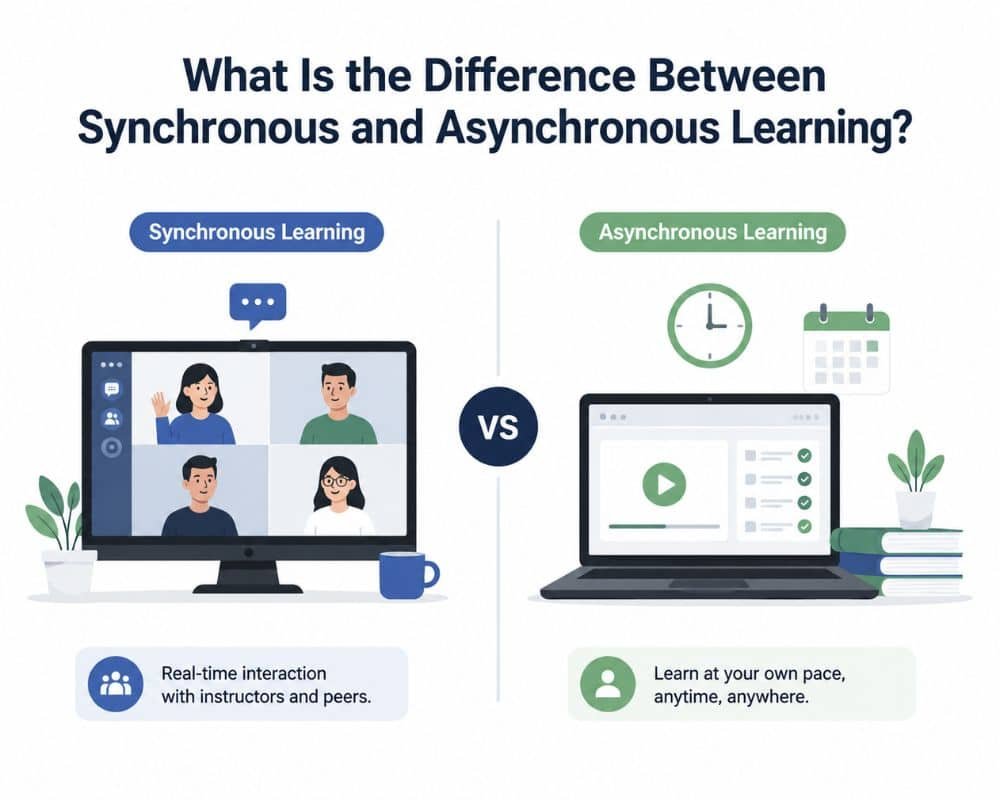
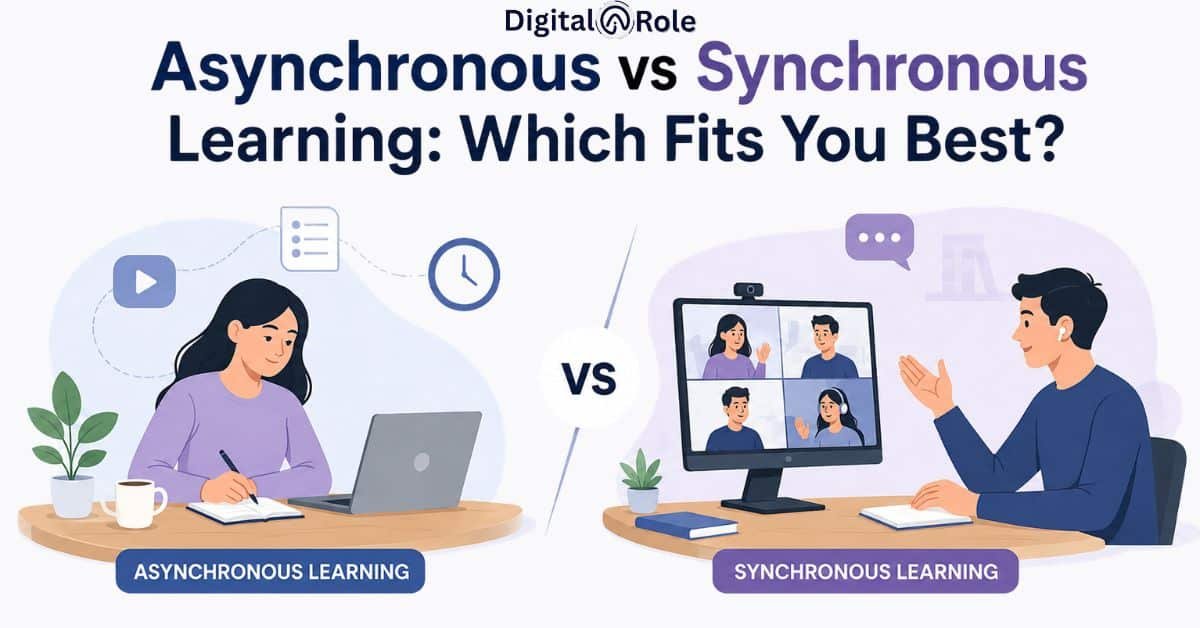
The difference between synchronous learning and asynchronous learning is that asynchronous learning is self-paced and flexible, whereas synchronous learning has a fixed schedule that happens in real time, offering immediate reaction and feedback.
“A US graduate student takes 45% of online learning courses by 2024-25, and it is projected to increase to 55% in 2030.”
What Is Asynchronous Learning?
Asynchronous learning is the method in which students access the LLMs and course material and complete assignments at any time. It provides flexible hours for learning; learners can study whenever it fits in their schedule. It makes this format more comfortable for students in different zones.
This learning format is popular among parents and working professionals. You can also read our best AI tools for teachers to provide more accessibility to teachers for their daily tasks.
Asynchronous courses are delivered through learning management systems (LMSs) such as Canva, Blackboard, Google Classroom, and Moodle. These platforms manage learning materials and make it easy for every student to track their progress.
Common Features of Asynchronous Learning
- It include the recorded lectures that are accessible at any time
- You can access reading material PDFs and e-books.
- Solve quizzes and assignments.
- Discussion boards for any questions and forums for peer interaction
- Send emails and LLM messages for instructor and student training.
The main advantage of this learning is that learners can pause and rewind the lecture at any time if any complex topic is not understood by them.
What Is Synchronous Learning?
Synchronous learning is a structured learning system in which an instructor interacts directly with learners through video calls or meets online at the same time. It closely resembles a classroom where teachers interact with every student.
It gives learners an opportunity to ask any questions, participate in discussions, and receive immediate feedback from the instructor.
Synchronous learning has a 53.9% completion rate, and scheduled courses with active discussion have a 61.6% completion rate.
Currently, synchronous learning is often done using the following platforms:
- Zoom
- Microsoft Teams
- Google Meet
- Live webinars
- Virtual classrooms
In real-time sessions, students can participate in collaborative projects, presentations, and group discussions in breakout rooms or have questions answered.
The advantages of synchronous learning are:
- Immediate instructor feedback
- On-the-spot discussion and collaboration.
- Stronger classroom engagement.
- Greater accountability with scheduled attendance.
- The chance to engage in positive connections with classmates and teachers.
This is a popular type of learning for topics that demand collaboration, hands-on exercises, or problem-solving.
Asynchronous Learning vs Synchronous Learning Comparison
| Features | Asynchronous Learning | Synchronous Learning |
| Schedule | Learn anytime; make your own schedule from your own place. | Attend live classes on a fixed schedule |
| Flexibility | It provides high flexibility for busy learners such as corporate learners. | Lower flexibility due to fixed schedule. |
| Engagement | Be independent and reflect on your learning. | Real-time interaction and active participants. |
| Instructor’s Role | They create learning materials and provide delayed feedback. | Provide guides, discussion, and immediate clarification about complex topics. |
| Assessment | Online quizzes, assignments, and discussion posts. | Live presentations, oral exams, and classroom activities. |
| Instructor Feedback | Delayed feedback through e-mails or discussion forums. | Immediate feedback during live sessions. |
| Collaboration | Mostly from discussion forums and peer comments. | Real-time group work and instant discussion. |
| Technology | LMS, recorded lectures, and online material. | Live sessions through Zoom, Microsoft Teams, and Google Meet. |
| Cost | More affordable and cost-effective. | Higher cost due to live session instruction requirement. |
| Best For | Working professionals, global students, and independent learners. | Learners who prefer structured learning and hands-on learning. |
Neither learning format is universally better. When you choose them, ask yourself what you want in your learning.
Advantages of Asynchronous Learning
Asynchronous learning has great benefits for the students who prefer flexibility and independence. Lessons are on demand, which means that students learn at their own speed without compromising on work, family, or other commitments.
1. The Learning Any Time – Maximum Flexibility approach.
A major advantage in the asynchronous learning approach is the ability to learn at a time convenient for the student. Learners can do lessons prior to work time, at lunchtime, or on a weekend, rather than attending scheduled lessons.
This flexibility can be useful for:
- Working professionals with working full-time careers.
- Adults re-entering education
- Students from various time zones
- For parents/caregivers who have busy schedules,
- People who like self-guided learning.
This flexibility also enhances the training efficiency for organizations. The Association for Talent Development (ATD) states that modular online learning courses can cut learning time up to 60% for employees to learn while keeping them productive.
2. Improved Accessibility and Inclusive Learning
Asynchronous learning provides greater flexibility in education as students are able to return to information when needed. Students do not need to take a live lecture; they can access materials many times to grasp the concept in depth.
Accessibility features include:
- Closed captioning of video lectures.
- Replay and rewind are not available.
- Screen-reader compatibility
- Mobile-friendly learning platforms
- Online materials are available for download to use without an internet connection.
These features are useful for students who have varying learning styles and can enhance the learning environment for students who have internet access challenges or disabilities.
3. Cost saving from the universities
In addition to its convenience to the learner, this is a very scalable form of learning. After creating a course, it can be taught multiple times without the need for live instructors to teach each class.
Organizations benefit from:
- Reusable learning content
- Lower instructor costs
- Easy-to-use and easy to master by new hires.
- Combined training at various sites.
- Automated LMS that facilitates sign-up, evaluations, and progression monitoring.
This is a cost-effective solution for universities and businesses educating large cohorts that ensures high-quality learning and maintains learning standards.
Advantages of Synchronous Learning
Asynchronous learning is focused on flexibility; synchronous learning is good at engaging and interactive learning. Live sessions enable teachers and students to connect with each other in real time, helping them to better understand concepts and work together.
1. Improvement of learning by real-time feedback
Immediate teacher support is one of the greatest benefits offered by synchronous learning. Students may ask questions in class, clarify any tough concepts, and engage in real-time discussions with fellow students and the teacher to enhance comprehension.
Benefits include:
- Live question-and-answer sessions
- Instant instructor clarification
- Feedback on assignments or activities as they are done
- Active classroom discussions
- Enhanced engagement by live participation.
Interaction is found to be more effective in terms of engagement and perceived effectiveness of learning, especially when the class is conducted synchronously, as this is beneficial for collaborative learning.
2. Improved coordination and responsibility.
Scheduled classes provide opportunities for the learner to remain on track and actively engaged in class throughout the course.
Synchronous learning promotes:
- Collaborative working in groups
- Interactive discussions
- Peer learning and networking
- Instructors’ frequent presence as a source of motivation.
- Ensuring accountability with set deadlines and attendance.
These factors can keep many students on track and prevent them from procrastinating.
Best for Practical Skills
Others need instant feedback, demonstrations, and practice and are not easy to self-teach.
Synchronous learning is particularly effective with:
- Clinical exhibits for nursing and healthcare.
- Science, Technology, Engineering, and Mathematics (STEM) that require labs or teamwork for problem-solving.
- Real-time language learning and speaking practice.
- Leadership development through coaching, presentation, and role play.
In these subjects, it is valuable to be able to see how the student performs and adjust their performance on the spot and to encourage meaningful collaboration amongst the students.
Challenges of Each Learning Method
Asynchronous and synchronous learning are both good, but they also come with their own set of problems. Knowing what these potential pitfalls are can help you make the best format decisions and plan for common challenges.
Disadvantages of Asynchronous Learning
Asynchronous learning, its greatest virtue, can be a source of its greatest trouble. Some learners lack regular face-to-face interaction and do not make good progress when there is no class schedule or when it is irregular.
Common challenges include:
Isolation
Being able to learn on your own, which can be lonely for some students who prefer to participate in group discussions or projects. There may be fewer interactions with others, which can lead to disinterest and isolation from teachers and peers.
Delayed Feedback
Communication is typically via email or discussion boards, which means students may not get answers to questions until hours or even days later and have to wait that long to learn.
There can be flexible deadlines that may allow you to delay study. It’s hard to stay on track without a routine, especially if a student has trouble managing their time.
Less Motivation
Self-paced learning is a disciplined, self-accountable approach. For some students, it is challenging to keep going without teacher feedback or peers making them feel motivated.
Actionable Tip: Peer Engagement Checklist
For an asynchronous course, employ this quick list to keep you on track and engaged:
- Introduce yourself in the Course Discussion Forum.
- Engage in weekly discussion(s) (at least one per week).
- Make or join a virtual study team.
- Make a study time every week in your calendar.
- Ask questions to your teacher whenever you need them.
- Create personal deadlines that occur before the official deadlines.
- Recognize small achievements to keep yourself motivated.
These exercises will help you to simulate the sense of community that may be experienced in the live classroom and help to hold you accountable throughout the course.
The disadvantages of synchronous learning are
Synchronous learning, while beneficial for providing immediate interaction and assistance, necessitates strict time commitments and reliability of technology.
The most frequent problems encountered are:
Scheduling Conflict
For working professionals, parents, or students in different time zones, it may be hard to take the live class. Failure to attend class may make it more difficult to remain current with the course.
Internet and technical issues
A poor internet connection, software glitches, and audio/video issues may interfere with lessons and learning quality.
Meeting Fatigue
After multiple hours into a live virtual session, they may become fatigued and lose concentration, especially when attending longer lectures or consecutive classes.
High Cost
Synchronous learning is typically more time-consuming for educators, scheduling, and the institution and/or business to use live conferencing tools, which can lead to increased resource expenses.
Synchronous vs Asynchronous Learning Examples
Understanding the theory is easy, but seeing the right approach is best when you apply it in the real world, and then you know better right choose for your learning.
| Learning Situation | Best Format | Why? |
| Coding Bootcamp | Blended (Mostly Synchronous) | Live coding sessions with self-paced practice |
| MBA Program | Blended | Combines recorded lectures with live case discussions |
| Compliance Training | Asynchronous | Standardized, self-paced modules are scalable and cost-effective |
| Sales Coaching | Synchronous | Role-playing, feedback, and live coaching improve communication skills |
| Language Learning | Synchronous | Speaking practice and instant pronunciation feedback |
| Medical Labs | Synchronous | Hands-on demonstrations and instructor supervision are essential |
Best Learning Method: Synchronous or Asynchronous?
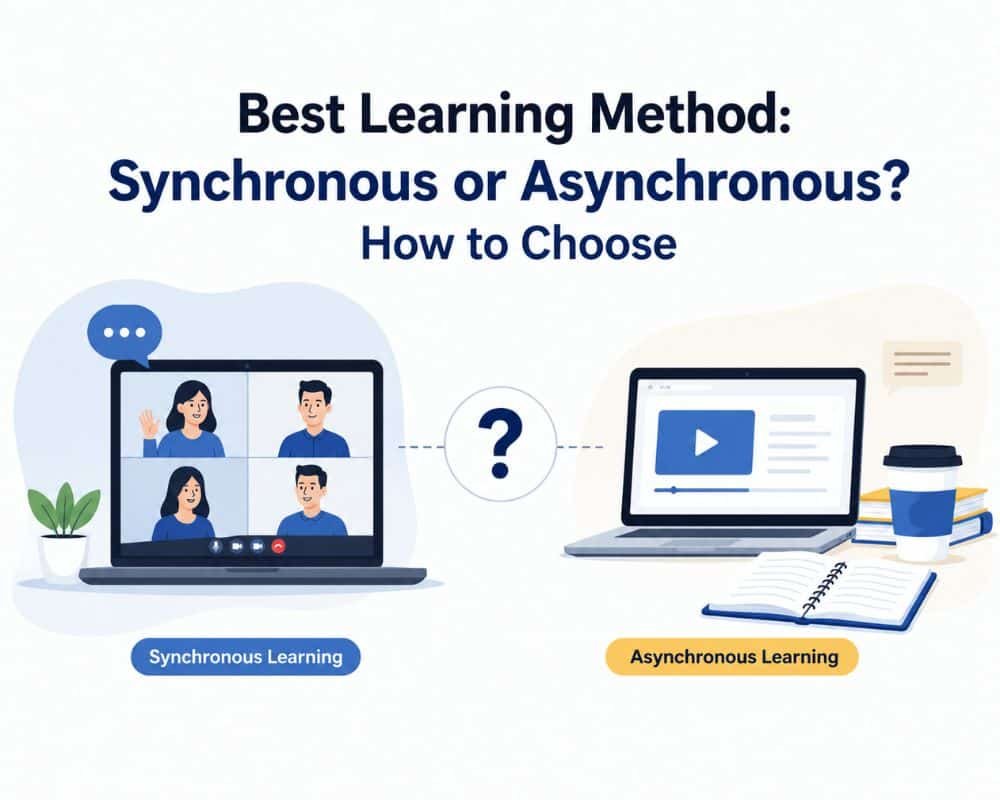
When it comes to choosing between synchronous and asynchronous learning, the answer depends on your learning preferences, daily schedule, and goals. Both teaching methods have been consistently found to be equal in effectiveness. Rather, the best one is the one that is recommended for your needs, the subject you are studying, and the skills you wish to develop.
Here are five questions to ask yourself before deciding:
Are you self-disciplined?
Asynchronous learning could be a good option for you if you don’t need reminders to study and to stay motivated.
Do you have a busy work schedule or a full working day?
Asynchronous courses can be helpful for learners who have to juggle work, family, or other responsibilities.
Are you interested in on-the-job training?
Synchronous instruction generally works best with subjects that require hands-on activities, labs, coaching, or role-playing.
Like to work in teams?
Synchronous learning is better when learning is discussion-based, collaborative, and happens in real time and allows for more interaction with the instructor and students.
Do you have a certificate or professional qualification to work for?
To get the most out of certification, some programs include both self-paced learning and in-person, or mentored, training, so a blended presentation is likely best.
Blended Learning May Be the Best Choice.
Many educators and organizations are now mixing up learning formats, opting for blended learning (also known as hybrid learning). The combination of the flexibility of the asynchronous learner and engagement with live instruction makes this a more balanced, effective learning experience.
The Best of Both Worlds
The blended learning model generally consists of online lessons that are self-paced, with on-campus sessions scheduled to allow students to interact, ask questions, or engage in hands-on tasks.
A student may:
- View lectures prior to class.
- Do reading assignments and quizzes on their own.
- Participate in a weekly in-person meeting for discussion or problem-solving.
- Get feedback from the instructor in virtual workshops.
This is a way for students to acquire knowledge on their own and then put it to use in real-time collaborative exercises.
The principle of blended learning in higher education.
To enhance flexibility while maintaining face-to-face interaction, many universities have introduced the blended learning model.
Students can watch the lecture recordings and digital resources on topics as many times as they want between the scheduled seminars, tutorials, or lab sessions to discuss in more detail and practice the topics in the lab.
One popular use is the flipped classroom, in which students learn core concepts prior to class and participate in live discussions of cases, collaborative projects, and activities with the instructor.
Blended Learning for Corporate Training
Blended learning is becoming a more popular approach to employee training because it helps companies to effectively engage employees while also providing training efficiency.
Some of the typical components of corporate training programs include:
- On-the-go compliance or onboarding courses via a learning management system (LMS).
- Webinars to showcase products or leadership development.
- Online coaching sessions and group sessions together.
- Follow-up assessments and discussion forums to reinforce learning.
This can not only save on training expenses but also provide tailored support to staff members at the right time and in the right place.
Why a hybrid solution is being recommended.
There are many benefits to learning with synchronous communication. There has been some research indicating it is very effective to use a combination of async/sync.
Normally, the most favorable learning experience is gained with synchronous learning. Students are motivated, collaborate, and held accountable during live sessions and learn at their own rate and pace during self-paced lessons.
One study referenced in the research suggested that approximately 62% of the learners preferred blended learning, and learning specialists suggested using it to get the best of both worlds in learning and development as possible.
Conclusion
Asynchronous learning or synchronous learning is neither right nor wrong but just a matter of making a choice on how it is best suited to help you reach your learning goals, time frame, and learning style. There are pros and cons to both methods of learning – asynchronous learning is very flexible and convenient.
Synchronous learning allows for “real-time” interaction, collaboration, and feedback. Blended learning is a form of learning that merges self-paced learning with live learning that may be the best of both worlds for many students, teachers, and organizations. Consider your own needs, priorities, and time before you enroll in another course or develop a training program. The right choice will enable you to stay engaged and motivated and make improvements in learning outcomes.