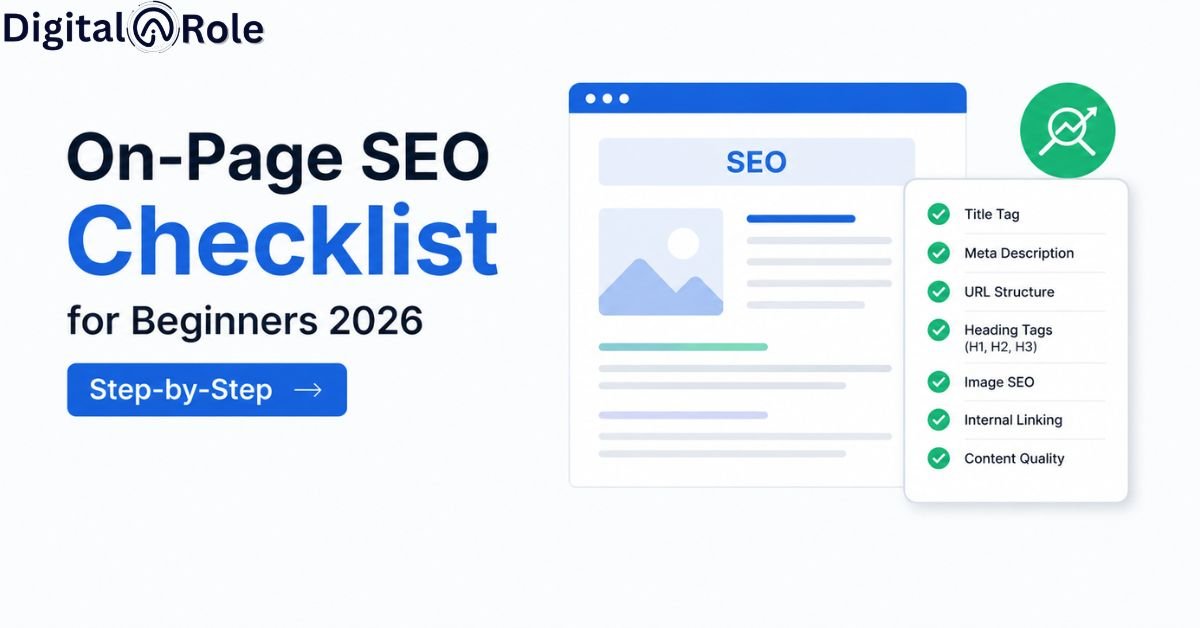
On-Page SEO Checklist for Beginners 2026 Step-by-Step
Most beginners think taking backlinks from authority websites is the main ranking purpose, and yes, links matter. But 80% of ranking power comes from your own on-page elements, which contains the title, keyword placement, headings, and your content structure. That’s where the On-page SEO checklist for beginners 2026 comes in, and you need to fix them today.
Newbies research the keyword and create quality content from competitors, but you do not hit higher traffic because you ignore critical on-page optimization, which Google and AI need to understand your content exists.
It’s 2026 now. Google AI systems are smarter, prioritising semantic relevance and user intent, but they require more demanding technical signals. A missing meta description, an unoptimized blog structure, missing images’ ALT text, and not including E-E-A-T in articles. None of these elements is a “nice to have.” It is all the ranking factors that determine whether you appear in the AI overview or remain visible.
This is not a generic SEO guide. It includes an on-page SEO checklist for publishing an article, so you can get 0-5,000+ in under 60 months if you work consistently.
By the end, when you finish reading, you understand why meta titles and core web vitals are the potential ranking factors that you never leave behind.
In this article, you’ll exactly know how to fix every error on a webpage. With a complete on-page checklist, step-by-step, with plain English. No guessing, no overwhelm, just a clear, beginner-friendly roadmap that helps you to get found on Google in 2026.
Why does an on-page SEO checklist matter in 2026?
As Google rolls out their updates every 3-6 months, the recent core update, March 2026, tells us that E-E-A-T is the main element that is considered in every article, which means the author who writes the article has enough experience so they provide the right information and do not collect it from other sources.
Your content is packed with detailed information, which can be measured using a user meter scale. That means on-page optimisation directly impacts whether Google considers your content trustworthy enough to rank.
With a solid on-page SEO guide before publishing the article, you are gambling on the visibility.
If your article is worthy of ranking but fails to provide clear signals (e.g., poorly structured headings, under-optimized title tags, or slow load times), then Google and AI Overview systems will not consider your article as having what it takes to be “ready for prime time.”
According to SEO statistics,“The brands who cited AI overviews earn 35% more traffic then brands that are not cited.”
The stakes are high: if you don’t do on-page optimization, your article will never rank—that’s it! Competitors who don’t have as strong a message, but who have optimized their technical elements well, will rank above you. This search checklist is not optional in 2026, when the world is in the midst of an AI-driven search revolution; it’s the building block for your discoverability, authority, and traffic.
Let’s sort this out before you post it again.
The Essential On-Page SEO Checklist for Beginners 2026
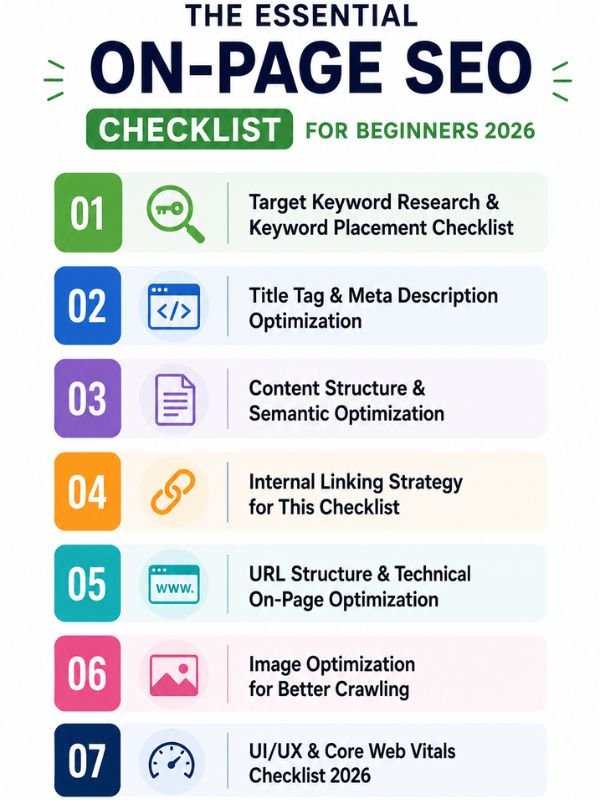
Every beginner needs an on-page checklist because it provides a clear benchmark for what to include on their website, helping them rank more easily on Google.
Target Keyword Research & Keyword Placement Checklist
You can optimize nothing without the right keyword. If you wish to learn more about the keyword, you can use the Google Keyword Planner, Ahrefs, or SEMrush.
If you’re just starting, avoid very competitive keywords.
Search for keywords that have commercial intent (increased likelihood of conversions)
✅ Identify user intent (informational, navigational, transactional)
- Informational: ‘how to,’ ‘what is,’ ‘guide to’ (ranking easier for beginners).
- Analytical: “read,” “sign up,” “forecast” (more commercial use)
- Take care to align your content type with intent.
✅ Use keywords in title tag (first 60 characters)
- Google highlights matched words in search results.
- The faster you can place the early, the better your CTR will be.
✅ Embed keyword within the first 100 words naturally.
- Signals relevance to search algorithms as soon as it becomes relevant
- Helps AI Overviews identify your topic
✅ Include body 2-3 LSI keywords (semantic variations)
- Example: on-page optimisation + on-page seo + on-page seo checklist
- Improves Google’s understanding of topic depth
- Prevents “keyword stuffing” penalties
✅ Conversational and long-tail keyword phrases
People type or speak longer, more focused phrases when they’re ready to find something, hence the term “long-tail keywords.” Conversational phrasing is now the standard in 2026, thanks to voice search and AI chatbots.
Smart beginners don’t focus on ‘on-page SEO’; they focus on ‘How do I do on-page SEO for my blog?’ (easier to rank, less competition, and more intent).
Finding and using conversational keywords
- Start typing your topic and note all the suggestions that appear as full sentences as you type in Google’s autofill.
- Read forums such as Reddit and Quora, and use the exact wording that people use when they ask about your topic there.
- Make headings as questions: ‘How do I optimize my title tag?’, is optimized for the exact voice topic people speak.
✅ Do not include keywords in the content (naturally occurring density: 0.5-1.5%).
- The unnatural repetition tank rankings for 2026 are compiled every day.
- Unnatural repetition tank rankings are released daily.
- Read aloud—If it sounds like a robot, rewrite it.
Meta Tag Optimization & Meta Description Optimization
The first impression in search results is your title tag and meta description. Tune them up as if they were the traffic director—after all, they are!
✅ Optimise title tag to be 50-60 characters long (which is ideal to display in SERPs)
- When posting on mobile apps, Google displays the response up to ~60 characters.
- Every character counts
✅ Use the main keyword in the first sentence.
- Put the main keyword in the first sentence or two.
- Positions 1-3 are ideal.
- Assists in both CTR and relevance signals
✅ Write for clicks (benefit-driven, curiosity-focused)
- This is a positive approach because it is beneficial and curiosity-driven.
- For Example: On-Page SEO Checklist For Beginners 2026: Rank In 10 Minutes”
- Leverage power words: Essential, Complete, Step-by-Step, 2026
✅Meta Description: 150-160 characters; use secondary keyword.
- The primary keyword is mentioned once.
- Naturally include “SEO checklist before publishing article.”
- Example: “Before Publishing, Here’s Your Full SEO Checklist: Check Out This On-Page Optimization Checklist 2026 to Rank Sooner & Generate Traffic.”
✅ Add a number/year (2026 for freshness signals)
- The terms “2026,” “Updated,” or “Latest” indicate that the information is recent.
- If you have evergreen content, it can improve CTR by 15-25%.
Another tip: Try out various titles using Google Search Console. If your title has a high number of impressions but a low CTR, it’s time to rewrite it.
The structure of content and its optimization for semantics.
The AI Overviews have been introduced, and Google’s ranking algorithm has started to focus on semantic structure. This means the organization of your content is as important as the words themselves.
✅ Avoid unnecessary heading levels (H4 or lower)
- One H1 per page – use as main title
- H2S for major sections
- H3S for subsections
- Use of skip hierarchy (H1 to H3) will confuse crawlers.
✅ Organise topics into clusters with subtopics
- When the primary keyword is “on-page SEO,” subtopics are title tags, meta descriptions, and internal linking.
- Optimizes content to help Google recognize how in-depth it is.
- Signals expertise (E-E-A-T)
✅ Use at least 1,500 words (the benchmark for the 2026 rankings)
- Average number of words on first page: 1,600+
- Length = opportunity for more keywords + subtopics
- However, don’t focus on the number of words but on the value.
✅ Scannability: Use bullet points (AI Overviews love it).
- 40% of readers scan (do not read)
- AI Overviews are generated from the information contained in bullet points.
- Makes content “skimmable”
✅ Include semantic variations of the main topic
- You can find the terms “on-page optimization” or “page optimization” as well as “on-page factors,” which are synonymous with “on-page SEO.”
- Helps rank for related searches
- Rewarding is an integral part of NLP. Rewarding is a key element of NLP.
✅ Add definition paragraphs (helps featured snippets)
- On page SEO: Example: “On page SEO is the process of optimising individual pages of a website…
- Featured snippets frequently feature definitions.
- Position 0 = maximum visibility boost.
Internal Linking Strategy for This Checklist
Internal links are a vote-of-confidence signal. They spread authority across your site and aid readers in navigation.
✅ Link to 3-4 internal pages with relevant anchor text
- The more, the better; quality over quantity.
- There should be a purpose for each link (not forced)
- Reference links (not just footer)
- Clicking contextual links has more weight than clicking on random links on the same page.
- Content for the guide: “Read our guide on [internal link: Meta Descriptions].”
- Firstly, connect to the pages of authorities on your website.
- Your cornerstone content (pillar pages) should get priority.
✅ Create topical authority clusters.
For beginners, it’s about building topical authority. For those just starting out, it’s about developing topical authority.
- Write one long, in-depth article about your big topic, called a ‘pillar page’ (like this checklist post)
- Create in-depth cluster articles on subtopics such as ‘how to write a title tag, ‘what is a meta description,’ and ‘how to use H1 tags.’
- Link all cluster articles to your pillar page and each cluster article to your pillar page.
- Don’t write articles that aren’t related to your topic — it weakens your authority signal in Google’s eyes.
✅ Incorporate keywords into your anchor text (no “click here”)
- Clicking “Read our guide on on page SEO optimization” ✅
- “Click here” ❌
- Improves the understanding of linked content for both users and crawlers
- Strategy: Connect to other relevant articles that are complementary to THIS article’s topic, to indicate expertise (a “topic cluster”).
URL Structure & Technical On-Page Optimization
When you optimize your on-page content, the URL structure is the main element that appears on Google. But beginners also struggle to fix technical SEO issues on websites. So here are some elements discussed that help you a lot.
Both your customers and search engines read your URL. Make it count.
✅ URL must be less than 75 characters.
- Shorter URLs are a little bit better.
- Easier to share and remember
- Example: /on-page-seo-checklist-beginners/ ✅
- Example: /2026/guides/seo/on-page-optimization/checklist-for-new-websites-and-blogs-that-want-traffic/ ❌
✅ Use hyphens to separate words (not underscores)
- Hyphens are separated by Google.
- Search algorithms do not consider underscores.
✅ Include primary keyword in URL slug.
- Primary keyword in the URL slug.
- Reinforces topic relevance
- It is visible in SERPs (It increases CTR by ~3-5%)
✅ Do not use dates in URLs (unless required)
- Dating your content can throw off the reader’s sense of time.
- Dates for news / time-sensitive material are not required, but they are helpful.
- Improved: Update date of content, not URL
Remove common English words: a, the, and (STOP WORDS)
- “/on-page-seo-checklist-beginners/” ✅
- “/the-on-page-seo-checklist-for-beginners/” ❌
- Maintains short and readable URLs
Optimizing the image for crawling
Images increase engagement but decrease page speed when they aren’t optimized. Google doesn’t “see” images; it reads the ALT text.
✅ Compress images (under 200K per image)
- TinyPNG, ImageOptim, or Squoosh can be used to optimize images.
- The larger the images, the slower the load time.
- Slow load times = ranking penalties.
✅ Use descriptive alt text with keyword context
- For example: SEO checklist before publishing an article with on-page optimization items.
- Not: image123 or screenshot
- Alt text is more than just an accessibility (E-A-T) signal; it also improves accessibility.
✅ Include image captions (which will improve keyword relevance)
- Captions are read by users AND algorithms.
- Words are provided, and there is a good opportunity to naturally reinforce these keywords.
Use WebP format for faster loading ✅
- 25-35% smaller than PNG/JPG
- Works with all current web browsers.
- Improved Core Web Vitals.
✅ Avoid using generic file names like IMG_001 (use descriptive names).
- Example: on-page-seo-checklist-2026.webp ✅
- Example: IMG_1847.jpg ❌
- File names are crawled by Google.
UI/UX & Core Web Vitals Checklist 2026
✅ Under 2 seconds (desktop)
- The mobile-first index = speed is important for mobile.
- Each second delay = 7% increase in bounce rate
- Test: Google PageSpeed Insights
✅ Mobile responsiveness: Check on all screen sizes
- 60%+ of traffic is mobile.
- Unresponsive = instant bounce
- Utilise the Google Mobile-Friendly Test.
✅Largest Contentful Paint (LCP): Less than 2.5 seconds
- The main content of the document is visible.
- Optimize: Image Compression, Server Response Time, lazy loading
✅ Cumulative Layout Shift (CLS): Under 0.1
- Don’t change the layout when the pages load.
- Okay, so if text loads before ads or images, that’s bad UX. Problem: Ads or images loading after text = bad UX
- Solution: Allow room for elements to move.
✅ First Input Delay (FID): Less than 100ms
- The time it takes for the computer to react to a user’s actions.
- The main thread becomes blocked by heavy JavaScript. Heavy JavaScript is blocking the main thread.
- The solution to the problem is to delay loading non-essential JS.
✅ Remove interstitials/popups above the fold
- Does the pop-up come up before the user scrolls? Ranking penalty.
- Show the user content first (allow the user to see Content first)
- There are exceptions, such as legal/consent popups (GDPR/cookies).
✅ Make it readable (font size 16px+ minimum)
- So, discontinue pinch-zooming for mobile users to read.
- Line length: 1.5-1.6 (breathing room)
- This is a contrast ratio of 4.5:1 (accessibility + usability).
Quick Implementation Timeline:
- Before publishing: 10 minutes (keywords, title, structure)
- During editing: 15 minutes (internal links, images, readability)
- Before hitting publish: 10 minutes (Core Web Vitals check, final review)
Total: 35 minutes to implement an SEO checklist that can earn you 1,000+ monthly visitors.
Use this checklist every time you publish. Bookmark it. Your future traffic depends on it.
Pre-Publishing On-Page Optimization Checklist 2026
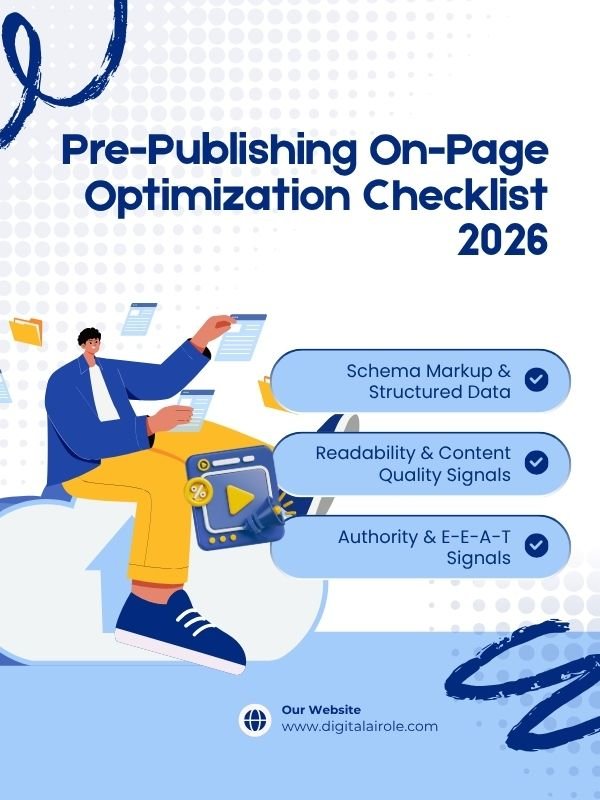
Schema Markup & Structured Data
Schema markup is like a translator that helps your content be understandable to Google’s AI systems. It gives Google an idea of what your content is. It informs Google what your content is, which makes it eligible for special SERP features and AI overviews.
✅ Add Article schema (helps AI overviews).
“This is a structured article with these attributes,” Google informs.
- This information is not required for all texts; in certain cases, it might not even exist. Not all texts have this information; sometimes it may be missing.
- If you can, use JSON-LD format, as it’s the easiest to implement.
- This snippet example should look like:
- Why it matters: AI Overviews are based on properly marked-up articles.
✅ Add Breadcrumb List schema (helps with navigation)
- Demonstrate Google’s website structure: Home > Blog > This Article.
- Enhances ease of crawling and user navigation
- Implements a breadcrumb trail in the SERPs
- Rewrite: “On-Page SEO: Checklist for Beginners”
✅ Add Organisation schema (brand authority)
- Helps build trust in your company/site
- Includes: name, logo, contact information, social profiles
- Supports Google’s ability to link all your content together with your brand
- E-E-A-T signal: Proof of credibility of the website or company.E-E-A-T signal: Evidence of credibility of the website/company.
✅ Think about using the FAQ schema if it applies.
- If you have answered 4+ questions in a natural way in your article, you should use the FAQ schema.
- Questions are shown in the SERPs as “expandable” items.
- Higher CTR potential
- On-page SEO: What is it?
✅ Validate markup with Google’s Rich Results Test
- Go to search.google.com/test/rich-results.
- If you can, copy and paste the URL of your article.
- Remove any warnings/errors (do not ignore these)
- Recheck after 24-48 hours (cache clears)
- Side note: Structured data does not guarantee any rankings, but it can boost visibility and CTR. No schema = no eligibility for AI Overview.
Readability & Content Quality Signals
Google has a readability algorithm. Google has a readability algorithm that measures how readable your content is. Still, no matter how well optimised, unreadable content is demoted. It’s a direct E-A-T signal.
✅ Flesch-Kincaid Readability: 80.0 (very easy)
- 60-70 = easy to read (good for most audiences)
- 50-60 = Moderately difficult
- 50 to 60 = Moderate (makes some readers)
- Tool: Yoast SEO, Hemingway Editor or Rank Math (all can calculate this)
- Why it matters: Eases the burden on those who are just starting out.
✅ Passive voice percentage < 10%
- Passive: “SEO experts have developed the checklist.
- Active: “This SEO checklist has been developed by SEO experts.
- Active voice = clearer, more interesting, more authoritative
- Yoast SEO underlines sentences lacking verbs.
- The rule of thumb is to use 90% of sentences in the active voice.
✅ Avoid lengthy paragraphs (more than 3 sentences)
- Readers can immediately jump into the content of the paragraphs – wall-of-text paragraphs.
- People tend to glance at, not read, news articles on mobile devices.
- The use of white space enhances understanding by 20%.
Example:
❌❌ “On-page SEO is the process of optimising a web page to get better ranking and more relevant traffic from search engines. It encompasses a variety of components, including title tags, meta descriptions, heading structure, images, and technical aspects. This is unlike off-page SEO, which involves activities you do outside your website.
✅ “On-page SEO: The process of optimising any specific web page to achieve higher positions in the search results. On-page SEO is distinct from off-page SEO, which involves actions outside of your website.
Use data or statistics with credible sources (if applicable).
- Include numbers to support statements. Examples: 60% of traffic is mobile (cite source)
- This is your link source, with articles ranking 2.4 times higher.
- Articles supported by research can be trusted by Google.
- E-E-A-T signal: Original research + citations = expertise.
- The addition of case studies or real examples is recommended.
- Links to hypothetical examples for the understanding of beginners.
- Real case studies confirm that your techniques and strategies are effective.
Speaker: “The following checklist was used by Company X, resulting in Y.
Expertise signal: Demonstrate past experience with this, not just theory.
Authority & E-E-A-T Signals
Here is where you prove that you’re not another blogger. These signals are indicators to Google (and visitors) that you are a trusted authority.
✅ Reference 2-3 credible, authoritative sources (2025-26 statistics)
- Instead of citing, cite RECENT data.
- Sources should be updated within the last 6 months.
Examples of sources for SEO:
- Google’s official guidance, Google Search Central
- The data in this document were gathered from HubSpot Research (original studies 2025-26).
- Niel Patel (industry benchmarks)/Moz.
- Do NOT use Wikipedia, Medium, or old blog posts.
- “Source” = “According to [Source], [statistic].” [Link]”
✅ Connect Google Search Central, HubSpot, and Neil Patel (for reference)
- Those are authoritative sites that Google trusts.
- Connecting with them demonstrates that you conduct thorough research.
- Improves your credibility by association
- It is possible to optimize Core Web Vitals for Google’s 2025 update. Google’s 2025 Core Web Vitals update emphasizes specific adjustments.
- Include a bio of the author, including credentials.
- Who wrote this? How can you convince readers of your credibility?
- Include: Years of Experience, Notable Clients/Achievements, Certifications
For example: SEO Specialist with 5+ years’ experience optimizing 50+ websites to the first page.
Place at the end of the article/byline as author
Expertise is evident in the writing: clear evidence of expertise:
✅ Include publication date + last updated date
- Be sure to add the date of publication and the date last updated.
- Publication date: June 15, 2026
- The information on this page is subject to change. Where applicable, the latest update is on 20 December 2026.
- Recency signals aid those rankings and credibility.
- For example, the number “June 2026” in the usage “Original publication June 2026” means the month of June in 2026, while “December 2026” in the usage “Last update December 2026” means the last update in the month of December in 2026.
- It is relevant today, based on the readers + Google.
✅ Use original research/studies to support your discussion.
References to others’ work are welcome; experiments and investigations of one’s own are better.
The examples are surveys, case studies, and data analysis.
In an analysis of 500 blog posts, we found that posts using schema markup rank 34% higher.
Original research is the top authority for E-E-A-T. Original research has the highest E-E-A-T authority.
✅ No AI-generated fluff—add human value
In 2026, AI will write article after article for the millions of websites. Google will be able to detect content that is generic, “stuffed,” and lacks value—and it will demote you. Google’s ‘helpful content’ algorithm prefers pages with actual knowledge and experience; if it were a real person, it would have acquired it by doing the thing it is writing about.
Making your content really human
- Use real-life screenshots from your own experience—your own Google Search Console experience, your own results, etc.
- Include your personal comment: ‘From my experience, this is a better strategy than…’ or ‘I did not see that in most guides.’
- Use specific numbers and results: ‘My traffic went up 47% after I applied this checklist in 90 days.’
- Make a “What most guides get wrong” or “Common mistake” section—only experience will achieve this.
- Use AI to draft each paragraph, then rewrite it in your style and tone, adding a personal perspective to each.
Conclusion
Now you know something that 95% of all beginners do not: on-page optimization is not a random set of tasks; it is a system that communicates to the AI systems of Google how relevant the page is.
Google is saying, “This blog post is reliable, relevant, and worth ranking” with each optimization on this list, from the title tag to schema markup to your Core Web Vitals.
Well-structured content will be preferred by AI overviews in 2026. Articles that don’t include schema, are broken, or take too long to load don’t get picked up.
Next steps: Check off this checklist and save it for later. Print it. Use it before you publish each article. Apply these 40+ optimizations, and your traffic should increase in 90 days or less.
Ready to rank? The following article will follow this one.