
It is not only your department, but the sales world is changing overall. The HubSpot 2025 Report also states that the average B2B sales process is 22% higher than it was in 2023. Today, buyers are flooded with options, are more content-reviewed to make a purchase, and engage more stakeholders than ever before. The prolonged research period leads to decision fatigue and delays deal closure.
So, what’s the fix? Simplicity and automation.
Companies that are automating their sales activities, from lead qualification to closing deals, are now converting at a rate of up to 40 percent faster. Making it simple does not mean cutting corners, but simplifying the process so that it becomes less frictional and less repetitive, allowing teams to spend more time on what actually drives revenue: developing meaningful customer relationships.
In 2025, simplicity is your competitive advantage. With AIs integrated into workflows and sales synchronized with marketing data, your team will be able to run at a faster pace, minimize human errors, and provide a buyer experience that feels effortless —precisely what contemporary B2B customers desire.
For more information: History of Marketing Automation
Understanding the B2B Sales Process

The B2B sales process consists of several key stages
- Lead generation, where businesses attract potential buyers through marketing
- Lead nurturing involves building a relationship between the customer and seller that provides value to leads.
- Lead qualification determines whether a product or service is a good fit or not.
- Negotiations where terms and conditions are discussed for further processing
- Closing when the deal is final.
The Modern B2B Sales Process, Step by Step

B2B sales have evolved beyond a linear process. Instead, they are a data-driven, AI-enabled cycle that is constantly adjusted to customers’ intent and engagement indicators. This is how to streamline all the phases to 2025 and beyond.
1. Smarter Lead Generation using AI Tools
Days of cold calling and static lead lists are gone.
In today’s world, predictive analytics is utilised in AI-based prospecting tools to identify and rank the most promising leads. Tools like Apollo.io, ZoomInfo, and HubSpot AI process millions of data points, including company behaviour, social intent, and other relevant information, and deliver targeted, high-quality leads directly into your CRM.
This implies that your sales team will have the opportunity to work on warm, willing-to-engage contacts rather than cold contacts.
Pro Tip: Utilise automated outreach campaigns, but supplement them with personalised email sequences to establish rapport more quickly. AI can now customise messages based on user intent, industry, and behaviour, saving hours of manual work while preserving the personal touch.
2. Individualized Lead Nurturing at Scale
Successful B2B selling has become the driving force behind personalisation. However, it was previously impossible to do so on a large scale before the advent of AI.
With AI chatbots and conversation marketing software, such as Drift, Intercom, and HubSpot Chat, it is now possible to cultivate hundreds of leads simultaneously and maintain a human-like approach. These devices immediately attract the attention of visitors, provide answers to frequently asked questions, and filter leads before a human response is entered into a conversation.
Research on AI-personalization in e-commerce indicates that those companies that have applied AI-based personalisation to their lead nurturing process have increased engagement rates by 31 per cent and lead-to-customer conversion time by 25 per cent.
How to implement it:
- Automate personalised follow-ups using behavioural triggers.
- Divide your audience into groups based on their level of engagement and the purpose for which they are attending.
- Establish chatbot processes that would direct the prospects through various stages in a natural way.
3. Predictive Scoring Qualification of Leads
The make-or-buy step in the B2B sales process is typically the Lead qualification, and in 2025, predictive lead scoring will make it a more informed one.
Rather than manually ranking prospects, artificial intelligence (AI) CRMs, such as Salesforce Einstein and HubSpot Predictive AI, automatically rank leads based on engagement behaviour, company-related data, and likelihood of conversion. This eliminates guesswork, allowing your reps to focus on the leads that are most likely to yield results.
Salesforce (2025 State of Sales Report) reports predictive scoring has the capacity to boost close rates by 35 per cent and reduce the sales cycle by almost 20 per cent.
Implementation Tip:
Give scores based on the frequency of engagement, interaction with the content, and fit with the company.
Evaluate your model monthly to adapt to new buyer behaviours.
Combine your predictive model and marketing automation tools to ensure a
smooth flow of data.
4. Automation Supercharges Your Sales Workflow
What would happen if your CRM informed you who is going to purchase next week?
This is precisely what sales platforms powered by AI will achieve in 2025.
The concept of automation does not mean that it will replace salespeople; it will assist them to work smarter, faster, and more precisely. Applications such as HubSpot, Apollo.io, and Lemlist have transformed the way sales teams work in the 21st century.
The teams are enabled to manage hundreds of interactions simultaneously with features such as AI-driven email sequencing, automatic pipeline tracking, and CRM-integrated scheduling.
AI Email Sequencing: The AI engine of Lemlist utilises past engagement information to personalise outreach, ensuring that follow-ups are both timely and relevant.
Pipeline Automation: HubSpot features intelligent workflows that can automatically guide leads through a series of steps and trigger the right actions at the right time.
CRM Scheduling: Apollo.io integrates with team calendars and client preferences, eliminating the delay of back-and-forth communication.
Your sales force will be able to redeem precious time to do what really counts the most – close deals and develop relationships by unloading the weight of repetitive administrative duties.
5. Balancing Sales and Marketing Teams in the Smooth Conversions
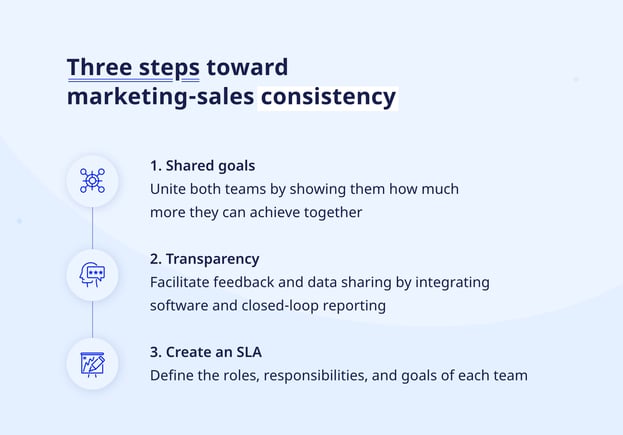
Sales and marketing alignment is not merely a catchphrase; it is the secret of the high-performance B2B organizations. As the LinkedIn B2B Report 2024 explains, businesses with closely knit teams have been found to have 67% better conversion rates and can grow revenue 36 times faster than those without them.
However, the majority of enterprises continue to think about these departments as silos. That is no longer sustainable in 2025.
The way the top teams are gearing up is as follows:
Shared Dashboards: Consider common platforms like HubSpot CRM or Notion AI Dashboards to display key metrics, such as lead quality, pipeline speed, or campaign ROI, in real-time.
KPI Alignment: The common goals of both teams are to target the same metrics, namely, MQL to SQL ratio, customer acquisition cost (CAC), and revenue per lead.
AI-Powered Insights: Revenue.io and Salesforce Einstein are tools that utilize marketing data to identify which campaigns yield the most valuable leads.
Marketing will only provide high-intent leads, and sales will offer feedback on conversion results, making your pipeline more efficient, predictable, and profitable.
6. Making Data-Driven Decisions with the Help of Analytics
Why do your sales become stuck in the funnel?
Your data, or, to be more precise, the way you utilize it, is the answer.
Effective B2B organisations are using revenue intelligence tools, such as Clari, Gong, and InsightSquared, to identify real-time bottlenecks in 2025. These applications extract samples from your CRM, process purchase indicators, and identify at-risk prospects before they become cold.
Measures of sales performance, including response time, engagement rate, and deal velocity, will enable teams to observe where prospects fail and make necessary changes precisely.
Example:
If analytics reveal that leads have stopped after demos, you can implement automated follow-ups, improved onboarding sequences, or utilise AI-assisted product explainers to re-engage them.
7. Clear Communication with Artificial Intelligence
Unclear communication may silently suck the productivity and postpone dealings. This is why, in 2025, intelligent teams are resorting to innovative collaboration tools that are enhanced with AI to ensure that communication remains clean, instant, and contextual.
Technologies such as Slack AI, Notion AI, and Microsoft Copilot have evolved into digital assistants that summarize conversations, identify sentiment in client communications, and even automatically create tasks for follow-up.
The way they can improve your workflow is as follows:
Task Summaries: Copilot will automatically create brief meeting notes and actions to take.
Instant Lead Updates: Slack AI is integrated with your CRM to notify teams as a lead progresses to a new stage or requests a demo.
Sentiment Tracking: Notion AI analyzes the tone of emails and consumer feedback to help reps follow up more efficiently.
A 2025 study by Forrester, which examined collaboration through AI-assisted communication tools, found that teams experienced 29% fewer internal delays and 21% higher client satisfaction, as work progressed more efficiently and received more explicit messages.
Pro Tip: Link these tools to your CRM and project management software so that they can be visible across all teams.
8. Keep It Simple — But Flexible
The greatest pitfall that B2B firms commit to? Making their sales process too complex.
Excessive approval steps, forms, or handoffs can cause slow progress and irritation among teams and buyers.
The most successful companies in 2025 will implement modular sales models—simple and scalable systems that conform to the client’s persona, their industry, and their purchasing process.
The following is an example of that in action:
Minimalism: Each action in your sales flow should have a definite purpose – when it does not produce a conversion, automate or eliminate it.
Flexibility: Have the option to customise outreach frequency, content, and engagement depending on buyer behaviour or account size. Go live in real-time with analytics to adjust your strategy as client needs change.
Once it is easy to implement and allows enough customisation, you build a frictionless buyer experience, which leads to quicker decision-making and extended relationships.
Conclusion
In this article, I’ll explore how a simplified sales process drives better results and increases efficiency in sales leads. Simplifying the sales process generates more leads, provides practical communication skills with customers, and helps automate emailing with a human touch. Make decisions with data analytics and change the sales process to meet customer needs and market trends. Regularly review and optimize the sales process to ensure that no loopholes are created; if any are found, resolve them promptly. By following effective sales strategies, you can easily increase your sales rate and generate a higher conversion rate.