How to Rank Fast on Local Search for Entrepreneurs
You’re implementing everything the local SEO guide told you. You claimed your Google Business Profile and received 15 positive client reviews. You put your business on Yelp, Apple Maps, and five directories and build local content.
But still, you’re not ranked higher in local search. Your competitors with 5 reviews are on the #1 page, and you’re on page 2.
Entrepreneurs feel hopeless in that situation and wonder how to rank fast on local search. But no worries, ranking fast in local search has nothing to do with how much effort you put in; it matters when everything is done on time and in the right order, when you apply the local SEO checklist in our strategy.
Some entrepreneurs see results in 30 days, while others wait for 90 days. The difference isn’t luck. It’s a strategy. In local SEO statistics, it is shown. “72% of consumers use Google search for local intent. “
This means customers search, and many results is show. If you’re not on these top listings, you’re leaving your customers on the table while competitors capture them.
I have examined 500+ local SEO campaigns over the past 5 years, and I have witnessed the trend repeat itself: the entrepreneurs who reached the rank in 30 days do three things differently than those who reached the rank in 90 days.
It’s not about more effort. It’s concerning more intelligent priorities.
The thing is, most guides do not tell you the following:
- The category of your Google Business Profile is more important than the number of your reviews (people have this inverted)
- Review velocity (speed of your reviews) places you ahead of review volume (total number of reviews).
- The rival who has outranked you may indeed possess a lower number of citations—they simply possess more good ones.
- To rank, you should know the time frame, since expectations kill momentum.
In this article, I explain how to rank fast on local search. Gives you the best ways to rank in local search, which gives you more calls and traffic than your competitors.
Entrepreneurs worry about how to get their business to the top of Google search results for free, so I share some advanced tips to uplevel your rankings.
How to Rank Fast on Local Search
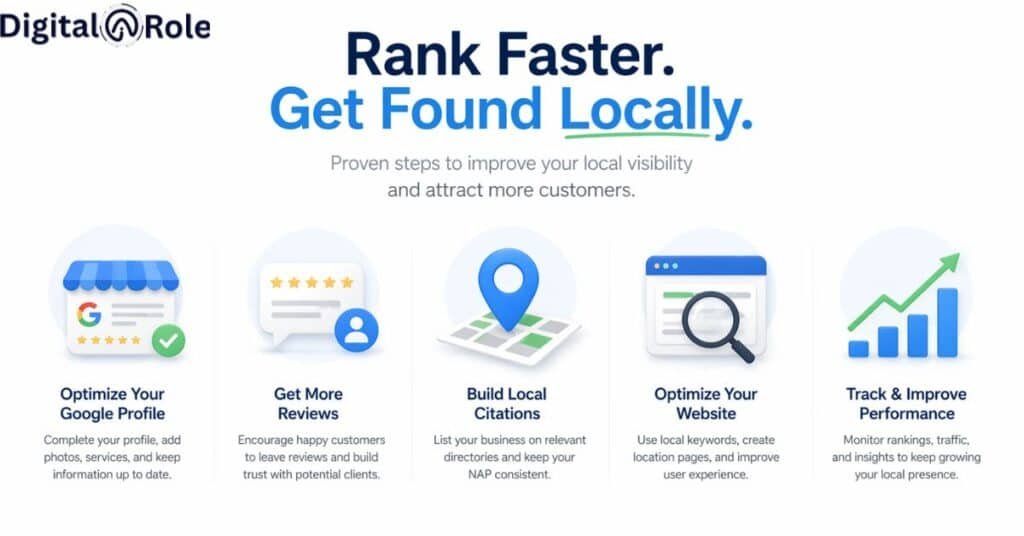
The majority of entrepreneurs take local SEO as a house-building process, starting with the foundation, then the walls, and finally the roof. That’s safe. But it’s slow. Then they think, “Is Local SEO worth it?”
The 48-Hour Fast Win That the Majority of Businesses Do Not Have.
This is the process: you sign in to your Google Business Profile, enter your phone number, include your hours, and believe you are all set. You still fail to acknowledge that it determines whether Google even displays you to the right searchers.
Your business category.
Wrong category = invisible. You may have the best reviews, regular citations, and content, but Google will not display you to those searching for what you really do.
I had an experience with a bakery owner.
Her Google Business Profile was going to be “Café” since she served coffee. However, 70% of her revenue came from custom cakes—people typing in “custom cake baker near me.”
Google wasn’t displaying her because she had the wrong main category. We renamed it to Custom Cake Shop, and within 48 hours, she began appearing in searches where she had previously not been visible.
To do it, you should do the following:
Enter your service and city in Google Maps. Find the top 5 competitors. What type of category are they using? Now consider whether that category is found in your area — not all categories are found in all markets. Google will not allow you to use it if Custom Cake Shop does not exist in your location.
It takes 15 minutes. And it affects rankings within 48 hours because you are providing Google with the right context for your business.
The Fastest Review Velocity Strategy (No Purchasing Fake Reviews).
The bad news is that 5 reviews during week 1 will put you ahead of 50 reviews over 6 months. “90% of consumers read the online reviews of a local business.”
The Google algorithm takes note of when you receive reviews, rather than the number of reviews. Regular business reviews mean you are active and credible, and that people are happy.
A company received 20 reviews during month 1 and 0 during months 2-6. That looks suspicious.
Velocity is more important than volume.
However, this is the most important thing that most guides fail to tell you: that when you request reviews, it is more important than the manner in which you do it.
The psychological window to leave a review is now—just after a positive experience. When an individual has had a fantastic experience, they are 10 times more likely to write a review within the next 2 hours rather than within the next 2 days.
The majority of review requests are made on business days after the momentum has passed.
The ethical quick-scan approach:
Wait, not till the end. Request right now, in a text message, QR code, or a quick email with a direct link, or an oral request in person. Make it frictionless. The more convenient you make it, the quicker you will receive reviews.
Then—and this is very important—reply to all reviews within 24 hours; the algorithm Google uses monitors response time. Fast-responding businesses are indicating their participation. You’ll rank faster.
Market results
A single client received 12 reviews (in 2 weeks) by simply adjusting the timing and the way they requested them after receiving 8 reviews (scattered over 6 months). They have shifted from position 6 in the local pack to position 3 in 30 days.
Top Tips for Ranking in Local Search
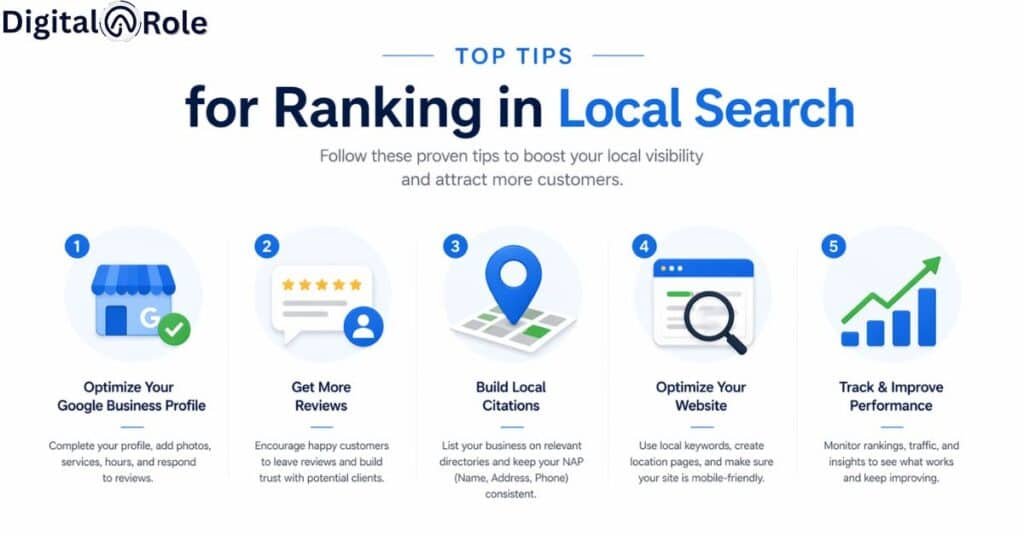
When you feel stuck and no doors are open, these tips help you rank in local search. Implement them and thank me later. If you’r e a owner of a store than you should focus on boosting shopify rankings with porven SEO strategies.
Write Location-based content instead of generic content
“The best plumber in [City] is competitive. The title “Best emergency plumber in Downtown [city neighbourhoods]” is not.
That is why this is important: micro-local keywords are much less competitive. A city-wide keyword may be a general term and may have 500 businesses in competition.
There could be 20 with a neighbourhood-specific keyword. You will score 3 times quicker.
Actual statistics on local SEO campaigns indicate that neighbourhood + service combinations are ranking within 14-30 days. City-level keywords require 60-90 days. That is no small difference when it comes to ranking fast.
The underutilised trick: develop location-specific landing pages. Not a single homepage, but single pages for neighbourhoods or districts you cover—plumbing in downtown, plumbing in Midtown, and plumbing in the suburbs.
The competition on each page is less. The pages are more rank-fast. And when combined, they propel more aggregate traffic than a single generic page could.
Mobile Speed + Local Ranking: Invisible Connection.
A mobile site that loads slowly kills the ranking speed. Period.
This is how it works: Approximately 70% of local searches occur on mobile devices. Google has made speed a factor in its mobile ranking algorithm. Does it take 5 seconds to load your site? The engagement, clicks, and ranking signals are slower at Google. It takes 1.5 seconds to load your site? An increase in clicks and engagement, and a quicker ranking improvement.
Actual effect: The local search provides 60% fewer clicks on a 3-second page than on a 1-second page. It is not a small figure—that is the distinction between the visible and the invisible.
Quick wins (can be applied today):
Reduce the size of images (TinyPNG or others)
Allow lazy loading (images loaded as the user scrolls)
Minimise response time on servers (contact your host)
These will take 30 minutes altogether and can help you reach position 4 in 30 days.
Your competitors aren’t smarter. They are doing fewer things, better.
Citation Stacking Method.
Quality beats quantity. The 10 references to official directories will give you a higher ranking in comparison with 50 references to the random directories with low authority.
Consider this
A Yelp citation (authority signal) is more important than a citation on some local business directory that no one uses.
The actual benefit
Rivals could have 80 references. However, when one of them has 70 low-quality and 10 high-quality directories, the increase in ranking is insignificant. You, with 15 citations — all of them authoritative sources — will be ranked higher. It is one thing to rank. Another one is staying ranked.
I have witnessed businesses being removed from the local pack within 45 days, only to be gone 3 months later. Why? They used one-time tactics rather than authority-building.
Building Local Authority
This is what rankings are all about: tactical victories cause a temporary rise in ranking. The authority signals give sustainable rankings.
A company that receives 10 reviews within the first week will shoot up in the rankings. However, if they do not receive another review, their rating will decline over time.
A company with a steady review speed, local associations, and a neighborhood will remain in the top 3 in 12+ months.
The disparity is authority.
Local influencer partnerships are cumulative. Whenever you collaborate with a local photographer, plumber, or community leader, they refer to you.
These are not necessarily links — they are mentions. The algorithm in Google is now following the reference of mentions as authority signals (within the new AI Overview rankings).
Actual case
A dental office collaborated with a local gym. Whenever the gym mentioned them on social media or in its newsletter, Google picked it up.
The dentist has moved from position 4 to position 1 in 6 months and has remained there for 18+ months without further SEO efforts. The coalition carried the brunt.
The sustainable approach
Stop contemplating single strategies. Begin to consider your neighborhood ecosystem. Who complements your business? Partner with them not because of a single backlink, but because of continuous mentions and presence in the community.
Periodic campaigns = short-term surges. Continuing relationships = uninterrupted exposure.
The Seasonal Local SEO Benefit
Most businesses handle local SEO reactively. When they lose visibility, they are optimised. Good businesses plan 6 weeks.
The following happens
The holiday season is coming. Competitors are instantly optimising, publishing content, and requesting reviews. The algorithm gets noisy. We are all competing simultaneously; thus, everybody is up and down the rankings.
But you? Your material was published 6 weeks ago. You possess a happy calendar that goes with the seasons of the year. You’re prepared.
Seasonality in the industry is important
A landscaper cannot rank the same searches in January as in May. In January, they look at winter lawn care. They use spring landscaping in May. This is what most businesses fail to do: post generic content year-round.
In November, smart businesses announce winter lawn care in [City]. By January, they’re ranking for winter-specific searches. Then they rotate out to March and to Spring Landscaping, where they are ranked by May.
Local events create event-based ranking windows. Event-based ranking opportunities. Food festival in your town? Food vendors that make content about it (“Food Vendors at [Event]) are ranked higher in that window. A local marathon? Physicians of sports and running stores that list it are higher.
You do not have to work harder. You must have strategic timing.
How to get my business to the first on Google for free
You do not have to pay to rank. You must have the appropriate free resources.
Free Tools That Reveal Why You Are Not Ranking Higher.
Google Search Console: This is where you find your ranking data. You will be able to view all the keywords you rank for, your average position, and most importantly, keywords you rank in positions 5-15. They are keywords that are just a small optimization away from being in the top. Fix those first.
The majority of amateurs do not check Search Console. They are flying in the dark, hoping their work will succeed. Check Search Console, and you’ll find out just what is going on and what is not.
Google Business Profile Insights: The number of people who search for your business? In which way do they search (your name vs. your service category)? It is free and invaluable data. When 200 people query your name, and 0 people query your service, then your category optimization has not been effective.
Google Maps: Take a literal search on your service in your location. Which are the best 3 competitors’ keywords? Click their profiles. What do they focus on? This is free competitive intelligence.
Ubersuggest Free Version: Enter a local keyword and get search traffic and competition. This would take 2 minutes and inform you of the keywords to target.
Answer the Public: A free keyword search engine that displays questions that your audience asks. The best plumber in [City]? Emergency plumber in my area? There is a treasure trove of voice search.
Expense to determine exactly what your bottleneck is: $0.
DIY Local SEO Workflow
You do not need a costly agency. You need a rhythm.
The 5-hour-per-month framework:
Monday (1 hour): Check competitor rankings. Do they climb or slide? What new content did they publish? Why?
Wednesday (15 minutes): Respond to all reviews. Every single one. It is non-negotiable.
Friday (1 hour): Post one geographically specific article. A post on a blog, publishing on a Google Business Profile, a series of photos, or anything new.
Weekly (20 minutes): Visit Google Search Console. What keywords moved? What queries are new? Adjust your strategy.
Monthly (30 minutes): Publish your Google Business Profile. Check the hours, new photos, and new posts.
Total: ~5 hours per month. It is not much above a freelancer’s normal retainer and is free as long as you do it yourself.
This isn’t complicated. It’s consistent.
The Mistakes That Slow Down Your Ranking
Why Mixed News Kills Your Promotion Rate.
Google is validating your data on the fly. On Google Business Profile, you have Mike’s Plumbing, and on Yelp, you have Michael Plumbing Services.
Google has to reconcile these conflicting signals. As part of that reconciliation, your ranking boost is suspended.
Fix the inconsistency, and you can often see your ranking rise in 48 hours. I have seen companies go from position 5 and up to position 2 by simply fixing their business name in the citation.
The Review Rejection Trap
5-star reviews are fake and have no history = zero ranking benefit. Google filters them out.
Five actual reviews by individuals who visited and have a history of reviews = a legitimate ranking boost.
Quality over quantity. Always.
Also, when all your recent reviews are in the same IP address or location (such as all your stores), Google considers it suspicious. Spread out your review requests and promote a variety of sources.
The Competitor Advantage You’re Giving Them.
Failure to reply to reviews is a sign of inactivity. The old hours (still showing you are closed on days you are open) end trust right away.
The fact that Google cannot contextualise your ranking does not mean that this is not a business description—vintage photographs lower your credibility rating.
With each week you do not take these, your competitor takes a step forward.
Advanced Ranking Accelerators
AI-Powered Review Sentiment and Ranking Connection
Google’s algorithm has changed, and now it evaluates review sentiment using AI. Favourable reviews = ranking increase. Bad reviews = ranking repression, despite acting professionally.
This does not imply that it is not about getting reviews, but getting positive reviews.
A company with 50 reviews with an average of 3.5 stars will be ranked below a company with 20 reviews with an average of 4.8 stars.
Put less emphasis on getting more reviews and more on avoiding negative reviews.
Voice Search Optimization of Local Ranking Speed.
The nearest plumber has less competition compared to the best plumber near me. There is a difference in the language that voice searchers use as compared to typed searchers.
The current unfair advantage goes to early adopters who rank highly in voice search. There’s less competition. Conversational keywords are optimized to help you rank higher in this new category.
Conclusion: Ranking speed is Base on the starting point.
The three factors that determine how quickly you rank on local search are competition level, consistency level, and starting position.
However, the point is as follows: With the right location, most small businesses can demonstrate tangible change in 30 days.
Do not exhaust yourself with all strategies. It is best to begin with the victories that will shift the needle the most: Fix your category.
Receive 5 pieces of feedback in week 1. Build NAP consistency. Create one place-based work. Response to reviews within 24 hours.
It is not a 90-day plan. That’s a 14-day plan. Then maintain it weekly for the next 90 days.
Rank not harder, rank faster. And when you are ranked, you must maintain your ranking through authority building and consistency.
Your rivalry is in the waiting room for you. Give such an advantage.