

Have you ever asked a question to Google and received an instant answer that is clear and conversational, like talking with a human? This is not a coincidence or AI magic; it’s voice SEO work. With the advancement of how voice search works, it is reshaping search engine behaviour and how users interact with them. It changes how content is discovered by providing direct answers from feature snippets that are more concise and to the point.
Instead of typing short keywords, users ask questions in natural language and expect Google to answer like a human. It’s crucial for marketers and SEO professionals that traditional SEO is no longer relevant. You may wonder how Google can give an exact answer when we give a voice command. The voice search SEO services also help you a lot.
In this article, I’ll explain to you how Voice SEO works, how Google interprets your spoken words, and how it delivers the perfect voice answer. Which technologies are involved in voice SEO work, and discover proven Voice Search Optimisation strategies that help your content get featured in these voice results and stay visible in the AI-driven SEO era.
Let’s drive in science, AI, and smart SEO tactics that make voice SEO more powerful, and how you can use them to get ahead of your competitors.
What is Voice Search, and why does it matter for Modern SEO?
Voice search is the technology that allows you to speak to devices such as the Google Assistant, Siri, Meta AI voice assistant, and others, which understand your intent and provide accurate answers.
This is possible with Google’s new technology, Speech-to-Retrieval, which bypasses the traditional step of converting speech into text. It directly maps the voice query into a semantic representation that captures its meaning and intent.
Its advanced neural network technology matches the most relevant information from the database and delivers a high-quality answer within seconds.
These innovations work together to understand what we say, what we mean, and which content best matches our intent without relying on potentially error-prone transcription.
Voice search works by understanding voice with S2R technology, analysing its meaning, and finding the most relevant answer within seconds.
The Reason Voice search is Transforming SEO
Voice search has entirely altered the SEO landscape. Inquiries such as “best shoes to buy online” are no longer typed robotically and full of keywords; instead, natural questions should be asked, such as: What are the most comfortable running shoes I can wear daily?
This change implies that Google’s new algorithms favour conversational, context-based content—content written with the human reader in mind, rather than content explicitly written to satisfy the search engine.
It is as follows, as far as your SEO plan is concerned:
Keywords are turning into questions: To optimise for voice search, write content that directly answers the questions —how, what, and why.
It is all about user intent: voice search is about providing solutions to real issues in real time, rather than a list of 10 blue links.
Artificial intelligence results prevail: Voice assistants frequently extract results out of featured snippets, knowledge panels, and schema-structured information, and structured data is more valuable than ever.
Quick Insight: Research indicates that more than 50 per cent of voice searches are. And therefore, unless your content is conversational and optimised for localised search, you simply do not exist in the voice search world.
How voice search works (Step-by-Step)
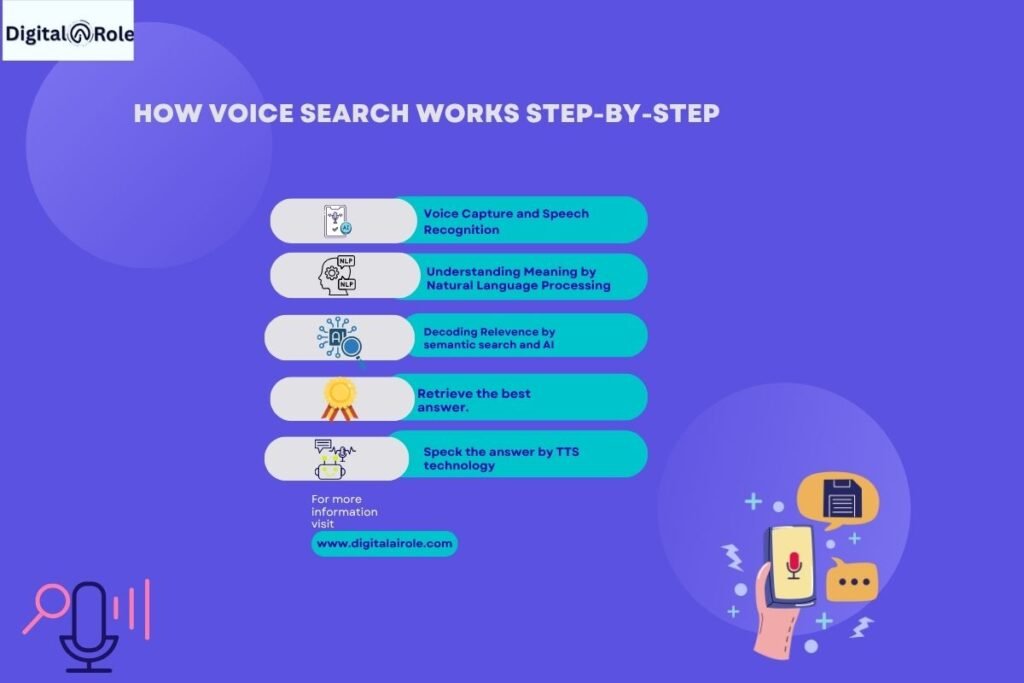
Did you ever ask yourself how Google seems to know what you are requesting in almost no time, and even which accent you have?
We should deconstruct the voice search itself, from the moment you speak to your intelligent assistant until the moment the smart assistant responds.
1. Capture voice and Speech Recognition work.
It can begin with a word Hey Google or Ok Alexa.
The microphone on your gadget records your voice, which is then converted to a digital audio signal. Traditionally, Automatic Speech Recognition (ASR) technology is used.
ASR recognises words, tones, and patterns and can even screen out the background noise or incoherent pronunciation. Your verbal query is converted into machine-readable, clean text. However, it causes minor transcription errors called “cascade” and ruins search results.
So Google’s new approach, Speech-to-Retrieval, is a fundamental shift that bypasses speech-to-text errors by using a dual-encoder neural network.
Audio Encoder
It processes raw sound waves directly, converting them into an audio embedding. This numerical vector deeply understands the semantic meaning and intent of your speech, not just the words you said.
Intent Alignment
This means that with this technology, the system can instantly understand the intent and meaning of your query. For example, when you ask “ Where can I get the pizza today?” and “Best pizza nearby,” both have the same intent but different wording.
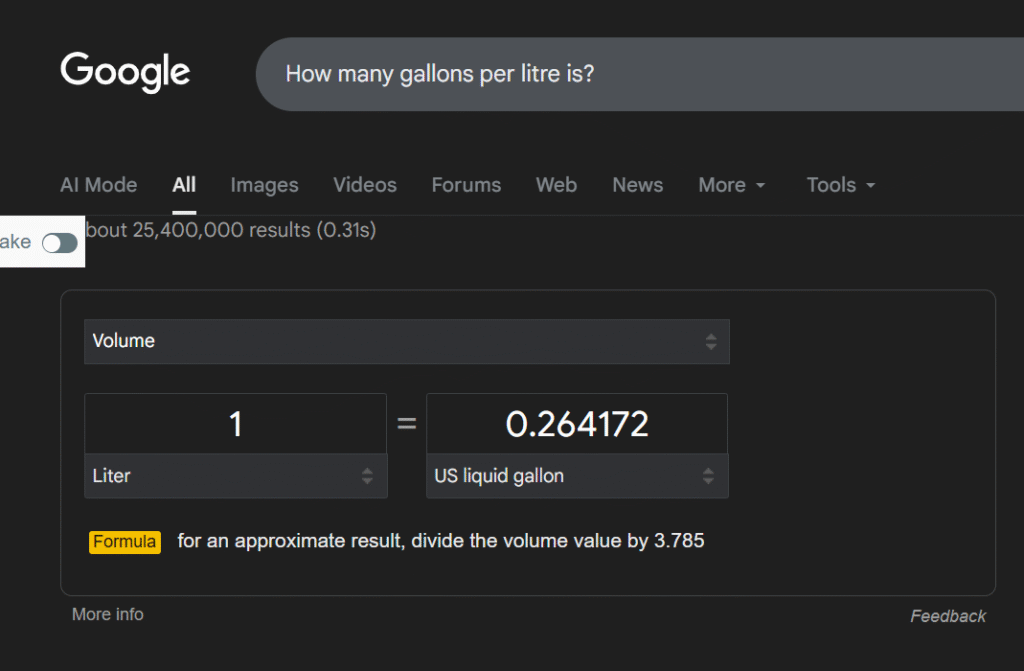
Example: When you ask a question or give a command aloud on a voice-enabled device, such as a smartphone or computer, you say, “ How many Gallons in liters?” The S2R technology analyzes the sound to extract the underlying intent, which is the conversion of units, which is then forwarded for evaluation.
2. Understanding Meaning Natural Language Processing (NLP)
After you have your voice turned into text, the Natural Language Processing engine of Google is ready to make out what you are saying, not what you are saying.
It considers:
- The purpose of your query is it informative, navigational, or transactional.
- The context is time, place, and the past searches.
- The degree of conversation is a question, a command, or a show of curiosity.
This is why Google realises you need a description of how voice search works, and that ‘voice search works near me’ may mean you are seeking a service provider or instruction.
The more natural and contextually more detailed your content is, the more easily the NLP can recognise it as a high-quality match.
3. Decoding Relevance: Semantic Search and Artificial Intelligence
At this point, Google’s AI systems, facilitated by RankBrain, BERT, and Gemini, come into play to retrieve semantic meaning.
This implies that Google does not just consider the actual keywords, but also considers the contextual connections between words.
The S2R audio embedding is instantly compared with document embeddings of billions of pages. Pages whose answer is mathematically is “closest” to query vector are consider the most relevant.
An example is asking, What is the easiest way to optimise for voice search?”
Google knows:
Optimising is about improving SEO.
Spoken search queries are referred to as voice search.
The easiest way is an indication that it is a how-to intent.
This helps Google surface results that are most appropriate for the user’s intent, rather than based solely on keywords.
Use semantic keywords, such as voice assistant SEO, conversational query, and long-tail voice keywords to build topical authority.
4. Retrieving the Best Answer
After the intent and meaning are visible, Google ranking algorithms estimate billions of indexed pages to locate the most precise and reliable answer.
Google gives priority to the voice search results as follows:
- Snippets, questions, and answer forms.
- Well-performing E-E-A-T signals, which show expertise, trust, and authenticity on pages.
- Context clarity, Structured data with schema markup.
- Blistering fast, mobile-friendly pages that load immediately.
In effect, Google is posing the following question:
Which reference gives the most applicable, human-sounding, and checked response to this question?
5. Speaking the Answer: Text-to-Speech (TTS) Technology
And lastly, Google converts the selected text result into speech through Text-to-Speech (TTS) technology.
It will be a short, clear, and natural voice reply from the assistant, frequently reading from the featured snippet or a graph of knowledge.
Example:
From the above example, the answer to the question of “ How many gallons per litre is? “
Responses by Google:”0.264172”
Why Google Gives the Best Answers – The Secret AI Reasoning
And when you talk to your phone and say something like, “What will be the most strategic time to post on Instagram?” and it gives you the same answer you wanted, too — that is not by chance. The voice search of Google does not only listen to your speech; it reads your mind.
This is how Google’s AI logic achieves this.
1. Learning Conversational AI Models
Voice search is powered by Conversational AI, which runs on Large Language Models (LLMs) such as Gemini and BERT. These models help Google:
Read between the lines-– They are not reading keywords but rather context, tone, and intent. The S2R technology is made with speech-native embedding which is perfectly facilitated this by giving AI direct access to the meaning, rather then relying on the text.
Tailor responses – Google personalises responses based on your location, search history, and even your device behaviour.
AI Insight: It is this level of personalisation that makes voice search work so intuitively; now enchanted voice embedding understand unique voice and speech,it is not about keywords, but about knowing you.
2. The Knowledge Graphs and Featured Snippets Role
The voice reply from Google is typically extracted directly as a featured snippet—those boxy items displayed at the very top of search results.
When Google finds a page that provides a clear, authoritative answer, it puts it at position zero and even serves it as the voice result.
The Knowledge Graph, which links facts, entities, and relationships across the web, also supports this process. This enables Google to provide factual, verified responses rather than speculative ones.
To be more likely to be the selected outcome:
- Organise your information using schema markup.
- Be brief and descriptive in your answers, using subheadings.
- Be factual and include references to reliable sources.
SEO Lesson: The better structured and semantically clearer the content is, the more likely it will be to become the verbal response of Google.
3. Continuous Learning – The Way Google grows smarter
The more voice search is used, the better. Google can also continually improve its interpretation of speech and intent through machine learning and feedback loops.
Each correction, missed response, or follow-up by the user assists the algorithm in learning:
- What responses are useful to people?
- What are the more natural sounds?
- Which are the sources that can always be relied upon?
The more people who speak, the smarter voice search becomes.
That is the key to Google’s success with its so-called perfect answers, which are continuously evolving under the influence of AI and human labour.
Voice Search Optimisation for Website
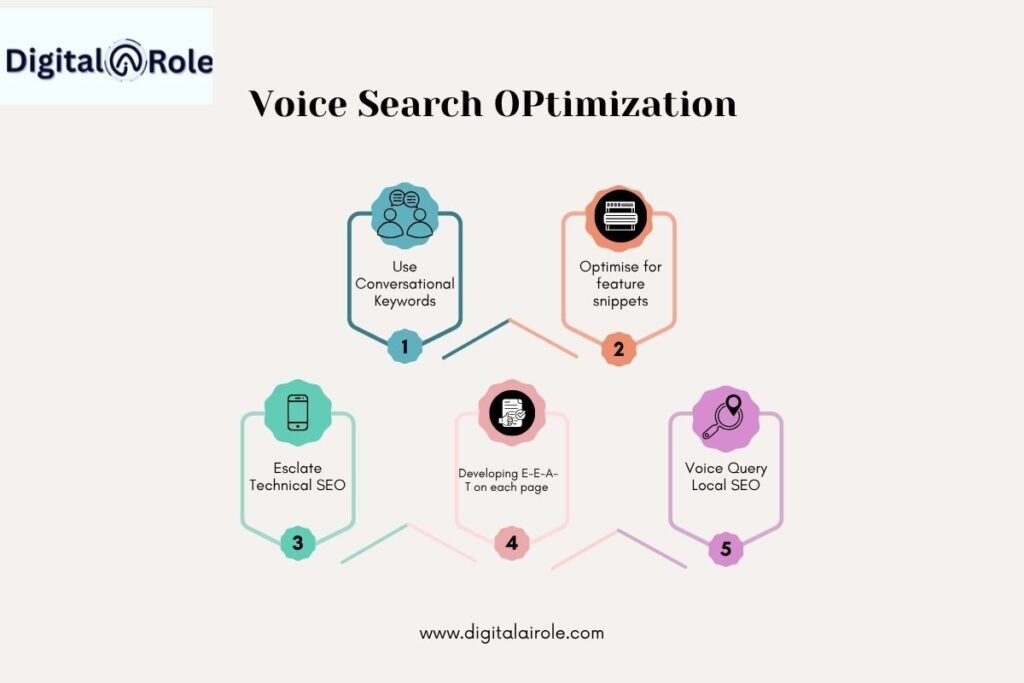
And now you know how voice search works behind the scenes, so you can make it work to your advantage and have your website rank easily for voice search.
The following is a voice search optimisation roadmap to ensure your content is noticed in the AI-driven SEO landscape.
1. Including conversational Keywords
Individuals do not speak in the manner in which they write. They ask full questions.
Optimise on rather than content moderation policy:
What is a content moderation policy?
What is the working of a content moderation system?
Voice search is successful in long-tail, question-based, and conversational phrases.
Write in a natural language, and reflect the way that people talk when using Google.
Pro Tip: Add frequently asked questions that begin with how, what, why, and best.
2. Optimise Featured Snippets
Your goal? Be the solution Google speaks out loud.
To do this:
- Give brief (less than 30 words) responses under headings.
- Use bullets and a list of steps to make it simple.
- Include definitions, summaries, and how-tos above the body of your content.
Example:
Q: How does voice search work?
A: Voice search reads the spoken and translates it into text with the help of AI, reads and comprehends the intent with the NLP, and provides the most relevant response.
3. Escalate Technical SEO
Voice search is quick—and your site should be, too.
Focus on:
Core Web Vitals: Get faster and more responsive.
HTTPS: Protect your site (Google relies on site security).
Mobile Optimisation: Voice queries are predominantly from smartphones.
Structured Data: Add schemas for FAQs, products, reviews, and how-tos to help search engines better understand their meaning.
AI Insight: Google AI crawlers would give more attention to organised, machine-readable information to comprehend content more quickly.
4. Develop E-E-A-T on Each Page
Google AI believes in content that appears human, authoritative, and written by an expert.
Enhance your E-E-A-T by:
- Vital inclusion of author biographies with actual knowledge.
- Associating with reputable research, statistics, or governmental portals.
- Adding one’s own experience or examples.
- Having your information current and up to date
Keep in mind: AI-based SEO does not list the relevant alone but the reliable. Your conversational keywords,structured content must have strong E-E-A-T signals to win voices snippets.
5. Voice Query Local SEO
A large percentage of voice searches end with ‘near me’.
To dominate local results:
- Maximise your Google Business Profile with full information.
- Be & Keep NAP (Name, Address, Phone) everywhere.
- Include local keywords, such as city names or nearby landmarks.
- Ask customers to post the real reviews.
Sample Voice Search: “Best digital marketing agency in my area.
When your local page is optimised and verified, Google Assistant may choose your company as the first result.
The Future of Voice Search: What to do next in intelligent SEO
Voice search is moving beyond phones and integrating with AI assistants, smart homes, and IoT devices, forming a smooth, talk-like system. It will not be long before users pose a single query, and their phone, car, and smartwatch work together to provide predictive, personalised responses.
The era of multimodal search (voice, text, and image inputs) is also approaching, requiring deeper intent interpretation. It implies that brands must be optimised not only for words but also for context, visuals, and structured data to remain discoverable.
To marketers, success in AI-based SEO will be based on structured, conversational, and credible content that aligns with how humans converse—and how AI listens. Voice search is becoming a connected, intelligent experience where the best and trustworthy responses are the winners. Your brand will no longer be searched; it will be spoken of in the future.
Conclusion
The key way voice SEO works for you is that your website ranks for voice search. Understanding how it works smooths the ranking process for voice search. Voice-assisted devices are not just tech; they’re a user intent defined by AI. For marketers and SEO specialists, SEO optimization is not only about ranking in search engines; voice SEO optimisation will be more important in the coming years. With the emergence of different voice devices and IoT technology, brands rank through voice search, which is why now Smart SEO works.