
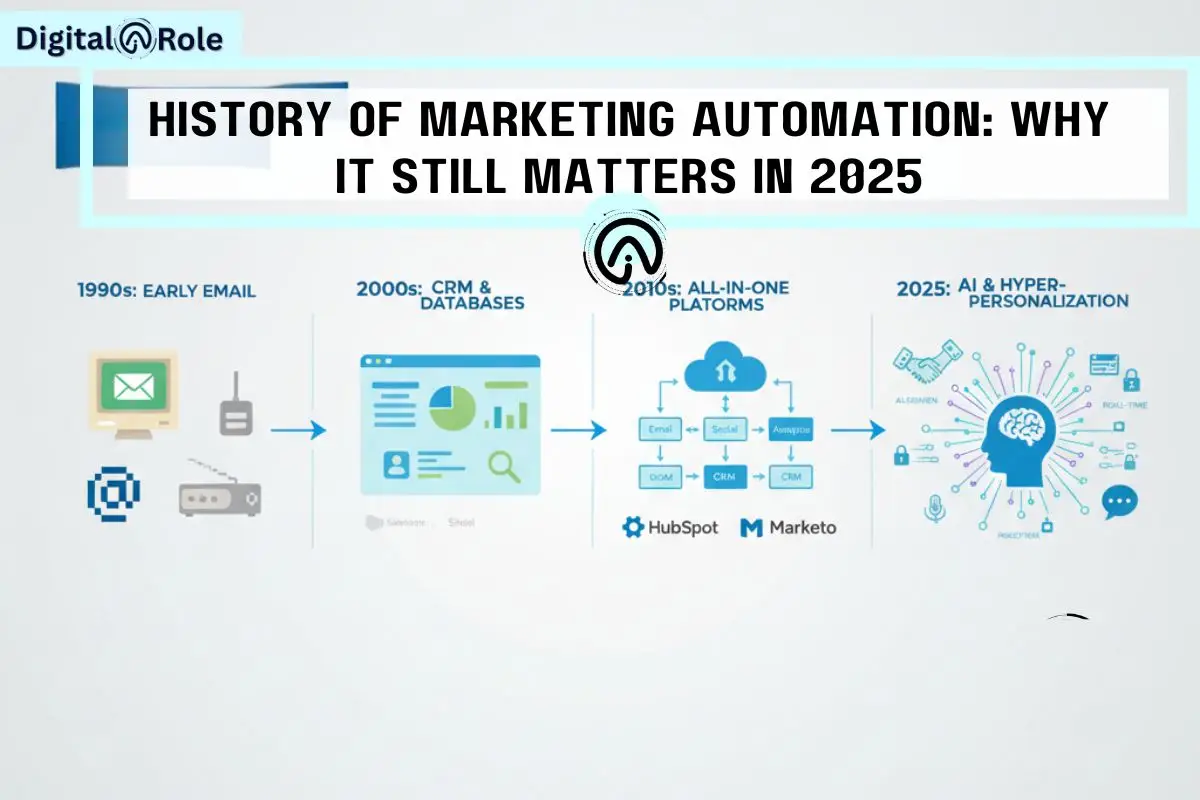
The history of marketing automation is not just about the timeline of tools; it is the story of how a business learned to scale its relationship with customers. Marketers still talk about the origin of marketing automation because it explains not only when automation started but also why it is a game-changer for modern marketing. The foundation of marketing automation was laid in the 1990s, when email campaigns were automated.
The history of marketing automation matters in 2025 because it helps them understand how technological innovation changes the way marketing is done, increases productivity, and efficiency of business over time, which sets the foundation for today’s AI-driven automation.
In 2025, automation will power the entire system, enabling marketers to automate the marketing process from customer journey to personalized recommendations and AI-driven analytics. Understanding when the automation begins helps us understand why these tools continue to evolve and is essential for our small business.
I’ve been working with marketing strategy for the past 5 years. I’ve seen how businesses, especially small businesses and SMEs, often adopt automation without knowing its roots. Look back at its development to provide valuable lessons on what works, what doesn’t, and how to adopt the innovative strategies moving forward.
In this article, I’ll explain the history of automation and when automation began. Highlights the key milestones and uncovers why history is essential for marketer to build their business and drive more sales.
History of Marketing Automation
When people search for the history of marketing automation, they usually type in a browser, “ When did automation start”? Or “ How has it evolved over time?”. The answer takes us on a fascinating journey where the AI marketing automation evolution begins, and it is central to today’s modern marketing.
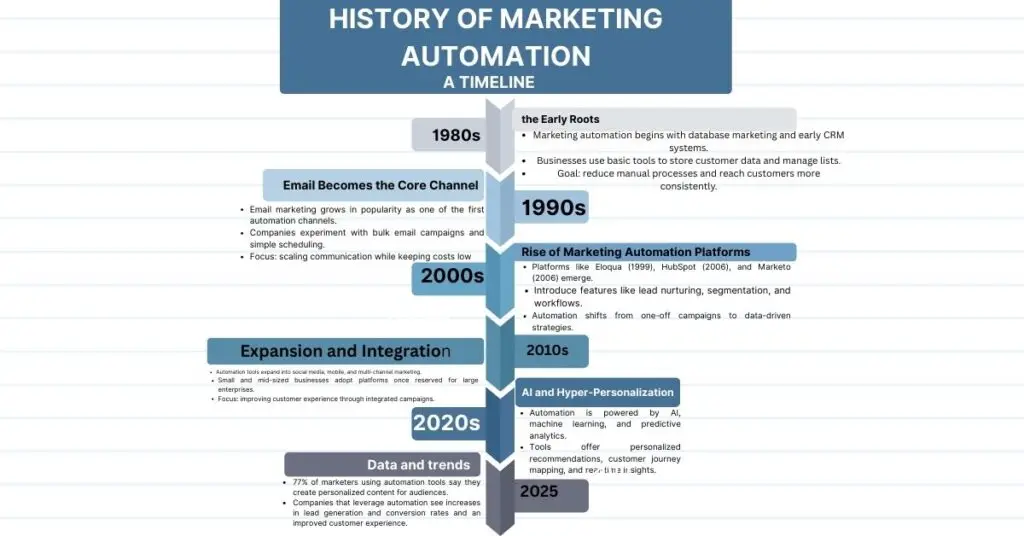
Let’s go back decades, to the automation roots, which began in the late 1980s and 1990s. The narrative dates back to the 1980s, when databases containing customer information were primitive, until they evolved into the AI-based systems we have today. We will deconstruct the main stages of this adventure.
The Early History of Marketing Automation (1980s-1990s)
Automation was first observed in the late 1980s and early 1990s, as businesses began to implement database marketing and rudimentary Customer Relationship Management (CRM) systems. It was used to store data on customers and target campaigns, and this is where automated marketing processes originated.
Increasing CRM and Email Automation of the 2000s
Marketing automation software was first developed in the 2000s, with notable examples including Eloqua (1999), HubSpot (2006), and Marketo (2006). These systems introduced workflows, lead nurturing, and segmentation, making it no longer possible to use bulk email blasts; instead, they enabled the creation of more effective one-to-one campaigns.
Expansion and Integration (2010-2020)
Marketing automation was growing swiftly between 2010 and 2020. The integration of social media, such as Facebook, Pinterest, and Instagram, enables rising marketing, facilitating mobile marketing and multi-channel campaigns. These platforms provide businesses with the ability to reach customers through multiple touchpoints. Notably, automation was made available to small and medium-sized enterprises, which was previously available only to large businesses. Automation became an everyday need and not a luxury in this decade.
AI and Hyper-Personalization of the 2020s
In the 2020s, remote working is starting to take off as the automated process begins the era of automation, fueled by AI and machine learning. The tools are now providing predictive analytics, hyper-personalized suggestions, customer journey mapping, and real-time campaign optimization. Automation is not only a time-saving software solution in 2025, but it is also a strategic asset that assists small businesses and large international corporations alike in competing based on experience, efficiency, and data-driven insights.
What is Marketing Automation? A beginner’s perspective

Marketing automation is the process of using software and various AI tools to automate marketing tasks, rather than doing them manually. It also involves measuring marketing campaign data, rather than sending manual emails, posting content on social media, and managing customer lists. Automates e-mail system, AI-content marketing, and uses CRM for data handling; all of these rely on an automated system for repetitive tasks. To start with, consider marketing automation to be a smart puppy that never sleeps – it can figure out how to deliver the right message to the right customer at the right time.
Major applications: Email, CRM, Social, and AI Tools
Marketing automation encompasses several fundamental functions that are utilized by most marketers and small business owners day-to-day:
- Email Automation – set campaigns, follow-ups, and messages on a case-by-case basis.
- CRM Integration – monitoring DoE, dealing with leads, and relationships.
- Social Media Automation – updating people, writing posts, and tracking performance in a variety of social media platforms.
- Artificial Intelligence tools – machine learning application in predictive analytics, customer segmentation, and custom recommendations.
The beginner marketers should realize that these are the initial steps towards creating a more efficient marketing plan. These features reveal that automation has evolved beyond email to become a comprehensive system capable of growth, saving time, and producing quantifiable outcomes.
Evolution of Marketing Automation: A timeline of key milestones
Marketing automation can be thought of as the milestones that have been developed over the years, and it has evolved the way business is conducted between a company and its consumers. Since manual campaigns were used in the past and continue to be used today, alongside AI-powered personalization, every new step reflects the role that technology has played in addressing the shift in consumer behavior and meeting business requirements.
Campaigns from Manual to Automated
Marketing in the early days was done primarily by hand–businesses used spreadsheets, cold calls, and blanket campaigns. The initial success led to workflows that automated most repetitive operations, including the scheduling of emails, nurturing leads, and following up with customers. This transformation saved time, minimized human error, and enabled marketers to maximize their efforts without overworking their teams.
The Growth of All-in-One platforms
The all-in-one marketing platforms came in the 2000s and 2010s. The email, CRM, analytics, and social media were on a single platform, products like HubSpot, Marketo, and Mailchimp. These platforms marked a turning point in automation, as they were not only made available to large businesses but also accessible to small and medium-scale businesses operating in the UK, as well as in the USA and other regions.
The Movement toward AI-induced Personality (2020-2025)
The latest achievement is the shift towards Artificial Intelligence-based personalization. Instead of set and walk-off workflows, automation has reached an advanced stage from 2020 to 2025. The process of machine learning involves predicting customer behavior. AI chatbots provide customers with real-time support, and personalization engines recommend products to customers based on their characteristics. In the case of small businesses, this implies being able to compete with larger players in the market- automation will bring the scope, and AI will bring the touch.
Why the history of Automation still matters in 2025
The history of automation is relevant in 2025 because it offers a comprehensive account of marketing’s evolution, including the development of various tools and the emergence of automation. It is not a rapid revolution; it involves small steps and builds the AI-automation system that we use now. Marketers understand the history of marketing automation to implement various strategies, tools, and informed decision-making, connecting you with the latest technology and leading towards best practices.
Marketer Lessons to be Learned
The history of marketing automation reminds us that successful tools are those that address real needs, such as saving time and targeting audiences more effectively. Awareness of these lessons can guide current-day marketers in avoiding overly complex approaches and focusing on the value they bring to their customers.
The History of the Tools of the Time
Email campaigns and CRM are the foundations of modern AI-focused platforms, which were established in the 2000s. Segregation, personalization, and analytics, which are the features, are not new; they just became quicker, intelligent, and more data-based.
Getting to know history, why Small Businesses should
In the case of small businesses, automation in the past definitely demonstrates that you do not need enterprise-level budgeted growth to increase. Once accessible only to big companies, scalable, affordable tools now deliver the same efficiency, and it has never been simpler to compete.
How Marketing Automation Shapes Future Trends

The question arises here as to why historical marketing automation shapes future trends. The answer is that it informs users about mistakes to avoid, how to utilize tools to make informed decisions, and also provides a competitive edge through efficiency, scalability, and personalization, making them better equipped for new development.
AI-based predictive analytics and customer insights
The history of the development of the simple email and the development of the data-driven platform proves why AI is the ultimate next. Through decades of studying customer behavioral trends, predictive analytics is now used to help companies forecast purchase decisions, optimize buying times, and maximize ROI with greater accuracy.
Customer Experience and Hyper-Personalization
Historically, we have learned that customization has always been the purpose, from our initial segmentation in the early days to the real-time customization we achieve today. By 2025 and beyond, automation will be applied to freelancer email, chat, and social media to provide hyper-personalized experiences, ensuring every interaction is a one-to-one, personalized experience.
The Future of Automation + Human Creativity

The history tells us how insufficient technology is. The future lies in the combination of automation and human imagination, where AI processes data and enables marketers to tell compelling stories, empathize with their audience, and effectively represent their brands. This balance makes sure that marketing is genuine and at the same time scales smarter.
Conclusion
In this article, I’ll explain the history of marketing automation and how it changes the way manual marketing is transformed into automated, run campaigns, and handles customer data. It starts from sending e-mail campaigns, and now, with the invention of different AI tools and software, it can easily automate every task of marketing. The automation era began in the 1980s, when CRM software was developed to manage customer data. Marketers understand the history to make informed decisions and prevent bigger mistakes, which means not automating tasks too much, as it can also lead to errors. The history of marketing automation influences future trends, which suggest that personalizing the customer experience, AI-driven content creation, and combining automation with human creativity are the most effective approaches to achieving high marketing results.
Frequently Asked Questions
Who invented Marketing Automation?
Marketing automation is not the creation of a single person, but instead was innovated by early software vendors.
- Unica and Eloqua (1999) are credited with having developed the first real marketing automation platforms.
- They also implemented automated email distribution, CRM workflow, and lead scoring.
- This was the beginning of the current modern tools of automation.
What were the first Marketing automation tools?
The initial marketing automation systems included email marketing, facilitated through automated systems, and customer management, which were handled in the same manner.
- Eloqua (1999): Inc. is the first B2B automation program.
- Unica & Aprimo (early 2000s): Enterprise campaign management.
- HubSpot (2006): Inbound marketing automation was introduced.
- Marketo (2006): Easy lead nurturing and scoring.
Why did Marketing Automation become popular?
Marketing automation gained significant popularity in the 2000s as a business requirement that threatened scalability and hindered data-driven marketing.
- Expanding email marketing and picking a CRM.
- Growing pressure to make customer experiences more individualized.
- Saving time with automated processes.
- Higher ROI and conversion rates than manual campaigns.
How does automation help small businesses today?
Marketing automation enables small businesses to compete with larger companies by making marketing more efficient and cost-effective.
- Automates emails, social-media posts, and after-sales follow-ups.
- Supports large-scale personalization cheaply.
- Delivers customer insights and analytics to make decisions.
- Time-saving so that any size of team can concentrate on growth.