
You probably heard the myth: “Build 100 backlinks and you’ll rank.” It is a wrong perspective because quality matters more than quantity. Many small businesses start with the wrong strategy because they lack knowledge of the quality backlink checklist for SEO.
One client came into my inbox frustrated, saying they built 100+ links, but their website’s ranking is flat. When we audited the quality of the backlinks for SEO profile, we found they focused on quantity rather than quality. Worse, they have no backlinks checklist to evaluate what actually matters.
I worked with 500+ websites and discovered a truth: A single backlink from a high-domain-authority (DA) and high-page-authority (PA) site beats 50 ordinary links every time. But knowing which backlinks work best requires a comprehensive approach that most beginners overlook.
Most people think that domain authority and page authority work together, but it is only half of the equation. The real magic happens when you combine the three critical factors of quality backlinks: ensuring your link is perfectly relevant to your target niche, optimizing anchor text to avoid spam, and building links from different websites rather than the same source. This strategy sets SEO professionals apart from owners who waste thousands of dollars on bulk backlinks.
That’s why I created this quality backlinks checklist 2026, which gives you a 5-point checklist to analyze whether your backlink is worth it. I’ll show you how to use free tools instead of paying for premium ones.
Why Your Backlinks Checklist for SEO Matters More Than Quantity
At the start of my career, I made a $500 mistake in my small business. I bought a backlink plan that costs around $500 and gives me 200 backlinks per week, but when I open my Google console, my ranking and organic traffic actually decrease because Google spams them.
I realized my mistake when I reviewed the report; at the time, I wasn’t aware of any backlinks checklist.
The fallacy of the new SEO game is this:
Quality over Quantity: Backlinks from sites with a Domain Rating (DR) of 40+ boost rankings 3 times faster than those from generic, low-quality sites.
80/20 Rule: Forget 200 links; in fact, over-analyzing 500+ backlink profiles reveals that 5 topically relevant links are more valuable than 200 spammy ones.
The Penny Risk: Google is very surgical. Spammy links from link farms are the prime cause of manual ranking penalties.
It’s not that backlinks are irrelevant—it’s that most people assess them incorrectly. They focus on the wrong things and neglect what matters.
Why You Need a Framework
Without a scoring system, you are flying blind. A quality backlinks checklist for SEO is invaluable because it helps you to
Uncover Gold: Tell the difference between a link opportunity that will help you rank and a link that’s a poisonous waste of time.
Preserve Your Resources: Don’t waste valuable time and money on “link packages” that generate no return on investment (ROI) or worse, a Google penalty.
Emphasize Relevance: Recognize the importance of a link from a tiny, highly topical blog over a “free” link from a big-name but irrelevant website.
Defend Your Choices
Be able to explain to your client/manager why you are rejecting “free” links instead of hyper-targeted links.
The 5-Point Quality Backlinks Checklist for 2026
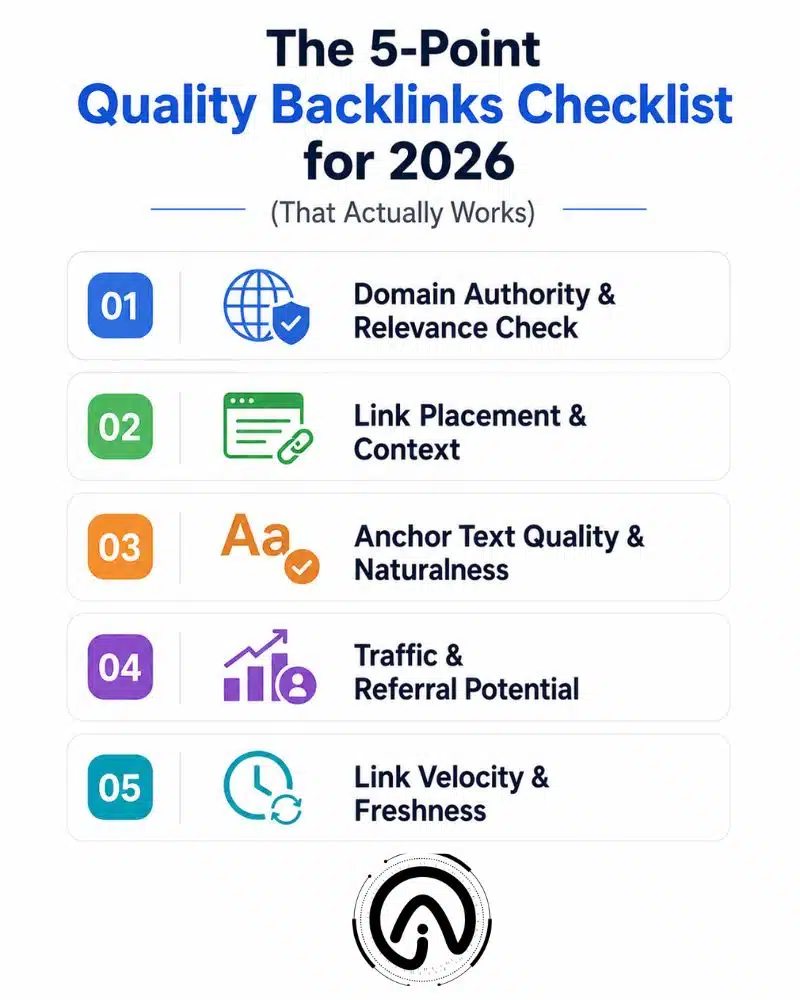
These 5 points tell you exactly what a quality backlink looks like and how it ranks with Google. You can also use this checklist to backlinks for SaaS tools, rank your tool, and drive organic customers.
1. Domain Authority & Relevance Check
I want to explain something you might not think about: A DR 30+ link from an extremely relevant site is better than a DR 60 link from an entirely irrelevant site.
I hear you asking, “How does that make sense?” Domain authority is important, but in 2026, relevance is nearly as important. Why? Because a link from an authoritative industry site tells Google, “This site is an authority on this topic. ” A link from a random site with a high-DA site means ‘I paid for this link.”
Here’s what beginners need to know
The Authority Check (Use Free Tools)
Moz DR Checker (free, no login needed): Enter the URL and get the DR
Semrush Free Tier: 10 free DR checks per month, but it also shows you backlinks and other traffic estimates
Google Search Console: Free to check backlinks for your website (Google’s data)
The Relevance Check (Manual, Takes 2 Minutes):
Look at the content on the linking site. Ask yourself: “If I didn’t know who owns this site, would I think it writes about my business?”
Real example
You sell fitness supplements. A health and fitness blog with 50k monthly readers that links to you? Gold. A travel news website with DA 45 links to you? Garbage, whatever the DA number.
The 2026 algorithm: Google’s algorithms now assess topical authority by considering the cluster of content on the domain linking to you. A link from a genuine site is worth five generic high-DA links.
Quick audit: Check out your top 5 backlinks. Rate them on a scale of 1-10 for relevance. Anything less than 6/10, you should disavow.
2. Link Placement & Context
Here is where most backlinks to-do lists fail—they don’t mention placement.
The fact: A link in your content body is 5x more valuable than a link in your footer.
Here’s why. Editorial links (the ones a person added to the body of the content for relevance) are an editorial endorsement. They tell Google, “We’re so proud of this resource for our readers; we’re sharing it in our post.” Footer links, sidebar links, page links? Google sees these as like footnotes—useful but not as valuable.
The Placement Hierarchy (for your checklist):
- Body content link (surrounded by relevant text) = 100% value
- In-page link (in a resource box or recommendation) = 70% value
- Sidebar/widget link = 40% value
- Footer link = 20% value
- Comment/hidden link = 0% (actually a penalty)
The Context Question You Must Ask:
Do related keywords and content surround the link? If you’re targeting “quality backlinks checklist” keywords, you want a link from “The Complete 2026 SEO Checklist for Small Businesses” article, rather than “47 Random SEO Tools.”
Real-life example
Your link is one of 3 on the page, vs. one of 50. The first scenario? You’re the feature. The second? You’re noise. Google’s algorithm notices this difference. Backlinks on resource pages (50+ links) are much weaker due to link clutter.
For your list: When someone offers a backlink, ask: “Is this link in the main content?” If they don’t know or say “sidebar,” ask for a better position or politely refuse.
3. Anchor Text Quality & Naturalness
Anchor text is the text you click on to follow a link. And it’s where Google gets really wary in 2026.
What changed in 2025: Google will now punish over-optimized anchor text more heavily. If you have backlinks with “click here for quality backlinks checklist” or “best quality backlinks checklist,” Google considers this unnatural link building.
Here’s the breakdown for 2026:
- 40% branded (“John Smith’s Blog,” “TechSmart Solutions”)
- 30% natural anchors (“Check out this article,” “I found this article helpful,” “Read more”)
- 20% long-tail keyword anchors (“quality backlinks complete guide” and “how to build quality backlinks”)
- 10% exact match (“quality backlinks checklist”)
Why this matters
Only exact match anchors trigger spam. Google thinks: “If all the links use the same text, it’s probably being manipulated.” Real editorial links are diverse. People use different phrasing. They sometimes use brand names. They sometimes use generic text.
Here’s what does not work for rankings:
❌ 100 backlinks with anchor text “quality backlinks checklist.”
✅ 15 backlinks: 6 branded, 4 natural, 3 long-tail keywords, 2 exact match
The second one looks natural. The first seems paid and spammy.
For your list: When acquiring backlinks, offer a variety of anchor text. Example: “We could link to ‘our backlink quality guide’ or your company name, whatever you’d prefer in your article.”
4. Traffic & Referral Potential
This is what makes good backlinks more valuable than link-farm backlinks.
The rule of thumb: 1 backlink from a site that sends you 5 visitors is better than 100 backlinks from sites that send you no visitors.
Why? Because Google tracks behavior. If a user clicks a backlink to your site, Google knows users are engaging. If there’s a backlink, but it doesn’t get clicked, Google gives it little credibility. You’re not only getting ranking signals, but also targeted traffic.
How beginners check this (free):
Semrush Free Tool: Review Organic Traffic estimates for the backlinking domain (free, but limited)
Similarweb: Estimates website traffic for most sites (free version available)
Google Analytics: 30 days after you acquire the backlink, check to see if you got traffic
The metric that means quality:
Backlinks from sites with 10,000+ monthly organic visitors indicate that Google knows and ranks these sites highly. A site with 2,000 monthly visitors is acceptable to your business niche. A site with 100 monthly visitors? That’s weak.
Why this matters in AI Overviews:
Google’s generative AI systems will favor backlinks from high-authority, high-traffic pages when deciding which sites and sources are considered to be the real experts. If you have links from pages that already attract a lot of organic traffic, you’re telling search engines you have recommendations from known experts.
Ask yourself: “Is the referring traffic from this site beneficial to my business?” If you say “just rankings”, it’s not as good.
5. Link Velocity & Freshness Timing is everything.
Most people get this wrong.
The myth: The quicker you acquire backlinks, the quicker you rank.
The truth: 5 high-quality links in 1 month is normal to Google. 50 backlinks in 1 week is a sign of “paid links”, and Google penalizes it.
Google algorithms measure link velocity: how quickly the number of backlinks grows. Organic linking is slow. Spam link building is spiky. Spikes cause Google to shine a light. That might not be a manual penalty, but the domain has been flagged.
The 2026 algorithm reality:
Slow and steady wins the long race. Acquiring 1-2 high-quality backlinks per week every week for a year is better than acquiring 24 links in 4 weeks.
For small businesses – the long-term approach:
- Build 2-3 quality backlinks per month. That’s 24-36 per year. At that rate, you’re:
- Growing organically (Google-friendly)
- Prioritizing quality, since you can evaluate each opportunity
- Building a strategy that you can stick to
- Don’t fall for the “link buying hangover” of link building: quickly buying links and then stopping, leading to a dead velocity.
Backlinks are fresher
New links are slightly stronger. If you gained 20 backlinks in 2023 but none since, your backlinks are “old”. New backlinks mean you’re still relevant.
For your to-do list: Monitor when you gain backlinks. If you haven’t earned any in 3 months, it’s time to start again. Consistency beats everything.
Free Tools to Check Backlink Quality
You don’t need fancy software to assess your backlinks. The best tools for small businesses and beginners:
1. Ahrefs Backlink Checker (Limited Free)
Enter your website URL to receive in-depth backlink information without registering. You’ll get information on up to 100 of your backlinks, Domain Rating, Page Authority, and estimated traffic. The limitation? There’s a limit of 3 free checks daily. It means you need to be strategic about those checks – I suggest you audit your top 5-10 backlinks every week (not every day).
2. Google Search Console (100% Free & Most Authoritative)
This is definitely the best (free) tool because it’s straight from Google. Go to Links → External Links, and you’ll find all of the backlinks Google has found to your domain. You won’t see other sites’ backlinks, but this is the truth of your site. You can export the data every month to see changes.
3. MozBar Extension (Free)
Add this extension to your browser,r and you’ll immediately get the Domain Authority, Page Authority, and spam score for any domain you’re browsing. When looking for link opportunities, you’ll have the authority at your fingertips. 2 seconds per domain – great for quick screening.
4. Ubersuggest Free (Limited but Useful)
Get backlink data for up to 3 sites per month. Great for the occasional backlink audit of a competitor, or for monitoring backlink changes. Only once per month, though, so choose wisely.
Pro Tip: Power Stack for Beginners
Rather than one paid tool. But use 2-3 of the following free tools:
Month 1: Google Search Console to get all backlinks + Ahrefs free checks for backlinks’ quality top 10.
Month 2: Use MozBar while prospecting new backlinks, and Google Search Console to confirm that new backlinks made it.
Month 3: Use the free Ubersuggest check to track all backlink changes + repeat.
This method is free, delivers 90% of the data you would get with premium tools, and means you have to be strategic and selective, rather than compulsively checking stats. Small businesses are successful because they are strategic, not because they have the best tools.
How Many Backlinks Do You Need to Rank?
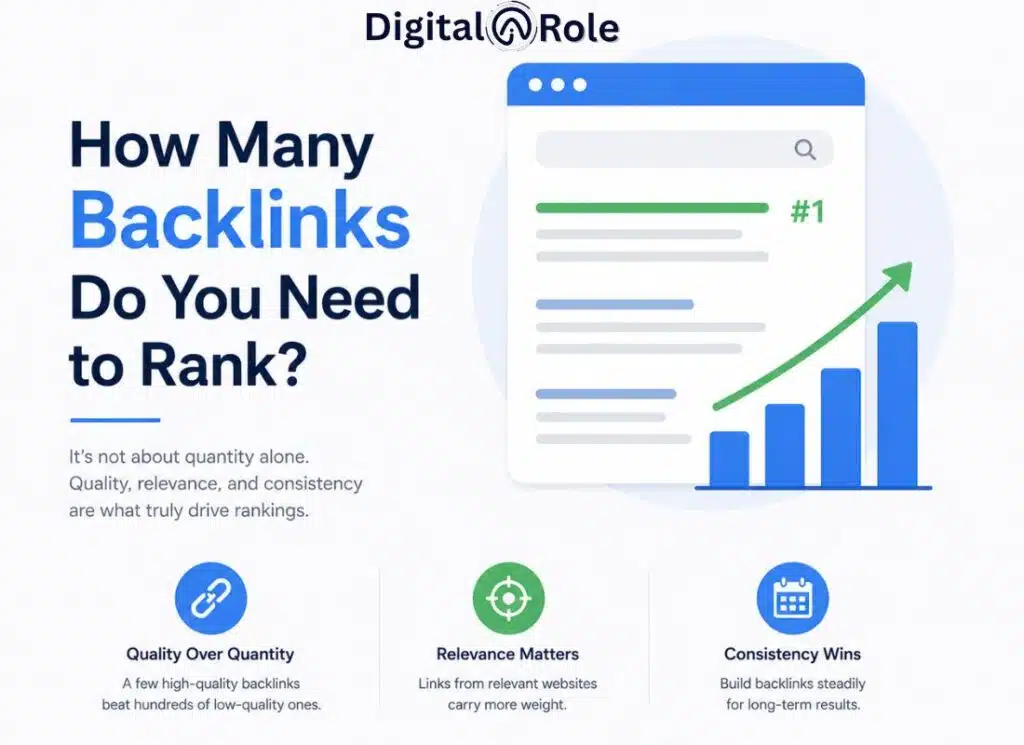
The myth that has to die: “You need 100 backlinks to rank in Google.”
It’s not true in 2020. In 2026, it’s a bad idea because it encourages small businesses to focus on quantity rather than quality.
Let’s look at the facts: Backlinko’s 2024 research of over 10,000 Google search results shows that the average page in the top-10 has 85 backlinks. Sounds high, right? The key takeaway: 15% of the top-10 pages have fewer than 20 backlinks. This tells you everything. Quality crushes quantity.
Competition Level Realistic Expectations:
Low Competition Keywords (5-15 quality backlinks to rank)
These are highly specific, low-competition keywords. A local service provider with a keyword like “SEO consultant in Canofonia” or a new product. You don’t need as many backlinks because there are fewer competitors.
Mid Competition Keywords (20-50 links + topical authority)
You’re up against established blogs and medium sites. You need more links, but you also need topical authority – signals that the content is relevant to the topic. To compete in the fitness supplement industry, you need 30-40 quality backlinks and information about topics related to fitness.
High Competition Keywords (100+ backlinks + brand recognition)
Examples are “best fitness supplements” or “digital marketing agency”. You’re up against big-name websites and well-versed domains. You’ll need a lot of links, plus mentions, media, and social. Small businesses shouldn’t go after these without deep pockets.
The Real Lesson to take home:
Don’t focus on the number of backlinks. Earn 10 high-authority and relevant backlinks from sites that drive traffic and are in your niche. These will help your rankings quicker than 100 low-quality ones from non-relevant sites.
Building Your Backlink Strategy Without the Guesswork
So you get the knowledge. So, how to do this:
3-Step Beginner Action Plan
Step 1: Assess Your Existing Backlinks
Export your backlinks from Google Search Console. Score each one according to the 5-point criteria we mentioned above: Domain Authority + Relevance, Link Placement, Anchor Text Quality, Traffic Potential, and Velocity. Score each backlink 1-10. Links below 5/10? Create a disavow file.
Step 2: Find Your Competitors’ Quality Backlinks
See where your top 3 competitors are acquiring backlinks. Enter their domain in Ahrefs free backlink checker, and note the good sites. These sites care about your topic. You know where to contact.
Step 3: Relevance is More Important than Domain Authority
No, you don’t need the highest DA. Go after sites with 30-50 DR that are relevant to your niche. They’re more likely to approve your backlinks and have a higher click-through rate.
Timeline & Results
This approach should start to improve rankings for small businesses in 6-9 months. This is not a quick fix; it’s organic growth that Google likes.
Case Study of an e-commerce brand
I was hired by an e-commerce fitness supplement company with no backlinks. We used this 5-point strategy, and in 7 months (one a month, no more) we built 8 backlinks:
- 2 from fitness blogs (DR 35-40)
- 1 from a nutrition expert’s website
- 1 from a health podcast resource page
- 2 from guest posts on relevant sites
- 1 from an industry directory
- 1 from a university health resource
Result: In 9 months, they’d moved up to page-1 for 12 medium keyword phrases for which they hadn’t previously ranked. Traffic tripled. Revenue doubled.
Conclusion
I want to be straight up with you: Creating quality backlinks is tougher than buying links. It takes planning, time, and effort. But this is what I’ve witnessed after reviewing 500+ backlink profiles – the small businesses and SEO novices who adopt this quality backlinks checklist strategy not only rank. They create long-term competitive advantages.
You now have the backlink-building formula that most SEOs charge thousands of dollars to learn.
There’s a 5-point quality backlinks checklist for SEO
- Domain Authority & Relevance Check – Check if the site is strong and relevant
- Positioning & Relevance – Insist on body content links (not footers!)
- Anchor Text Diversity (40% branded, 30% natural, 20% long-tail, 10% exact match)
- Referral Traffic & Potential—Authority comes from links from high-traffic sites
- Growth Rate & Recency – Acquire 2-3 per month, not 50 in a week
That’s a backlinks checklist. Use this for every link. Use the free tools we mentioned earlier to check backlink quality and audit your backlinks against this criterion. You’ll be able to tell which links are bad and which ones are good.