

AI can generate content in seconds, but Google can’t rank it because it lacks ranking value. Many AI tools, such as ChatGPT, Claude, and Gemini, only generate content that lacks personalization, brand voice, or emotion. Google’s latest algorithm updates are getting smarter at detecting AI-generated content and penalizing it.SO, you thought about how to humanise AI content for Google rankings.
Write AI-friendly content that aligns with your brand voice, has strong storytelling, and evokes emotion. Publishing AI content without refinement and without a human touch often leads to weak SEO, low engagement, low dwell time, and a drop in website rankings. You worried why your month’s SEO strategy couldn’t work?
Here is the good: you don’t have to choose between AI efficiency and human authenticity. In this guide, I explore how to humanise AI content that easily ranks on Google. I’ll walk you through with proven steps to humanise AI content.
What is Humanising AI Content?

Humanising AI content refers to the process of interpreting machine-generated text to produce high-quality, relatable content that demonstrates actual expertise, a personal voice, and a genuine human attitude. It is not about concealing that you used AI, but rather about using it as a means to an end, ensuring that your own experience, judgment, and voice is express.
Three Pillars of Humanised AI Content
Authenticity
Authentic voice, authentic examples, and real-life experiences are interwoven. The reader should feel that the writer knows their business.
Professionalism
You add contextual information, subtlety, and industry-specific details that I would gain only through experience. AI offers the platform; you offer the authority.
Involvement
Your writing is emotionally involved. It not only talks about their actual pain points but also speaks in a conversational tone, does not lecture, and encourages interaction.
The Rationality of the Google Shift to Human-Centric Content.
It is not AI that Google is punishing, but dead content. It is what has changed: the latest updates to the algorithms are fullfil at the E-E-A-T factors (Experience, Expertise, Authoritativeness, and Trustworthiness). Google’s systems can now tell the difference between content written by someone who has a real understanding of the subject matter and content written solely to improve search engine rankings.
Why Google Cares About Humanised Content

The thing is, you are probably asking yourself: Will Google punish my AI content? The short answer? Not directly. Yet what matters is this: Google relies on natural language processing (NLP) to find content, which does not replace human vision, personal understanding, or practical experience. This reduces your ranking because it indicates lower topical authority.
Why is AI Content considered to be unhumanised?
Such red flags of unhumanised AI content usually include:
- Cliched language patterns –Bread and dumplings, such as in the modern digital world, or it should be mentioned.
- Absence of personal anecdotes- No real-life examples or author opinion.
- Robotic structure – The paragraphs are always perfectly predictable, and there is no variation in them
- Loss of subtlety – No contradictions, no gray areas, no ambivalence or ambiguity about the human being.
- Zero emotional intelligence – Not related to the frustrations or wins of the reader.
- Superficial signs – No signs of deep knowledge, only regurgitation of information.
Why These Mistakes Kill Your Rankings?
Semantic SEO analysis helps search engines to interpret the context, intent, and authenticity. Google not only searches on your material when it crawls, but it will also check whether or not you are a real expert. AI-only content does not pass this test because it requires no human judgment, personal voice, or the in-depth insight available only through experience.
7 Ways to Humanise AI Content for Google Ranking
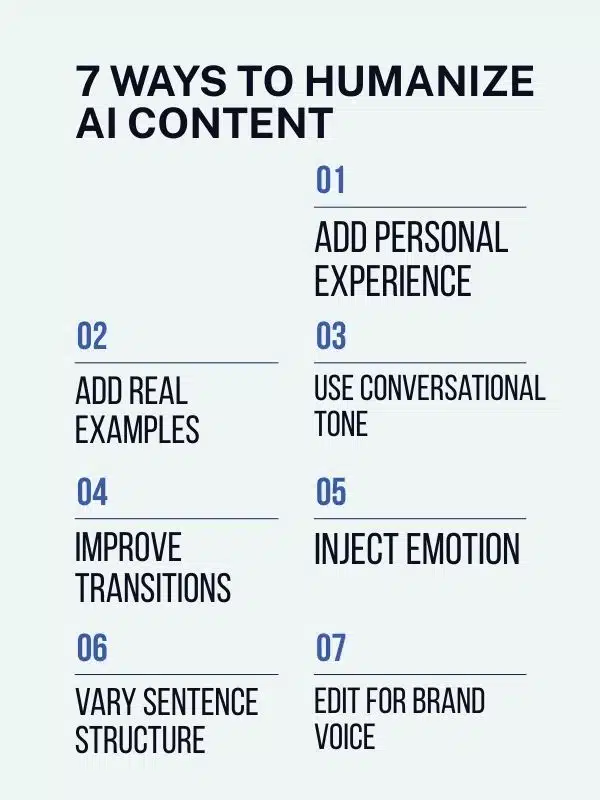
Making AI content human and easily ranking on Google is not about replacing your tools; it is about strategically adding human expertise to each piece. The following are seven sure methods of converting robotic AI into natural, ranking information.
1. Add Personal Experience
It is personal experience that will make you stand out in AI. It is what Google’s E-E-A-T systems seek.
How to implement:
- Introduce with a real difficulty you had concerning your topic.
- Give case examples of your projects or clients.
- Discuss what has not been successful; it is wisdom to know something has not been successful.
- Cite certain measurements or accomplishments that you have made.
- Include 1- 2 personal anecdotes in 1500 words.
Real-life example: Replace with “AI tools make the content creation more efficient with the following statement: Last year, I tested five AI writing tools with my team. Two failed spectacularly. Here’s what I learned…”
2. Use Conversational Tone
AI tends to use formal, stiff language. The tone of conversation is authentic.
How to implement:
- Write as though you are explaining this to another employee at a coffee shop.
- Use Contraction: “It is, it does not, it is yours, you are, you are not, you have, you were, you should, you will, you must,” etc.
- Ask rhetorical questions that your audience will ask.
- Naturally, use the pronouns I, we, and you.
- Split long sentences into shorter, punchier sentences.
- Change” It is imperative to note” into “here’s what matters.”
3. Include real-life examples and Specificity
Generic claims rank poorly. Concrete and practical examples are preferable and more authoritative.
How to implement:
- Substitute ambiguity with facts and figures.
- Add real names of tools, schemas, and approaches that you employ.
- Insert screenshot sample or case study findings.
- Cite official documents (research, market surveys, examples of competitors)
- Refer to special industries, situations, and cases.
- Exception cases or reference edge cases–nuance recognised by real expertise.
Real example: Many marketers use AI tools; 72% of B2B marketers use AI to create content, but only 31% use it to create authentic content.
4. Enhance Handover and Sequence
AI composes sentences individually. Humanised content is easy-going and well-transitional.
How to implement:
- Make use of transition phrases which indicate the connections: because of this, here is why, that said, in practice.
- Make sure that the paragraphs have logical connections.
- Write topic sentences that give previews.
- Indicate the sequence of ideas with sub-bullets.
- Read aloud — in case you trip, the passages should be improved.
Make sure that examples back up claims (not mentioned ad hoc).
5. Poke the Sentiments and Attend to the Pains of the Reader
Unemotional content does not interest readers and does not create social shares. AI misses this entirely.
How to implement:
- Admit your frustration to your reader: You are likely thinking…
- Be understanding in language that confirms their experience.
- What exasperated you in this subject matter?
- Bring out success and innovation, not theory.
- Be careful of power words: use words that are equal to the intensity of your message: transform, skyrocket, avoid, master.
- Final sentences with statements of reader goodwill: “This is to mean that you can…
Real-world example: Instead of saying that content authenticity is important, one can say, “You have spent months scaling content with AI.” The last thing you want is Google penalizing your whole site because of your robotic writing.
6. Vary Sentence Structure
The repetitive sentence constructions are a sure sign of AI writing. It is a natural variation in human cadence.
How to implement:
- Combine shorter, punchier sentences with longer, more complex ones.
- Change the start of sentences- do not open every paragraph with your keyword.
- Appeal to fragments: hereof. You need this.”
- Alternate questions, statements, and/or exclamations.
- Switch paragraphs- now and then a single sentence, now and then five.
- Read and listen to determine whether the rhythm sounds human.
7. Revise Brand Voice and Authenticity
The last humanisation pass is when you achieve consistency with your original voice.
How to implement:
- Write about your brand voice in 3-4 words: professional, but friendly; bold; data-driven; funny, etc.
- Check your AI draft and provide the following question: “Does this sound like me?
- Rebrand problem areas completely.
- Reference a style guide or already performing well content.
- Get someone who knows you to read it — is it in your regular voice?
- Check originality with AI detectors (Originality.ai, Grammarly).
- Complete one last round of typos, clumsy phrasing, and branding.
Real case: When your brand is conversational and bold, a safe, middle-ground AI tone will not work. Add colour, make judgments, defy conventions.
Common Mistakes When Humanising AI Content

1. The Overkill Trap
You should not go to extremes; having too many personal accounts, slang, or views will make the material unprofessional and reduce trustworthiness. Limit yourself to 20-30 percent personal touches in your content; let expertise reign.
2. Ineffective Implementation
Humanise your whole work, not the introduction. The transitions between AI and humans are not supposed to be seen. When the first half is genuine and the second half is written like a robot, Google’s NLP systems will detect it.
3. Skipping the Fact-Check
Humanizing things does not help when you are wrong about the facts. Always look into statistics, quotes, and claims. AI tends to produce plausible-sounding fake information.
AI Content at Scale: Tools and Workflows to Humanise

Use this Workflow
- Create using AI (ChatGPT, Claude, Copy.ai)
- Use the 7 ways: personal experience, conversational tone, real examples, transitions, emotion, sentence variety, and brand voice.
- knowledge of the layer (30-45 minutes per 1500-word piece)
- Check and refute claims (AI is prone to hallucinations)
- Test with AI detector ( ZeroGPT- target 90%+ human)
- End editorial (read through, flow, branding consistency, etc.)
- Features (bold keywords, snippet -structure) optimization.
Tools That Help
- Originality.ai identifies AI content and plagiarism and provides humanisation feedback.
- Grammarly Premium – Tone, voice consistency, readability.
- SurferSEO – NLP optimization and topical coverage.
- Hemingway Editor – Makes sentences easier to read and understand.
Your experience can never be replaced when it comes to personalities, examples, and subtlety.
Conclusion
It is not difficult to humanise AI content. It is a deliberate overload of 7 human factors in each publication that you make.
The 7 Ways:
- Include personal experience – Generic advice is no match for real stories.
- Conversational tone – Use the language that you speak.
- Include real-life examples – Specificity is a source of authority.
- Enhance transitions – Flow knowledge expertise.
- Infuse emotion – appeal to the reader’s pangs.
- Vary sentence pattern – Beats of natural rhythm, repetition.
- Brand voice editing builds brand recognition.
Begin now: Have your next AI draft, spend 45 minutes using these seven elements. The difference in engagement will happen with the readers the moment you do–and in your rankings within 4-6 weeks.