
You put hours into creating the content with the full hope that people will like it, and it goes viral. But in reality, the shares, likes, and comments are less than you hope. I know it hurts a lot. But you’re not alone in facing this problem. Every marketer and content creator faces this silent struggle: creating great content that fails to spark or engage.
However, the truth is that your ideas are not the problem; content strategy is.
In the era where AI has revolutionized the world, it is also transforming the content creation market, whether it involves a blog, video, email, or campaign. As people change their engagement with content, an AI-driven content strategy is the fastest way to stay ahead. Stop guessing what works. Now, AI content creation helps plan, write, and optimize for specific platforms that actually attract the right people. From spotting trending topics, writing headlines, and scrolling through stop headlines, to improving SEO in real-time, AI tools for content planning and AI tools for content optimization are reshaping how creators grow.
AI tools help analyze user behavior and create content based on it, optimizing it for various platforms. Think of AI as a smart, creative partner that enables you to brainstorm innovative ideas, inspiration, stories that stick, and content that converts.
In this article, I’ll explain AI-driven content marketing, which accelerates engagement rates and eliminates guesswork, delivering high-quality content that your audience enjoys and engages with.
Why your Content isn’t getting Engagement?
You’ve posted consistently. You have written applicable content. You have even taken all the SEO pieces you can acquire, but the likes, comments, and shares are coming at a painfully slow rate. Sound familiar?
This is because your audience is no longer the same as before, but rather in terms of their behavior. It is a content-fatigue world, and individuals scroll past hundreds of posts per hour. Unless what you have to say appeals to their needs within the initial few seconds, they will have left.
Poor quality does not necessarily mean low click-throughs, lack of attention, or drop-offs in interest; it is an indicator that it is time to change your strategy.
AI-driven content strategies are where AI-driven marketing approaches are particularly effective. It analyzes behavioral patterns, such as when users scroll, click, and freeze, and determines the most appropriate moment to reach them, in what form, and what tone to use.
With the help of AI-optimised content, brands will be able to determine the type of content that will perform best before it is published. Indeed, studies of AI content indicate that brands using AI optimisation tools experience 83% more engagement than those using other content workflows.
AI is not here to kill your creativity; it only enhances your relationship with your audience.
What Is an AI-Driven Content Strategy (and Why It Works Fast)
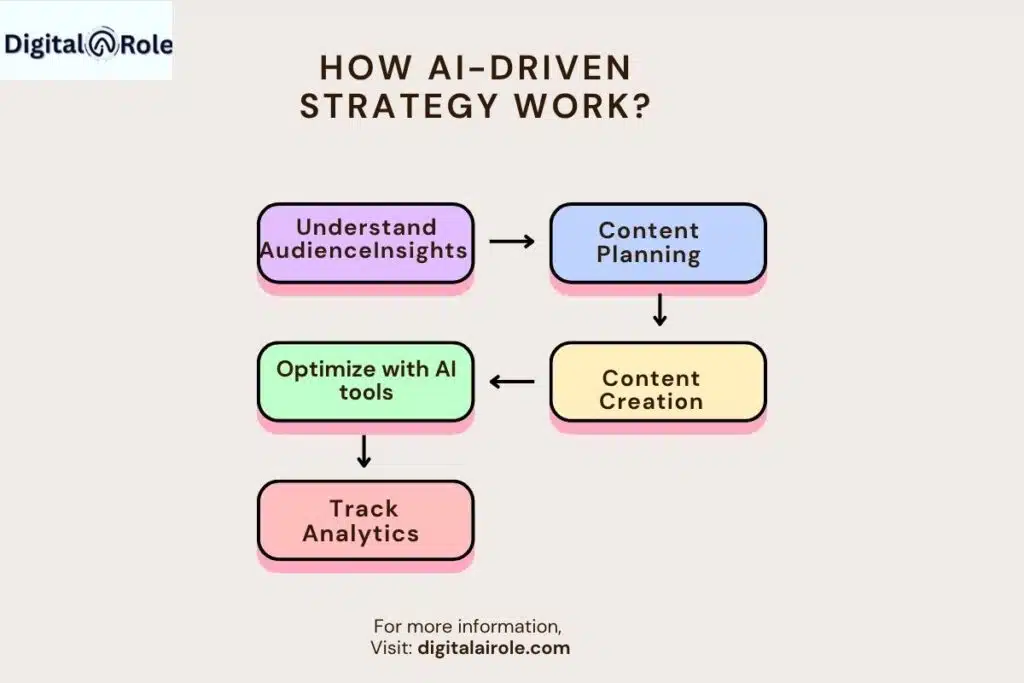
In simple words, it is an intelligent platform that implements machine learning and automation to plan, create, and optimize your content using live audience data – not speculation.
An AI-based content strategy utilizes machine learning software to strategize, develop, and optimize content that aligns with the audience’s intent, resulting in increased engagement.
Old-fashioned methods are based on manual research and fixed keywords. On the one hand, AI monitors the optimal behavior of the audience, trending queries, and interaction triggers in real-time. It helps you:
Plan smarter: Plan what you actually want written by using AI tools to plan your content (Frase or MarketMuse) in the first instance.
Get it faster: Develop outlines, ideas, and even draft headlines, based on trending intent.
Optimise better: AI examines tone, readability, and emotional appeal to ensure that your content works on all platforms.
Simply put, AI does not merely speed up content creation; it also refines, brings it nearer, and makes it more entertaining.
How to Build an AI-driven Content Strategy that actually works?
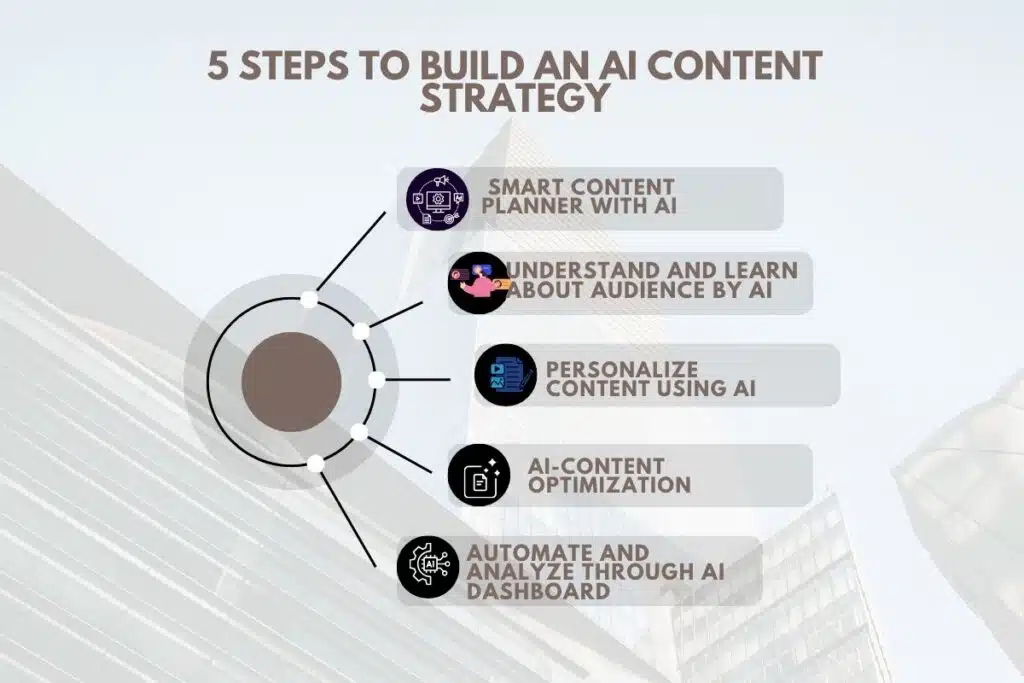
A content strategy makes content more effective and authentic because it plans before creating, analyzes, and continually improves it. With the innovation, the AI content strategy greatly helps users. Here, I break down the step-by-step process.
Step 1 – Smart Content Planner with AI
The vast majority of creators post and analyze it later, but with content planning AI tools, it is possible to do it the other way around. AI does not merely assist in brainstorming, but it also helps you foresee what your audience desires before you produce it.
Frase, Jasper, and SurferSEO are tools that can be used to find out what people are asking immediately in your niche using live search and trend information. At a glance, you can tell what has the potential to engage them, which questions people want to hear, and even their competition.
This means that by planning what you will discuss, you will have eliminated speculation and all of your articles will be supported by facts and not mere feelings.
Step 2 – Use AI to Identify and Learn Your Audience

It is half the battle to know who you are speaking to. An AI-powered content strategy is based on brilliant audience insights to identify the specific sections of your audience, including their demographics, their feelings, and the tone to which they respond best.
“ Companies that use behaviour data and demographic data to understand the audience see a 60% engagement rate rise”.
AI software such as HubSpot AI, Audiense, or SparkToro scans millions of data points on social networks and search engine queries to identify trends:
What would your readers find to be their most popular content types?
- The themes and hashtags they subscribe to.
- When they are the busiest online.
- Research your audience behaviour and build demographic data
This implies that you can create messages that are both personal and timely. The people’s right eyes are put in front of those who care, instead of talking to empty air.
Step 3 – Persanalize Content using Artifical Intelligence
Having the right audience is the first thing; the second is to personalize it. You can use AI to customise your voice, images, and messages to suit various types of audiences.
To illustrate, one can rephrase the same idea with the help of ChatGPT or Copy.ai in a variety of tones, such as a friendly tone for posting on social media, an authoritative tone for writing a blog, or a concise tone for use in email subject lines.
When you make your content seem like it is talking to a person, rather than talking at one, then engagement naturally increases.
Step 4 – Optimize All Posts with the Help of AI
The magic takes place here. When you use AI-based content optimization tools, such as GrammarlyGO, Scalenut, or RankIQ, you can refine your content to ensure it is both easy to find and easy to read.
Optimization is not only about grammar and keywords. You can use AI to:
Develop Click-Tail Titles: With the help of such tools as Copy.ai or Headlime, you can create the emotional and curiosity-inducing title with fewer than 60 characters. E.g.,” How This AI Hack Doubled My Engagement Overnight.” These headings are appealing to the reader and enhance click-through rate (CTR).
Quick Answers structure: AI gives you a proposal on how to structure your headings and paragraphs to be featured in the snippets and AI search. Be brief, use bullet points, provide concise definitions, and include ‘ wh’/and ‘how subheads to ensure your post becomes the solution searchers are looking for.
This increases visibility and ensures that your readers receive value promptly.
Step 5 – AI Dashboards: Analyze and Automate
Artificial intelligence analytics applications, such as Hootsuite AI or Notion Insight, monitor the performance of your content work, including CTR and engagement rates, as well as reading time. Then they can provide you with straightforward advice: post more of what works and polish what doesn’t.
The result? An engine of content that evolves itself.
Why AI Doesn’t Replace Creativity – It Enhances It
If you have ever feared that AI will render human creativity irrelevant, then you need to breathe deep because it will not. In fact, AI-based marketing practices are most effective because they do not substitute human creativity, but rather enhance it.
The weakness of AIlies lies in its reliance on data, specifically in identifying trends, predicting engagement, and optimizing structure. But creativity? That’s 100% you. Even the narratives, feelings, humor, and reality that make your work stick with people are based on your original point of view.
Why can’t AI replace creativity?
- Consider AI in the content generation process as a creativity enhancer: it provides guidance, so you don’t waste your energies trying things that don’t work.
- It eliminates monotonous work, allowing free time to be devoted to truly inspirational ideas.
- It is your brainstorming companion, providing ideas for hooks, metaphors, and emotional appeals that you can work into your own wording.
To take the example of an AI-based content optimization tool, your paragraph can be analyzed by one of the tools, and a sentence will be shortened or a question asked to draw attention. However, it is you who knows the narrative behind that material, the reason behind it that resonates with actual individuals.
The most successful authors nowadays combine the accuracy of AI with human emotion. They leave AI to the logic and them to the magic.
Don’t think of AI as competition; consider it as a form of cooperation. When correctly applied, it does not drain your creativity; instead, it multiplies its effect.
A real example: How one brand doubled its Engagement in 30 days
Here, I discuss with you a real-world example where a small agency doubled its engagement rate within 30 days.
Before applying an AI-driven strategy
A small marketing agency that sells its services to clients and does most of the marketing work manually. They write high-quality content that is informative, commercial, and transactional, while also adding visual appeal. However, they update only two to three articles per week, but their online visibility is new, so Google wants more content to understand them. However, their audience engagement took a different story, with high bounce rates, short read times, and no social shares. They’re doing everything right, but their performance is not excellent, which is what they want: an AI-driven content strategy.
After Results
After they use and implement AI tools in their research, audience understanding and solving their problems provides a solution instead of a lengthy explanation. They use AI tools to plan the content, which helps them analyze the audience’s interest and craft trending topics that have high CTR and that the audience loves to read.
Utilize AI-optimization tools to improve the content readability, make it SEO-friendly, enhance structure, and provide click-through titles that spark curiosity. The AI analytics dashboard tracks which posts receive more clicks and people reads, and within 30 days, their engagement had doubled.
The Results:
- Average Content Read session increased by 42%
- Social Shares jumps 2x.
- CTR increased by 57%
Summery
AI isn’t replacing human creativity; it saves the time you would otherwise spend analyzing website performance and addressing main issues, allowing you to focus on content quality. It sparked the genion audeinec connection with the content. When they utilize an AI content strategy, they build a content system that keeps improving itself every week.
How to future-proof AI-driven Content Strategy
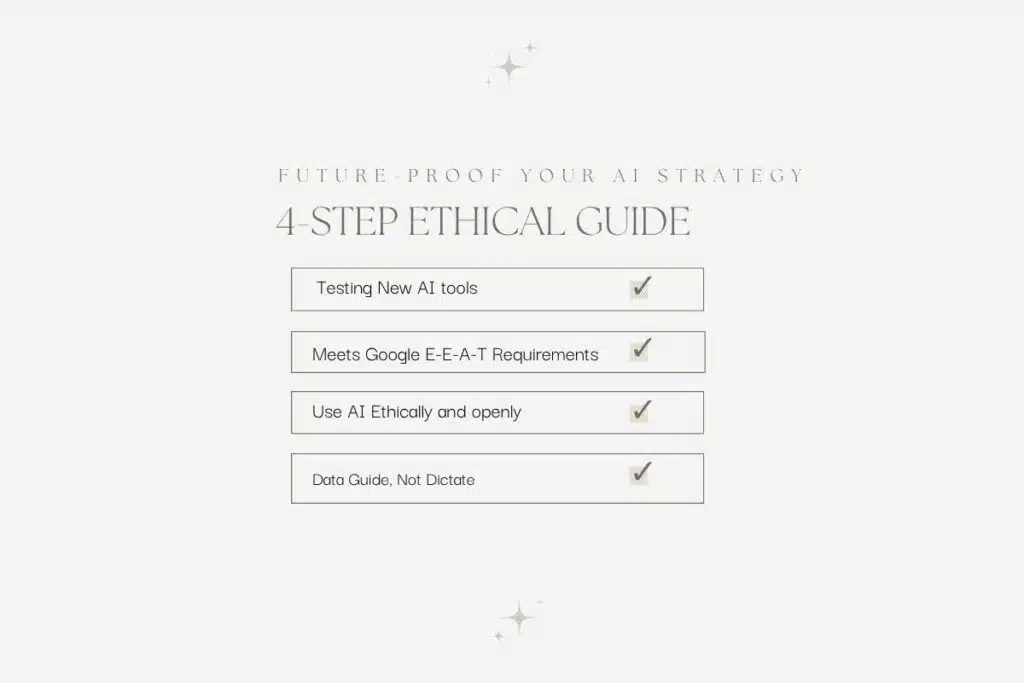
The adoption of AI in marketing is changing at a rapid pace, which is why it is best to remain dynamic. What is working today may become obsolete tomorrow as algorithms, tools, and audience behavior evolve.
This is how you can future-proof your AI-driven marketing strategies and make them reliable:
1. Keep Testing New AI Tools
Avoid using the same AI platform consistently. New tools are being created every day, and they are becoming more intelligent, automated, or personalized. Reserve time every month to investigate, experiment, and assess the new possibilities – both in the form of AI analytics dashboards and new writing assistants.
2. Meets Google E-E-A-T Requirements
The Google system rewards the content that portrays Experience, Expertise, Authoritativeness, and Trustworthiness (E-E-A-T) even when an AI is involved in the process.
Always:
- Eliminate Fact-check AI-generated content.
- Include human experience, real-life examples, and original observations.
- Human brand voice should be maintained.
This will ensure that your content not only ranks but also builds trust.
3. Go AI Ethically and Openly
In high automation, there comes high responsibility. You must always identify the time you have used AI tools to assist in creating content. This is also an ethical best practice, as it fosters content trustworthiness with your audience.
Note: Being honest is not a form of weakness; it is an element that builds credibility.
4. Let Data Guide, Not Dictate
AI must not take control of your creative choices, but guide them. AI insights: Glean insights into the trends and then make decisions about how to introduce your own spin or emotional orientation. Balance data with intuition.
Thinking of AI as a partner, not a substitute, you will develop a strategy that evolves with technological progress, responds to changes in the audience, and ensures your brand remains at the forefront.
Conclusion
Having learned one thing in this guide, it is that the formula of content marketing no longer lies in producing a lot of content, but in creating content intelligently.
A good AI-based content strategy is not based on replacing your creativity; it is just giving it an engine with a strong data foundation. By doing the right thing, you can make guesswork more accurate, and participation leads to growth.
The following are five easy steps to remember:
- Content planning: Use AI to plan your ideas.
- Develop material that appeals to your audience.
- Maximize all your posts with the help of the AI content optimization tools.
- Compare what is effective (and what is not) using AI dashboards.
- Continuous improvement- allow the data to drive your action.
The best part? You do not have to spend additional hours brainstorming or editing. You only require smarter help -the kind that learns, gets adjusted, and changes with you.
You do not need more hours in a day, but smarter AI assistance since, in the modern digitalized world, time is running out.