
For newcomers seeking free backlinks, focus on content that earns them. So you need to Create content that earns backlinks by publishing high-quality, original, valuable, and useful information that other websites want to cite. By producing quality content, you eliminate the need to beg or use spammy tactics.
Various writers are unfamiliar with backlinks and ask why natural backlinks are important for SEO. The straight answer is that Google prioritizes websites that earn natural backlinks, not sponsored or promotional ones. Quality backlinks for SEO are important for building authority in Google’s eyes.
If you’re wondering how to create backlinks without spam or how to earn natural quality backlinks, the answer is to create content that no one else is creating in your niche.
In this article, I share 7 shocking tips for creating content that earns backlinks. If you want to earn natural links organically, this solves your problem, and in the end, you easily build the links that give you authority and organic traffic.
Why Natural Backlinks Are Important for SEO
If you are serious about long-term rankings, you must understand the importance of natural backlinks in SEO. The engines have become very intelligent—they are now able to differentiate between links that the honest value has earned and those that have been made only to rank higher. To the novice and small company, the only thing that this implies is that quality beats shortcuts every time.
Natural Backlinks: What Are They?
Natural backlinks are links from other websites that are free because your content is useful, insightful, or worthy. It is also known as “editorial links”—they are earned, not built.
Editorial links: These are provided naturally by bloggers, journalists, or site owners who believe you have valuable content.
Paid/spammy links: Sold, traded, or picked up using manipulative strategies such as PBNs or link farms.
Real-world example:
Suppose you are a bakery owner and write an in-depth post on the blog about the trend of the best wedding cakes in 2026. Your guide is useful to a local event planner, who cites it in their article. That is a natural backlink: no outreach, no payment, or even any payment, just raw value.
The importance of natural backlinks to SEO in 2026.
The helpful content and spam-oriented updates from Google have altered how links are evaluated. Backlinks are not merely a matter of numbers; today, they are all about trust, relevance, and authenticity.
Signs of trust: Natural backlinks are votes of trust.
Authority building: The more quality links one has, the greater the domain authority.
Ranking effect: Pages that have natural backlinks will always rank better than pages with artificial links.
Sustainability: Natural links, rather than spammy ones, can provide long-term value.
Google Search Central states that websites with manipulative link-building strategies might be overlooked or even punished, underscoring the importance of the links obtained.
How to Create Backlinks Without Spam
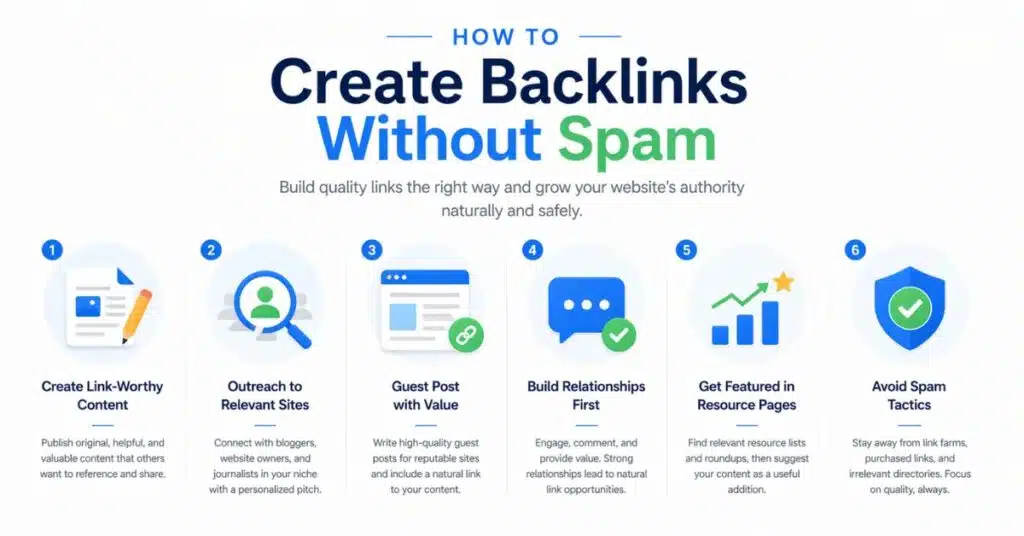
When it comes to creating backlinks without spam, there is no trick as such; it’s a strategic change. You do not have to pursue links; rather, you create content that attracts them on its own.
The reason traditional link building isn’t working
- Outdated methods such as mass guest posting, PBNs (private blog networks), and paid backlinks are becoming increasingly less efficient—and unsafe.
- Google can now identify unnatural link patterns.
- Poor-quality backlinks are illegal according to Google.
- Penalties can result from over-optimized anchor text.
To put it simply, something that was effective 5 years ago is now damaging your site.
Link-Earning Mindset vs. Link-Building.
This is the actual change:
Stop building links. Start earning them.
Link-building mentality: “Where am I going to put my link?
Link-earning mindset: “What can I make to link to?
Everything changes when you consider content as an asset, rather than a tactic. It is no longer about outreach but about value creation before sustainable SEO growth occurs.
7 Shocking Tips to Create Content That Earns BackLinks Naturally
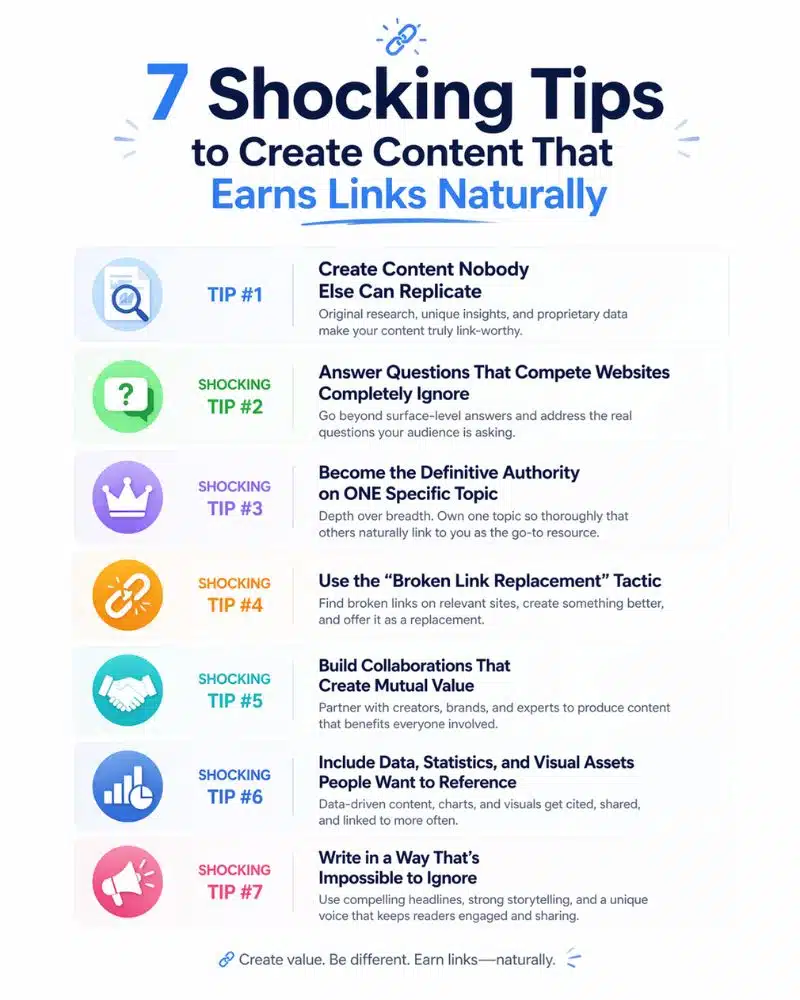
I show you 7 shocking tips that help writers write content that makes people link to it; when someone finds your content, they are forced to link to it. In this way, you get quality backlinks without guest posting and outreach. You need NO SEO tactics; it’s the pure value and clarity you delivered that make sharing automatic.
Shocking Tip #1: Create Content Nobody Else Can Replicate
This is the key: The majority of content is recyclable information.
You are speaking of 10 Ways to Improve Customer Service. The Ultimate Guide to Customer Service Excellence is written by someone else. Customer Service Best Practices for 2025 are published by another individual.
Everything is the same. No one in particular is to be connected with your version.
This is why original research and data are the top magnets.
How This Works in Practice.
In publishing original data, you are the source. Other individuals do not simply reference you but quote you. They must, as you possess information that no man has.
Real case: A US-based water treatment company surveyed 200+ residential customers about water quality issues in hard-water areas. They also presented the results in tables, demographic data, and suggestions.
Result? That article was also linked to:
- 12 local blogs that talk about water quality.
- 3 trade magazines that used their data.
- Local water department (connected in their resource guide)
- Websites about the water quality in the neighborhoods.
All those connections were not outreach. They arrived because the information was actually useful and relevant to what those sites were talking about.
How to develop original research as a small business.
You do not have to have an enormous budget:
- Conduct a basic survey of your clients using tools like Google Forms or Typeform.
- Ask 5-10 questions to disclose pain points or trends in your industry. Get 50-100 responses (doable in 2-3 weeks).
- Visual analysis of data. Present your results using Canva or plain spreadsheet graphs. Make it visual—people associate with content that has original graphics.
- Add local context. How Small Businesses in [Your City] Address [Problem] is automatically more linkable than nationwide statistics.
- Write the research guide as a complete article: Incorporate methodology, sample size, key findings, and actionable insights on what you learned.
Pro tip:
Do the research, then contact other sites with the information, saying, “We have done research on ‘Quality backlinks’ and found surprising insight.” We think that your audience would be interested. There is no need to request a connection, but only to exchange value. They will naturally link to it 80% of the time.
Shocking Tip #2: Answer Questions That Compete Websites Completely Ignore
This is the point at which most writers fail.
They view competitors’ rankings as “how-to guides,” and they create their own responses to the same answers. Perhaps a little better, but essentially the same solution that everybody is providing.
Provide answers to the questions people are asking but aren’t getting good responses to.
The Unspoken Equates of Your Customers.
This involves not being a marketer, but you need to think like your customer.
The actual questions that lie behind the question “How do I build backlinks naturally?” are:
- Will it be forever?
- Is it necessary that I am a great writer?
- Will Google punish me if I do it wrong?
- How long do you really have?
- Why say ‘everyone’ when I cannot measure this?
The content that provides responses to these questions will be connected as it resolves a real anxiety rather than simply parroting industry knowledge.
Practical Example
An article by a fitness coach titled “Why You Will Fail at Strength Training (And What Actually Works).”
The majority of fitness articles claim to be the 5 exercises to get strong. This coach wrote, “Here is the main reason why the strength training of most people is a failure, and here is the mental model that really works.
That article was shared 4,000+ times and linked to by:
- Blogs on psychology that talk about the motivation frameworks.
- Fitness magazines are prone to frequent errors.
- The psychology of behavior change blogs in business.
- Motivational websites
Why? Since it did address the actual issue: not the how of training, but the why people quit.
Your challenge: Name 5 questions that your target audience is afraid to ask. Answer those. Link magnet achieved.
Shocking Tip #3: Become the Definitive Authority on ONE Specific Topic
It’s straightforward to handle 20 or so topics with the general audience. But do you want links? Go deep on one.
The most-linked pieces in any industry are written by individuals who are evidently experts in something extremely specific.
The Pillar Model in a nutshell.
Instead of writing:
- Social Media Marketing Tips.
- “Instagram Growth Strategies”
- “TikTok Best Practices”
- “LinkedIn for Business”
You write:
A single giant pillar article: The Complete Social Media Strategy for Local Service Businesses (2025-26 Edition) – 8,000-10,000 words.
10-15 in-depth cluster articles on sub-topics:
- What Is the Reason Your Instagram Strategy Is Not Working (And 3 Fixes)?
- Using LinkedIn to develop business relationships that produce referrals.
- “TikTok in the Home Service Business: Case Study.
The pillar is connected to every cluster. The pillar is connected to clusters. This is a topical authority that indicates to Google that you are a true expert.
More to the point
Individuals connect to sources of authority. They are the guide of reference in your industry.
Connection to Links.
Once you establish yourself as the go-to source for something, you no longer have to compete for links; you become the link people refer to.
You are linked to journalists who cover your topic. Your findings are mentioned on industry blogs. Competitors also connect with you because their readers require them to recognize the best resource.
Shocking Tip #4: Use the “Broken Link Replacement” Tactic
It is the least exploited link-building technique among small businesses, and it is pure gold because it is ethical and highly likely to succeed.
The way it works:
- Identify broken links on the applicable websites within your sector.
- Design superior content to substitute what is broken.
- Contact in a respectful way: Hey, I noticed that [page] links to [broken resource]. We have a detailed guide on that topic that may be more useful to your readers. [Link]”
Wait. The majority of people remove it and refer to you. It’s a win-win.
Why is this so effective?
Website owners do not desire broken links. Their user experience and their SEO are negatively affected by a broken link. Offering a solution when you highlight the issue is assisting them. It is not a question of begging but of gratitude.
Real Example
An agency that produces content marketing discovered that a local business blog had referenced a now-defunct Guide to Digital Marketing for Small Businesses. The connection was broken.
They developed their own small-business guide tailored to local businesses. They got in touch: “We see you were linking to [dead link]. We have released a new digital marketing guide with specific strategies for the business environment in [region] and would be pleased if you could link to it if it aids your readers.
Outcome: They were not only provided with a replacement link but also had the blog owner share it on social media, and their newsletter included it as well.
That is the strength of doing good and seeking acknowledgment afterward.
Shocking Tip #5: Build Collaborations That Create Mutual Value
And this is how you expand your reach without spamming anyone.
Rather than writing and hoping to get linked, partner with complementary businesses. Something you do in common. You both are connected to it. It benefits both of your audiences. Natural links happen.
The Collaboration Formula
- You (plumber) + Electrician = Ultimate Guide to Home Repair and Maintenance Issues.
- You plus a bookkeeper = a complete financial organization system for a small business.
- You (fitness trainer) + Nutritionist = The Real Science Behind Weight Loss That Actually Lasts
The partnership is multi-value:
- Your audience receives information from two authorities.
- The collaborator’s audience does as well.
- The work is inherently more detailed.
- You both have it on your websites.
- You both advertise it to your lists.
- Both of you appeal to your respective networks through backlinks.
Why This Will Create Links Automatically.
- Partnering: Partnerships help establish natural connection points since:
- It is promoted by both partners (you have 2 sources of promotion)
- It is shared by their audiences (greater visibility = greater organic links)
- Publications in the industry would be interested in successful partnerships.
- It is truly more engaging than a single piece of material.
A web developer and a graphic designer worked together on the creation of the article, Why Most DIY Websites Look Unprofessional: A Designer and Developer’s Honest Breakdown.
They were linked with:
- Design blogs
- Web development publications
- Professionalism of websites and business blogs.
- Online course platforms
Why? Since it was the two true professionals concurring, which is uncommon and worthy of attention.
Shocking Tip #6: Include Data, Statistics, and Visual Assets
And here is a mere fact: Individuals attach themselves to what they want to reference.
And people quote material that has :
- Original statistics to which they can refer.
- Graphs and diagrams that they can consult.
- Real number case studies.
- Comparisons with data supporting them.
The Importance of Visuals and Data to Links.
A journalist reporting on industry trends would want to use actual statistics. A case study about best practices is in demand by an industry blog. A business publication wants to publish infographics that can be understood in a short period of time by its readers.
Content lacking these elements simply does not get referred to.
How to Add Link-Worthy Data to Your Content.
- Give certain figures of your experience:
- We have examined 500+ customer projects and discovered that…
- In our survey of 300+ small business owners in 2025…
- Within our client base, we have seen…
Create original graphics:
- Tables of comparison of various methods.
- Infographics to simplify complex processes.
- Progress timelines.
- Before/after comparisons
Cite valid outside statistics (with attribution):
- References Backlinko, HubSpot, Statista, or research specific to the industry.
- Connection to the source (this is also beneficial towards your SEO)
- Conserve quotes (use no more than 15 words in a quote)
Real Example
The State of Email Marketing 2025: Data from 1,000+ Small Business Owners has been published by a marketing agency.
The piece included:
- Their survey data is based on their own experiences.
- Plots with trends in email marketing effectiveness.
- Comparison with the past years.
- Downloadable infographics
Findings: 47 articles have mentioned the piece, 23 industry publications have linked to it, and 100+ websites (some with links, all visible) have posted the infographics (sometimes with links, always visible).
The trick: Share your data. Bloggers and journalists will refer to you, as they will need such data for their articles.
Shocking Tip #7: Write in a Way That’s Impossible to Ignore
That is the mystery formula that business writers lose.
This is the reality: Good writing is transparent. Good writing that generates links is apparent.
Not bad looking (such as clickbait). Easily seen in a manner that causes individuals to say, “I have never read something like that.”
Four Elements of Un-Ignorable Writing.
- Clear Elements Explanation: Not to mention only facts. Know what is and what is not.
❌ “There exist numerous methods to create backlinks.
✅ “This is the only psychological principle that most backlink strategies disregard and fail.
- Particular examples: Not hypothetical situations. Real situations.
❌ “It may take a business 3-6 months to see results.
✅ “A plumber in [city] realized that he had the visibility of his local pack grow by 40% in 4 months by prioritizing this single tactic.
3. Straight up constraints: Confess what fails and why.
❌ “Everyone works with these strategies.
✅ “This plan is effective, unless your industry can do it. [Name of industry] is too competitive to follow this plan.
4. Real-world action steps: Not general guidance. Actionable steps.
❌ “Establish connections with your followers.
✅ “Write 10 bloggers this month individually (in a personal email). Mention something they wrote. Do not request anything. Only begin the connection.
Why This Gets Links
Individuals are associated with unique writing. There is a view to that. That is truthful about trade-offs. That is, considering their intelligence sufficiently to provide them with action items.
Conclusion
By the end of the day, the trick to create content that earns backlinks is not in shortcuts or old-fashioned tricks but in value, originality, and consistency. When you really know how to create backlinks without spam, you will no longer be in the game of seeking links; you will create links that are attracted to your content by content that is really helpful to your audience.
For small companies and novices, the prospect is even greater. And once you focus on helping solve real issues, publishing valuable resources, and sharing insights, you will learn how to earn natural backlinks without using risky techniques. That is precisely why natural backlinks are important for SEO—they build trust, authority, and long-term rankings that do not vanish overnight.
Rather than wondering, “How do I get more backlinks?” change your mind to:
How shall I make anything worth connecting with?
Since then, you will no longer have to struggle to get backlinks; they will become a natural result of quality content.