
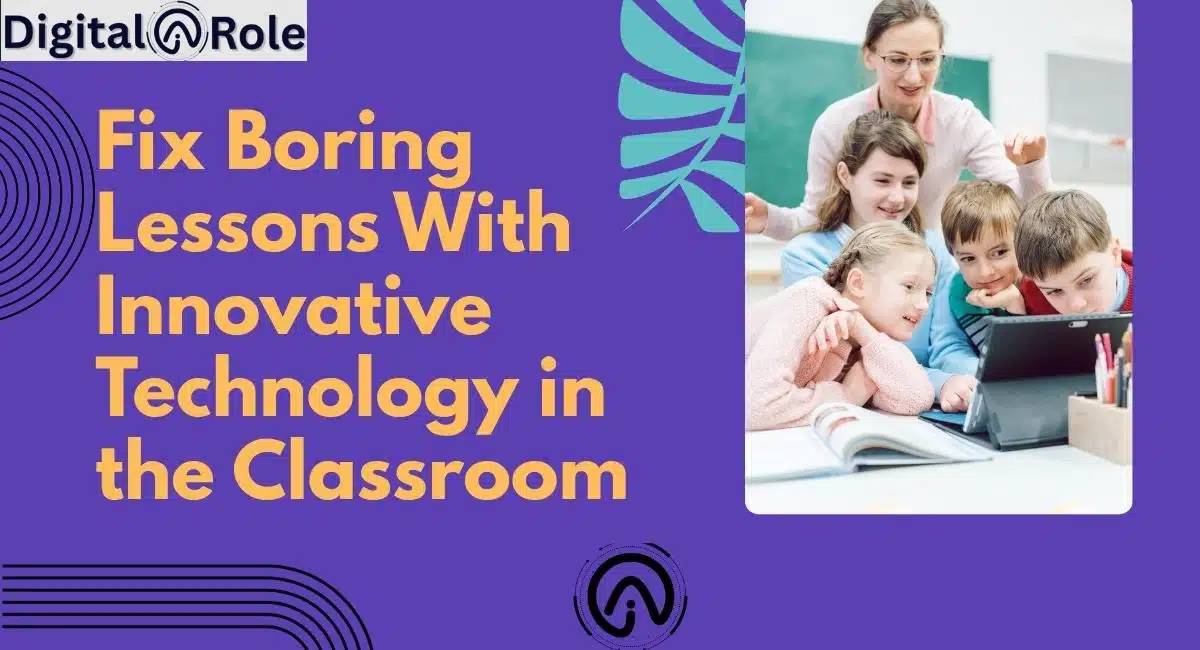
When you attend the class, you face distractions, never-ending slides, a clock stuck, and waiting for the lecture end. You feel lazy, but actually, you’re not alone; various students face this problem. The main problem is the teaching method, which makes you bored during the lecture. This problem is for all secondary and high-level students.
But don’t worry, edtech innovations create a massive difference in students’ lives with innovative technology in the classroom. It helps you to cut down your distractions with the fantastic, entertaining learning digital tools.
Daily, you use smartphones, AI, and other tools that disconnect you from studying. Use digital education tools that help in study and you’re no longer distracted. Technology integration in the classroom allows students to learn in different ways, which makes them more efficient and energetic.
From AI-powered personalized learning tools to interactive education digital tools that give a modern feel to students and transform boring lectures into engaging, personalized, and student-centered learning. When used correctly, it helps students to understand faster, stay focused longer, and actually enjoy learning.
In this article, I’ll explain to you how to use technology in theclassroom, give digital tools for education that help in the integration of technology in the classroom. Also, discuss the pros and cons of technology in the classroom.
Why Students Find Traditional Classroom Lessons Boring?
Most students don’t struggle to maintain their focus in class because the learning environment is not engaging. Traditional classroom and teaching methods fail to match the students’ engagement, thinking, and learning levels.
Here, I mention the biggest reason why students lose their interest.
1. One-way instruction and passive learning.
Students are also compelled to take long lectures where the lecturer speaks, and they listen, but they are not involved in the learning process; learning becomes monotonous and tiresome.
2. Absence of interaction and personalization.
Not all students learn in the same way, yet in a conventional classroom setting, all learners are treated similarly; this leaves most of them lost or bored.
3. All students teach at the same rate.
Quickly learning students become bored, and those who learn slowly feel neglected-both get demotivated.
4. Little use of contemporary digital media.
Learning becomes obsolete and alien when the classrooms do not consider the technology that is used in the day-to-day activities of the student.
5. A disconnect between real-life technology and classroom studies.
Students get ready for a digital future with analog means, which generates issues of frustration and irrelevance.
Consequence: A decreased level of attention, low level of participation, poor level of understanding, and decreasing interest in learning.
What is Innovative Technology in the Classroom?
Innovative technology in the classroom refers to using smart digital tools such as AI, Interactive software, and immersive technology in the school, which engages the students with the study. It gives students a personalized environment that is elective for students.
- Unlike traditional teaching methods, innovative technology focuses on:
- It helps students to maintain focus by using interactive slides.
- AI creates an active participation of students instead of passive learning.
- Provide personalized learning paths for Students.
- Real-time feedback and interaction.
How innovative technology Improves Students Outcomes
- AI tools help students understand complex topics faster
- Adapt the content to the individual student’s knowledge level.
- It helps learners to increase their focus, intentions, and motivation.
- These tools encourage the students to collaborate in class and boost their critical thinking.
Why It Matters?
With the AI-driven tools and emerging technology, students have access to new tools, which encourage them to focus on the class lecture. Digital workspace and innovative education become the norm, modern education is not just about helping students to pass the exams, they also train them for the real world, practical life.
Digital Tools for the Classroom That Make Learning Interesting
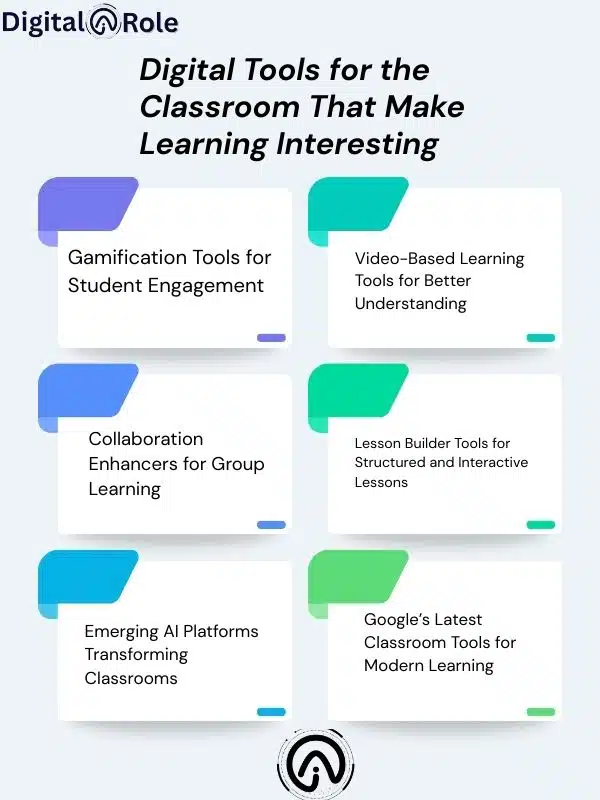
Modern digital tools for the classroom go beyond PDFs and slides. In the AI modern era, every school should incorporate modern technology with beautiful, engaging slides that attract and engage students with personalized learning.
Here, I discuss some categories of digital tools for the classroom.
1. Gamification Tools That Turn Learning Into a Challenge
Gamification tools make the learning process more of a challenge than a task through the application of points, leaderboards, and rewards. Students do not passively listen but rather take an active part that will instantly raise their attention and motivational levels.
Kahoot and Quizizz are examples of tools that are popular in classrooms to make quizzes and revision activities more interactive in the form of a game.
The best use case of Kahoot! is in an actual classroom, whereby learners respond to questions on the fly and interact with each other on a leaderboard. This maintains the energy level high and works out to be fun in revision.
Quizizz, however, encourages students to take their own time and, as such, prevents pressure and enables self-paced learning, which is particularly useful for students who require more time.
Gamification can enhance memorization, alleviate exam stress, and make otherwise dull lessons enjoyable and fulfilling with fun, repetition,n and instant feedback.
2. Video-Based Learning Tools for Better Understanding
Learning materials in video format help the learners to study complicated subjects visually rather than reading much and hearing about everything in long lectures. The common problem with many students is that they fail to visualize what is being taught, and this issue is addressed by the use of videos, which makes an abstract concept easy to follow and provides a straightforward explanation.
An example can be given where, in a science lesson, rather than reading about chemical reactions, students may view a computer-generated animation cartoon that offers them the step-by-step interaction of the molecules.
Such tools as Edpuzzle enable the incorporation of questions within the video by the teacher. While watching, the students can be requested to answer some short questions so that they will remain concentrated and learn the concept directly, as opposed to viewing passively.
Loom can be used by a teacher in math or computer science classes to record short explanatory videos. An instructor is able to take notes of a stepwise solution to a challenging issue or describe a computer program. The students are able to stop, rewind, and watch the video repeatedly as many times as required, particularly the slow learners or students who are going through exams.
Video tools are also helpful in the flipped classroom model. As an example, students can watch lesson videos at home and spend classroom hours on discussions, solving problems, or clearing doubts. This helps in making the time of classes interactive and productive.
In general, video-based learning tools enhance the understanding of concepts, self-paced learning, and academic stress. These tools make learning more flexible, engaging, and practical, especially in contemporary classrooms, by enabling students to have the chance to learn at any time and thus revisit lessons where learning was not possible.
3. Collaboration Enhancers for Group Learning
Collaboration tools make students cooperate effectively even when they study online or in hybrid classrooms. They eliminate miscommunication in group work and enhance communication.
Students can collaborate in real time using such tools as Google Docs and Microsoft Teams. Using Google Docs, several students are able to write, edit, and comment upon the same document simultaneously, and, as a result, group assignments are more understandable and can be completed faster.
Microsoft Teams integrates chat and video meetings with shared files into a single environment and keeps all the conversations and activities arranged.
These devices enable students to acquire teamwork, communication, and problem-solving skills, besides equipping them with skills that can be applied in the current digital workplaces where teamwork is the order of the day.
4. Lesson Builder Structured Learning Tools.
Lesson builder tools assist in the development of a structured and interactive lesson that keeps the students attentive throughout the lesson. Students are not subjected to unstructured lectures; instead, there is a definite flow of learning with active checkpoints.
Such tools as Pear Deck and Nearpad are usually utilized to create interactive lessons. Nearpod enables educators to include slides, videos, quizzes, and pop-ups in a single interactive lesson, keeping the students engaged during the lesson.
In Pear Deck, students can answer questions anonymously during the lesson, making this tool more engaging and less imposing of the fear of providing incorrect answers.
Lesson builder tools make lessons easier to understand and achieve more because they are structured clearly and include interaction, which ensures that students remain longer in the lesson.
5. Emerging AI Platforms Transforming the Classroom
The use of AI-driven tools is transforming the learning experience of students by providing them with customized and real-time assistance. These devices are learning aids and not learning substitutes.
Educational websites such as Khanmigo and Google Gemini for education assist students in learning at the same time. Khanmigo does not provide answers but asks students questions and hints in order to learn independently and think critically. Google Gemini also facilitates the learning process; it simplifies the complicated subject into an easy language, summarizes lessons, and also assists students in preparing and passing examinations more effectively.
In 2025-26 learning environments, AI supports each person’s learning pace, pinpoints the areas of weakness, and minimizes academic anxiety; thus, learning becomes more intelligent and personal.
6. Google Classroom Tools in Modern Education.
The education tools developed by Google provide a networked and structured online learning experience to learners. They facilitate both face-to-face and remote education and do not complicate it.
Google Classroom, Google Meet, and Google Forms are standard tools that are used in the contemporary classroom. Google Classroom stores assignments, due dates, and feedback in a single location, enabling students to remain organized.
Google Meet supports recorded and live classes, meaning that students can watch lessons over and over again.
With Google Forms, it is possible to create quizzes in a short time frame with automatic grading, which allows students to understand their weak points instantly.
These tools combined make classroom management easier, communication easier, and ensure that students follow their learning.
How Technology Integration in the Classroom Improves Student Learning
Technology does not distract students when used intelligently, and this changes their learning process. Students are not passive but are made to be active participants in the learning process.
Technology makes lessons more interactive by the use of quizzes, videos, simulations, and discussions, which enhance student engagement. There is a high likelihood of students remaining attentive when learning is an engaging process as opposed to a monotonous one.
It also improves conceptual knowledge, particularly on complex subjects.
The visual tools, simulations, and AI explanations allow students to observe how the ideas work in real life and understand the learning process more vividly.
Technology has been applied in modern classes to embrace various learning styles. Videos and diagrams, recorded explanations, and interactive activities and simulations are beneficial to visual, auditory, and hands-on learners, respectively.
The other significant advantage is self-paced learning. The online programs enable students to take breaks, review, and rehearse lessons at their leisure, with no stress and no anxiety, particularly for slow or struggling learners.
Above all, technology will assist students in developing digital skills that make them future-ready, i.e., collaboration, critical thinking, digital communications, and AI literacy skills that are required in higher education and contemporary professions.
Pros and Cons of technology in the classroom
Prons of technology in Classroom
- Make lessons interactive and engaging for students.
- Favors customized learning where students can learn at their own pace.
- Enhances the learning of complicated issues via videos, simulations, and AI descriptions.
- Promotes teamwork and interaction on online group platforms.
- Gives immediate feedback and grade monitoring, which eliminates exam anxiety.
- Develops digital skills to get ready for higher education and employment in the future.
Cons of Technology in the Classroom
- May lead to distraction in case of misuse of devices or applications by the students.
- Loss of initiative in thinking and becomes addicted to tools.
- The inequality of digital access could be detrimental to particular students.
- To be effective, it needs to be well-guided and trained.
- Increases the time on the screen that can influence the focus and health.
- Lessons and learning flow can be interrupted because of technical problems
How to Use Technology in the Classroom Effectively
Technology is not effective when applied haphazardly. This is how well-organized classrooms do it.
1. Begin With Learning Objectives, Not Teaching Aids.
There must always be a good purpose of learning supported by technology. Teachers and students should ask themselves the question of how a particular tool can help them in understanding, and not just use it because it is there. The use of technology as a support tool makes learning better rather than a distraction.
2. Integrate Technology and Engaging in Learning
The best types of classrooms are digital integrations of discussions, problem-solving, and collaboration. As an illustration, students have been able to discuss ideas, solve problems, or work in a group after viewing a video or using an app. This makes learning interactive and meaningful.
3. Study with AI Tools (Not Cheating)
The AI tools are not supposed to make students stop thinking, but rather make them smarter. Appropriately used AI breaks down complicated learning, recaps lessons, and offers practice advice. This enhances clarity of concepts and promotes learning on one’s own.
4. Monitor Performance using digital feedback
Learning analytics, instant feedback, and online quizzes will assist students in knowing their positions. Such tools also expose areas of weakness early enough, and the student can work on them before exams, as opposed to realizing them late.
Future of Innovative Technology in the Classroom (2025-26)
Classroom technology is moving towards the future of personalization, immersion, and skill development.
The real-time learning support will offer AI tutors and bright classrooms, which will be student-specific. The VR learning environments will enable the students to be exposed to the subjects instead of studying them. Digital assessments that will be based on skills will be used instead of rote learning, with practical assessments. New emotional and responsive systems will also change learning depending on the stress, concentration, and performance of the students.
These trends demonstrate that 2025-26 education will based on meaning learning rather than content delivery.
Conclusion
In this article, I explain how students fix their boring lessons with innovative technology. Many students face the issue of how to use the technology. First, familiarize yourself with the technology and then incorporate it into your daily routines. Many digital tools, such as gamification, AI, Gemini for education, Loom, Video tools, and lesson-structured tools, give students an interactive environment, and they easily focus on their studies. Incorporating technology in the classroom helps students and teachers a lot by improving teaching style, and students see it as entertainment and learn lessons easily.