
In a world where global search visibility defines business success. But if you’re relying on one language, SEO is like having an open online store in Paris and only posting the signals in English. You miss a lot of local customers because of the language barrier. Research shows that when people see a store website in their native language, there is a greater chance of boosting business sales.
Multilingual SEO helps businesses to reach their target audience, which engages and converts in different countries by speaking their language. It helps content to connect with users everywhere, from London to Tokyo, by optimizing user search intent, regional culture, language nuances, and local search behavior.
Multilingual SEO is not about translating the words; it’s about localizing your content to connect users in Spain, the UK, or Tokyo so that they feel the brand was built for them. With the right multilingual strategy, you can turn your website into a global growth engine that connects you with international audiences, boosting organic traffic and outperforming competitors who work on one-language SEO.
Whether you’re a small business owner or a marketer and an expanding international brand, and are worried about how to do Multilingual SEO for multiple countries, let’s build global trust that attracts high-quality traffic, and stay visible in your specific region.
In this article, I walk through how to do multilingual SEO, which increases sales and introduces you to other countries, regions, and people by incorporating their native language. You learn how to do international keyword research, hreflang tags, AI-powered translation tools, and localization.
What is Multilingual SEO and why does it matter for International marketing?
Expanding your brand across different countries is not just about shipping products across borders; it’s about speaking the customer’s native language both literally and culturally.
Multilingual SEO is the bridge that gaps between your brand and international audiences by making your website discoverable and relevant to your target audience’s language and regions.
It ensures that when the Spanish or French people search for your brand, the search engine shows your brand and ranks English, Spanish, and French pages in the search engine.
What does Multilingual SEO mean?
Multilingual SEO is the process by which brands optimize their website for multiple countries’ languages so search engines can correctly rank the product pages in their preferred country on the basis of user search language or location.
It targets the user who searches the product in different languages, for example, optimizing the product for the English page is “ running shoes” and in Spanish “zapatillas para correr”. This helps Spanish users to find this brand product easily because they optimize it according to them.
Why multilingual SEO is Key to winning International customers?
Search behavior is not universal as it varies depending on culture, language, and purpose. Someone in the UK would search for the best trainers and someone in France would search for meilleures baskets. In case your site does not change, you will be below the radar of that audience.
Multilingual SEO fosters trust because it demonstrates to the customer that your brand knows them. It improves:
User Experience: The visitors will be able to read and browse through your site using their language.
Participation, Purchase, and conversion rates: When people have clear information about products, they will purchase more.
Search Engine Visibility: Google and other engines demand pages that meet local search intent as well as hreflang tags.
Real World Case Study of Nike uses multilingual SEO to dominate the Global Market
Nike is not just a shoe brand when it comes to global reach. Nike is a masterclass in how to apply Multilingual SEO and localised content marketing to conquer international markets.
Nike has more than 190 countries of operation and several dozen localized websites that are specific to the language, currency, and culture of their market. As an example, the UK site of Nike (nike.com/gb) has not only a different currency, but also a different tone, spelling, and product names compared to the site in the U.S (nike.com/us).
In the meantime, French (nike.com/fr) is entirely multilingual, with localised product descriptions, campaigns, and keywords that align to search intentions in the French language, such as chaussures de course homme rather than running shoes available to men.
This is the way that the Multilingual SEO strategy of Nike provides it with a global advantage:
Localized Keyword Targeting: Nike has their SEO staff research country-specific search terms. In Germany, it maximises in Sneaker Damen, and in Japan, it maximises in sunika redeisu, so that it appears in the Google list of languages.
Cultural Adaptation: The slogans, graphics, and seasonal sales differ according to the region of operation, or what works in the U.S. Just Do It can have a localized tone and imagery to suit Asian and European audiences.
Technical Accuracy: The localized pages have hreflang tags, structured URLs, and schema markup, which have been used to indicate to Google what version to present in this or that country.
Consistency of User Experience: Nike takes care of a smooth experience, whether in language selection or in local payment options; this way, international visitors will feel at home.
The result?
Nike is always number 1 in the search results in several languages, engages the region effectively, and gains brand trust across continents. The fact that it can integrate both the global brand visibility and local SEO accuracy makes it one of the most successful Multilingual SEO efforts in the retail sector.
To the small enterprises, it translates to accessing new markets without having an enormous ad budget – all one needs is to tune up their content so that they speak the language of the customer.
How Multilingual SEO Works for Multiple Countries
It’s not merely a question of translating your content so that your website will appear in several countries, but also of organizing your site so that search engines will be aware of which version to display with which audience.
Multilingual SEO operates by the joint work of technical signals (such as hreflang tags and URL format) and thoughtful localization of the content. If properly implemented, it makes sure that the French user ends up on your French page while the American ends up viewing the English version, but both are top-ranking in their respective Google results.
Let’s break down how it works step by step.
Understanding hreflang Tags and Localized URLs
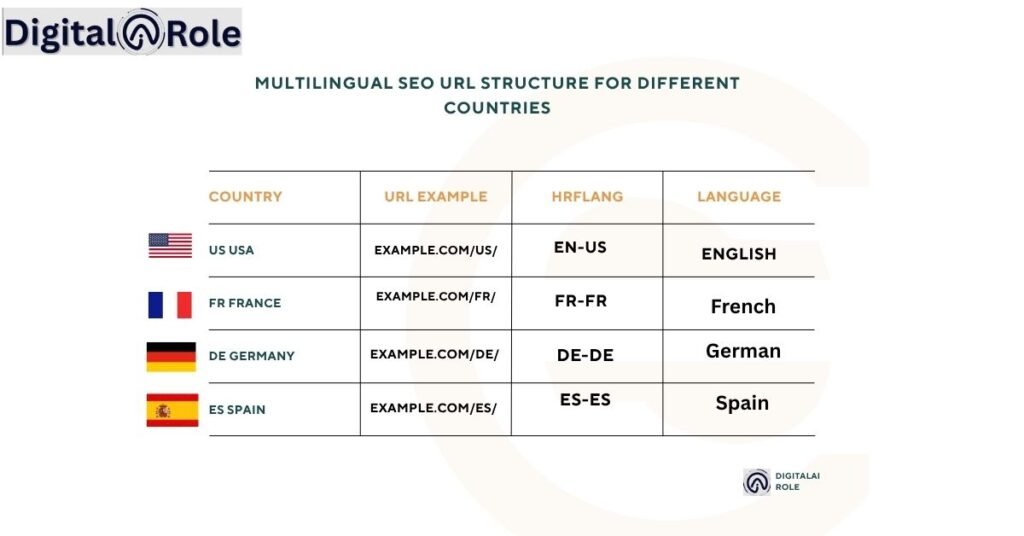
The building block of mult-country SEO is the hreflang tag – a humble but mighty piece of HTML that informs Google which language and geo each page belongs to.
For instance:
- <link rel=”alternate” href=”https://example.com/fr/” hreflang=”fr-fr” />
- <link rel=”alternate” href=”https://example.com/es/” hreflang=”es-es” />
- <link rel=”alternate” href=”https://example.com/en-gb/” hreflang=”en-gb” />
These tags give signals to the Search Engine
- /fr/= France country domain
- /es/= Spanish speakers in Spain
- /es-gb/= English that is spoken in the UK
Why it matters:
Without hreflang tags, your English pages might be served to Spanish speakers, causing poor interaction and elevated bounce rates. With them, you guarantee the appropriate audience views the appropriate language variation — enhanced rankings and a better experience for the end-user.
In addition to hreflang, URL localization also has a crucial role. There are three major methods for constructing URLs for variations in languages or countries:
URL structure for Multilingual SEO
- ccTLDs (Country Code Top-Level Domain
, e.g., example.fr (France), example.de (Germany)
Good for developing local authority, but expensive to maintain a variety of sites.
- Subdirectories
e.g., example.com/fr/ or /es/
Easier to manage, has shared domain authority, ideal for a small business.
- Subdomain
e.g., es.example.com or fr
Provides separation for languages but divides link equity.
How to Choose between Subdomain, Subdirectory, and Country Code?
Your URL structure breaks down the Multilingual SEO strategy and gives you a clear roadmap for this. You decide the right URL structure based on your brand goals, team size, and also consider its pros and cons.
| URL structure | Example | Prons | Cons | Best for |
| ccTLD | example.fr | It fosters a strong trust in the local audience and also ranks the website | It is costly for many brands, and it is hard to manage. | It fits best for the big brands that have a large team. |
| Subdomain | es.example.com | Subdomain makes it easy to separate the content for the audience. | It split the domain authority on both English-language and Spanish-language sites. | It is best for businesses that want control over local regions. |
| Subdirectory | example.com/fr/ | It is great if you want to share the SEO power. It is easily manageable. | It is weaker for the local signals. | It is best for the Small to mid-sized brands which has small teams and want to grow internationally. |
If you have a small business and want to expand it with an internal audience, the subdirectory URL structure fits best for /es/ or/fr/ for simplicity and shared SEO value on your English and other language sites. When the resources and traffic grow, you go with a ccTLD domain for stronger local pressure and win the global market.
How AI Tools Make Language Optimization Simple
Creating accurate, culturally sensitive translations for a number of markets once required months — now, localization software incorporating AI makes that possible sooner, less expensively, and in greater amounts than ever.
Here’s how AI tools streamline Multilingual SEO:
AI Translation & Localization
Services such as DeepL, Weglot, and Lokalise translate your text with near-human accuracy while retaining tone and purpose.
Automatic hreflang Implementation
Weglot automatically creates the hreflang tags for all translations so that Google indexes all the language versions correctly.
Dynamic Keyword Adaptation
AI will automatically identify local search patterns (e.g., “trainers” in the UK versus “sneakers” in the US) and recommend localized keyword permutations that align with user behavior.
Cultural Relevance Checks
SomeAI software assesses the tone and sentiment of the writing so your communication aligns with in-country expectations — the cornerstone of brand credibility.
Example: A small online shop by using Weglot + DeepL is able to publish French and Spanish versions of their shop in a week or less — complete with translated metadata, localised URLs, and SEO tags waiting for indexing.
How to do Multilingual SEO to Dominate the International Market

Expanding your business beyond borders is exciting—but it’s far from a guarantee that localizing your website into a few languages and calling it a day. A successful multilingual SEO strategy ensures that your brand speaks the locals’ language, intentions, and culture of the market that you’re entering.
Let’s consider a step-by-step roadmap that world-beating companies utilize to become world leaders and command confidence in the marketplace.
1.Identify the Audience for a Multilingual SEO
Before you translate and optimise your website, you need to identify which countries your audience is interested in your products and services. Many small businesses in the start make this mistake when choosing the target audience by assumption, and it affects their marketing strategy in that region.
You choose it by implementing the data-driven strategy and using the Google free tools, such as Google Analytics, Google Console, Google Market Finder, and Google Trends, you can uncover from real demand that already exists and in which regions the website has potential traffic.
Analysing Existing Traffic and Demand with free tools
Step 1: Use Google Analytics (GA4)

- Click Reports, then User, Demographics, and Location to determine where your visitors are coming from.
- Look at the language dimension to learn which browsers and languages your users prefer (such as “es-es” for Spanish speakers in Spain or “fr-ca” for French speakers in Canada).
- If you see consistent traffic from a particular country, like Germany or Mexico, it obviously shows international organic interest, even before you have any localized content.
Tip: Monitor average time spent on site, bounce rate, and conversion rate by country. If people from particular countries spend more time on your site, your product or message is likely well-received there.
Step 2: Utilize Google Search Console (GSC)

- Go to Performance, then Search Results, and choose the Countries tab.
- This reveals which countries your website shows up in search results.
- Pair this with the Queries tab to view the local-language keywords used by people to locate your pages.
GA4 and GSC together supply a data-driven map of where to target your next multilingual SEO campaign.
Google Trends & Market Finder — Evaluating Market Feasibility
Once you have an idea where your traffic is originating from, the second step is to confirm market potential with tools such as Google Trends and Google Market Finder.
- Enter your target keywords, for example, “running shoes,” “vegan skincare,” or “handmade candles.”
- Filter by location to compare search interest by country.
- See if there is consistent or increasing interest in countries that correspond to your analytics reports.
- For example, if “eco-friendly sneakers” is popular in Germany, it’s a good indication to develop native German content around that keyword.
Google Market Finder (Free by Google)
Type your website URL and receive insights on potential markets using search volume, competition, and buying power.
The tool also provides suggested languages, payment habits, and logistics information for every country. Perfect for new companies and small companies, Market Finder prevents you from spending time on low-demand or highly competitive areas.
2.Identify Country-Specific Keywords and Search Intent
Do your research before translating.
Each nation has its distinct ways in which citizens search, even for a single item. For instance, “sneakers” in the U.S. or “trainers” in the U.K. may be “baskets” in France.
Utilize these instruments for local keyword information:
- Use Google Keyword Planner for location and language to find top keywords.
- You can also use Ahrefs or SEMrush to analyze keyword volume, competitiveness, and your competitor’s ranks by location.
- Google Trends is used to search for intent changes from country to country.
Pro tip: Seek long-tail keywords that have high intent but are sparsely competed — they frequently indicate the way that locals actually search.
3.Translate and localize your Content.
Translation ≠ Localization.
Word-for-word translations will hurt your brand credibility if the cultural allusion or wit is lost. Localization will ensure that your writing naturally sounds emotional and sincere to the reader.
Example: When a new US apparel brand moves into Japan, it shouldn’t directly translate “Free Shipping” but may want to do better by incorporating phrases that convey confidence, quality, or gentle shipping because Japanese consumers appreciate these.
Localization tips for the better:
- Utilize local translators or AI programs (such as DeepL or Lokalise) that are human-checked.
- Adapt units (cm vs inches), currency, and cultural references.
- Adjust tone — formal in Germany, conversational in Brazil, concise in Japan.
4.Optimize for On-Page Elements in Other Languages
Your SEO basics also remain relevant—but they need to be adapted for each region’s language and nuance.
Checklist for multilingual on-page SEO:
Meta Descriptions & Title Tags: Incorporate natural keywords and colloquial expressions.
Schema Markup: Make the proper language tags for enhanced SERP visibility.
Regional Formats: Show the prices, dates, and measurements in the user’s country format.
Alt Text: Localize alternate texts for accessibility and SEO advantages.
Example: If your Franch site quotes the product prices in USD or uses the format MM/DD/YYYY, the users will immediately distrust it.
5.Generate Country-Specific Backlinks and Cit
Local authority signals tell Google you’re relevant in that region. Start by making connections from neighborhood directories, websites, and joint ventures – global websites.
Methods of obtaining country-level backlinks:
- Register your company in local directories (e.g., Yell for the UK, Kompass for Francophone countries).
- Post guest articles on regional industry websites.
- Align yourself with local business chambers or influencers.
- Support community or local initiatives.
Example: A British clothing company that expands its stores to Spain can partner with Spanish style bloggers for backlinks and exposure on .es websites.
6.Keep Track of Performance by Region
Once your campaign has gone live, look to see what’s working (and isn’t).
Global SEO is never a “set it and forget it” situation — performance may change by location and language.
Track success with:
Google Search Console: Click “Performance by Country” for all the traffic by country.
Google Analytics: Segment by language, by nation, or by landing page. Ahrefs Rank Tracker: Track keyword positions in various locations. Do this by adapting this data to tweak your strategies — while your German users will respond to blog posts, your Spanish users will respond to the video format.
Conclusion
In this article, we discuss how to do multilingual SEO and increase your sales internationally. Many brands do Multilingual SEO for other countries so that they can be introduced locally in other countries. Multilingual SEO works for other countries by setting up their URL structure in that country’s domain or subdirectory according to their goals and teams. Use hreflang with the main domain example.com/fr/ or example .fr.
You can do multilingual SEO by firstly identifying your audience through Google console, Google Trends, and Google Analytics, if they show the other country, optimize your site for that country’s audience. Start researching the local keywords, understand their culture, optimize ON-page elements, translate and localize the content, build country-specific keywords, and measure their performance. It may look difficult, but when you start and research more about it, you easily understand what you do, which aligns with your goals.
For more informative SEO and marketing tips, just visit our website and share it on social media. Also, comment to us for any other informative tips and tricks.